

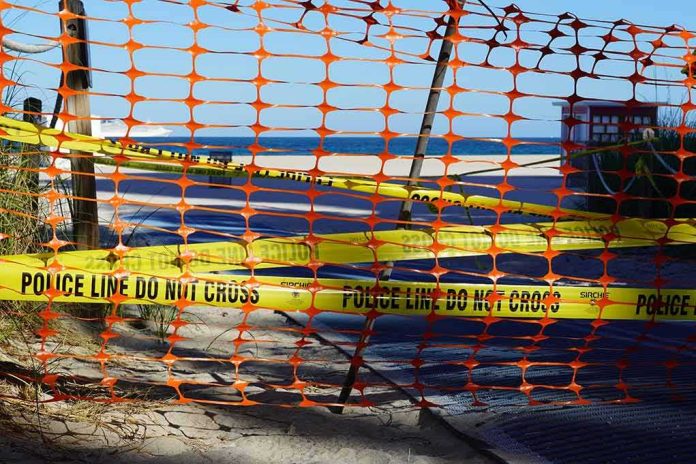
Hundreds of families and teens packed onto Narragansett Town Beach watched a sunny Rhode Island afternoon flip into a crime scene in seconds.
Story Snapshot
- Three people suffered minor stab wounds during a sprawling brawl at Narragansett Town Beach.[2][3]
- Police evacuated parts of the beach, shut roads, and called in state troopers to control the crowds.[2][3]
- No suspect was publicly identified or arrested for the stabbing even as other people were cuffed on unrelated charges.[2][3]
- Short social clips sold a neat “massive teen melee” story that the actual facts do not fully support.[1][3]
How A Senior Skip Day Turned Into A Police Line
Police scanners in Rhode Island crackled on a weekday afternoon with a familiar phrase that makes every parent tense up: disturbance at the beach. Narragansett Town Beach, loaded with teens on a local senior skip day, suddenly went from towels and volleyballs to yelling and running. Local news later confirmed three people had stab wounds, described as minor, and medics treated them on the sand before hospital transport.[2][3] Hundreds of beachgoers were ordered off the sand as tape and cruisers appeared.
Witnesses told reporters the fight began on the sand near the North Pavilion, then spilled toward the parking lot.[2][3] One described a “large group” only about thirty feet away, shoving and throwing punches before people started screaming and sprinting in different directions.[2] Another said he saw fists fly but never saw a blade, only the aftermath when a victim turned and revealed a wound in his back.[3] That kind of partial view is exactly how public myths get built out of fragments.
The Stabbings Everyone Saw After, But Almost No One Saw Happen
Narragansett Police told local outlets they arrived around 3:00 p.m. and found three victims with stab injuries, none life-threatening.[2] That core fact pattern is not in dispute: three people were stabbed at a crowded public beach. What happened in the seconds before the knife made contact is where the story falls apart. The witnesses on camera admit they did not see the weapon deployed.[2][3] They saw punches, heard screams, turned away, and then saw wounds. That uncertainty matters if we care who actually started what.
Reporters also highlighted a crucial detail that gets lost in social media retellings: as of those early stories, no one had been arrested for the stabbing itself.[2][3] Two adults were taken into custody for simple assault, disorderly conduct, or resisting arrest, but police stressed those charges were unrelated to the knife attack.[2] From a common-sense conservative perspective, that should set off alarms about due process; yet online, people were perfectly happy to assign guilt from a ten-second clip with no suspect name, no affidavit, and no footage of the actual stabbing.
Chaos, Crowds, And The Convenient “Massive Brawl” Label
Cameras love disorder. Fox News summarized the scene as three stabbed and “teens sent running,” feeding the impression of a single, unified riot-like event.[1] Local television spoke of “multiple fights” and “disturbances” at the same beach that day, again with hundreds of young people present.[2][3] That framing is not necessarily wrong; police did close roads, clear parts of the beach, and call in Rhode Island State Police for crowd control.[2][3] But it blurs a critical line between general mayhem and the specific criminal act of stabbing someone.
Analysts who study public-violence episodes see this pattern constantly: a handful of scuffles merge into one mental picture of “the brawl.”[3] Once that happens, every teen on the sand becomes part of the same nameless mob, and individuals disappear. That narrative is handy for politicians who want to talk about “out-of-control youth” and handy for platforms that monetize outrage. It is not so handy if you still believe in the old-fashioned idea that government should identify an actual person who actually committed a specific crime before punishment or public shaming.
What We Still Do Not Know, And Why It Matters
Even with the available reporting, large holes remain. Neither local outlets nor national coverage have clarified whether the three stabbing victims were active fighters, blindsided bystanders, or a mix.[2][3] That distinction matters morally and legally. We do not have incident reports, dispatch logs, or sworn statements in the public record here to reconstruct who threw the first punch, who escalated, or whether the stabbing was a targeted act or a panicked reaction. Instead, we have fragments, emotion, and the word “chaos.”
Narragansett have multiple stabbings at the town Beach?
— Chris Palmer🇺🇸 (@CJPFirePhotos) May 19, 2026
Common sense and core American conservative values point toward a simple standard: do not let a viral narrative outrun the facts. Police had not named a stabbing suspect when the early stories ran.[2][3] Yet social clips and commentary already framed the event as a singular massive teen brawl with implied collective guilt. That move erodes personal responsibility, blurs crucial distinctions between bystander and aggressor, and hands more power to institutions and platforms that already struggle with transparency and accountability.
Sources:
[1] Web – 3 stabbed on Rhode Island beach, teens sent running – Fox News
[2] YouTube – 3 injured in stabbing at Narragansett Town Beach
[3] YouTube – Disturbances break out at beaches in Rhode Island