

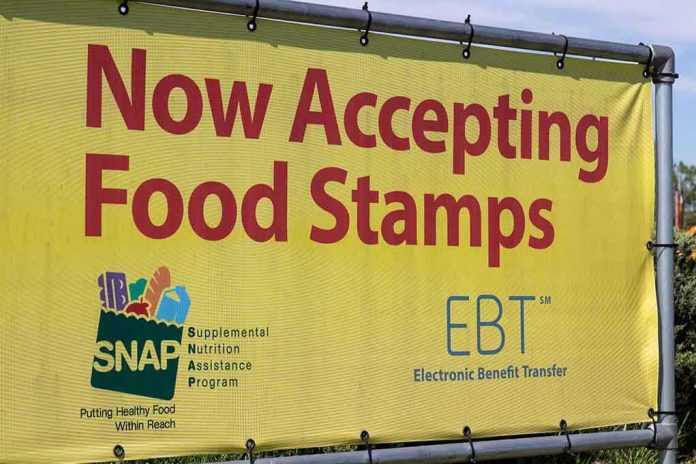
A $66 million insider-enabled scam and a federal sweep against electronic benefit theft show SNAP’s integrity problem is real—while the loudest numbers in the headlines still lack the receipts.
Story Snapshot
- Federal prosecutors charged a United States Department of Agriculture employee in a $66 million Supplemental Nutrition Assistance Program fraud scheme [1].
- The United States Department of Agriculture says theft of electronic benefit funds has surged and launched targeted, multi-agency crackdowns [3].
- United States Department of Agriculture guidance frames fraud as a serious crime and emphasizes state-federal coordination [4].
- Claims about dead recipients and mass duplicate enrollments are not documented in the cited primary materials [3][6].
What the federal cases actually prove—and what they do not
Federal prosecutors allege that a longtime United States Department of Agriculture staff member sold privileged access, including license numbers for electronic benefit transfer terminals, fueling unauthorized redemptions that topped $36 million and a wider conspiracy exceeding $66 million [1]. That case confirms both motive and mechanism for large-scale looting: insider abuse plus retailer trafficking. It does not, by itself, validate claims about hundreds of thousands of ineligible beneficiaries, which are a different category of misconduct requiring separate data.
The United States Department of Agriculture publicly states that theft of funds on electronic benefit cards has dramatically increased, citing skimmers, cloned terminals, and coordinated criminal networks. The department teamed with the United States Secret Service and Homeland Security Investigations for targeted operations, calling one such push the largest effort against electronic benefit theft in United States Secret Service history [3]. Those statements establish priority and scale of the enforcement surge. They do not resolve whether touted national counts reflect confirmed fraud versus suspected irregularities.
Retailer trafficking, skimming, and insider risk dominate the evidence
The Food and Nutrition Service describes fraud as a serious crime and highlights state partnerships to prevent it, which aligns with a focus on retailer trafficking and stolen benefits rather than beneficiary-centric narratives [4]. The public record centers on how criminals compromise terminals, spoof legitimate devices, and exploit weak identity or licensing controls. That emphasis matters. If the biggest leaks come from retailers and thieves siphoning benefits electronically, then headline claims about dead recipients tell only part of the integrity story—and may distract from fixable control points.
The United States Department of Agriculture Office of Inspector General reported potential fraud signals in Ohio’s participant data, which shows that state-level anomalies exist and can be quantified through audits [6]. That finding demonstrates the value of matching exercises and data analytics. It does not, however, substantiate sweeping national figures about deceased recipients or half a million duplicate payments. Those numbers demand published methods, match logic, and error rates to separate confirmed fraud from false positives and administrative cleanup.
The blue-state-versus-red-state storyline needs evidence, not echoes
Partisan framing alleges that blue states block oversight while red states comply, but the cited primary sources do not document a list of noncompliant states, their legal objections, or adjudicated outcomes. The United States Department of Agriculture’s own materials emphasize cooperation with states, joint operations, and shared responsibility for integrity [3][4]. Without letters, court filings, or official refusals, the geography argument remains assertion, not proof. Common sense and conservative principles favor transparent audits over viral claims without underlying datasets.
Policy discipline—pay only the eligible, punish actual thieves, and close the skimmer-to-terminal pipeline—requires specific fixes. Congress and states should require routine death-file matching, interstate duplicate checks, and near-real-time anomaly detection, with public release of methodologies and error bands. The United States Department of Agriculture should publish de-identified transaction patterns behind enforcement operations and disclose how many suspected cases convert into confirmed fraud. That approach protects taxpayers, defends truly needy families from stigma, and replaces slogans with verifiable results.
Sources:
[1] Web – USDA Sec. Brooke Rollins CONFIRMS That a Swath of Blue States Are …
[3] Web – Large-Scale Food Stamp Fraud | Cato at Liberty Blog
[4] Web – USDA Participates in Targeted SNAP Benefit Fraud Operations
[6] YouTube – Government shutdown exposes fraud, abuse in SNAP program