
A single word – “bloodbath” – just yanked the half-forgotten Cuba–United States rivalry back into the center of world politics.
Story Snapshot
- Cuba’s president warns any United States military strike would trigger a “bloodbath” with “incalculable” regional consequences.
- Washington is reported to be studying Cuban drone capabilities while tightening sanctions, not announcing war plans.[3]
- Both sides insist they are acting defensively, yet the media turns every word into fuel for panic.[3]
- History, not just hardware, makes this crisis dangerous: old grudges and new technology are colliding 90 miles off Florida’s coast.[3]
Cuba’s “bloodbath” warning and what Díaz-Canel actually said
Cuban President Miguel Díaz-Canel did not mumble his warning; he broadcast it on his official account, knowing the world would repeat it within minutes. He said that any United States military action against Cuba would provoke a “bloodbath with incalculable consequences” for regional peace and stability, language that instantly echoed across Spanish and English outlets. He also stressed that Cuba “does not represent a threat” and claimed Havana has no aggressive plans against any country, including the United States.[1]
Díaz-Canel framed his country as already under “multidimensional aggression” via sanctions, economic pressure, and political isolation. From his perspective, a direct strike would merely formalize a long-running war by other means. Cuban Foreign Minister Bruno Rodríguez reinforced the line that Cuba has “the right to legitimate self-defense against any external aggression,” while rejecting the idea that this could justify a United States-led war against “the noble Cuban people.”[3] The message: we are cornered, not hunting for a fight.
The drone report, Florida fears, and what the United States is really doing
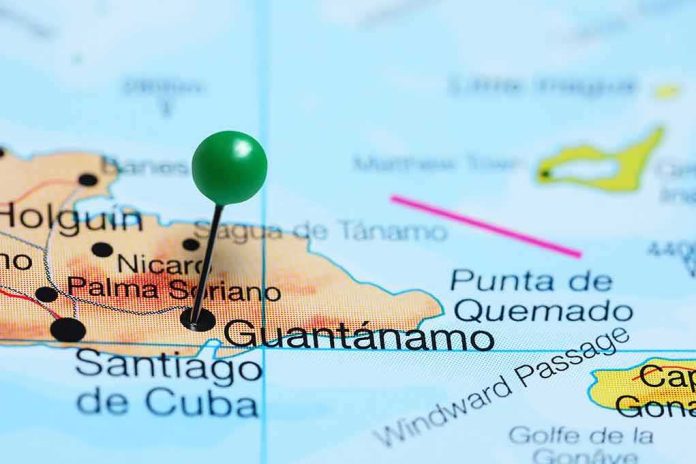
The immediate spark came from reporting that United States intelligence believes Cuba acquired more than 300 military drones, allegedly from Russia and Iran.[3] Media summaries claim those drones were discussed as potential tools to target the United States naval base at Guantánamo Bay, nearby United States warships, or even Key West, Florida.[1] United States officials are described as “monitoring” the situation and assessing ranges and payloads, not issuing public strike orders or evacuation notices.[1][3] Deterrence and data-gathering, not declared war, appear to dominate Washington’s posture.
On the American side, one of the clearest public statements cuts straight against the idea of an imminent United States assault. Congressman Mario Diaz-Balart, a longstanding Cuban regime critic, said there is “currently no intelligence suggesting an imminent threat” of a Cuban drone attack on South Florida. Local law enforcement agencies have not warned residents of any immediate danger.[1] For a security establishment that leaks even routine weather worries, the absence of concrete public alerts speaks volumes about how hypothetical this all still is.
Sanctions, civil defense sirens, and the politics of fear
While war talk grabs headlines, the United States Treasury quietly expanded sanctions on Cuba’s main intelligence services and several senior officials, tightening pressure on a regime already facing blackouts, shortages, and currency chaos.[3] Havana calls this “economic suffocation” and folds every new measure into its argument that the United States is waging a slow-motion assault. The Cuban government, in turn, has circulated a family “guide” on how to behave during a “hypothetical military aggression,” urging citizens to prepare backpacks with food, listen for air-raid sirens, and adopt the mantra “Protect, Resist, Survive, and Prevail.”[1]
That last phrase is not abstract. Many Cubans grew up with drills, shelters, and constant reminders of the Bay of Pigs invasion and the 1962 missile crisis. Cuban media now loop images of past confrontations while commentators say United States rhetoric about intervention has returned, this time wrapped in drone fears and “regime change” speculation.[2][3] For a government that depends on mobilization, threat narratives do double duty: they signal defiance abroad while justifying tighter control at home, especially when the economy is collapsing.
Signal, bluff, or tripwire? How conservatives should read the standoff
American conservatives face a familiar dilemma: stand firm against hostile regimes or avoid another open-ended foreign entanglement. The facts on the table suggest caution. No declassified document shows a finalized United States strike plan, and even hawkish voices acknowledge the drone threat remains theoretical pending hard proof of Cuban intent and capability.[1][3] A serious military action against Cuba would risk American lives, destabilize the hemisphere, and hand authoritarian allies a propaganda gift, all without clear evidence of an imminent attack on our soil.
Common sense says two things can be true. First, Washington should treat any Russian or Iranian-supplied strike technology in Cuba as a red line, quietly making clear that attacking United States bases, ships, or cities would trigger overwhelming retaliation. Second, saber-rattling alone does not justify preemptive war. A measured policy would harden defenses in Florida and at Guantánamo, intensify intelligence collection, and use targeted sanctions while avoiding the very escalation Díaz-Canel seems eager to frame as an existential showdown.[3]
Sources:
[1] YouTube – Cuban president warns against US military action
[2] Web – Cuba warns US military action would lead to ‘bloodbath’ – Dailymotion
[3] YouTube – Diaz-Canel warns of ‘bloodbath’ if U.S. attacks Cuba