

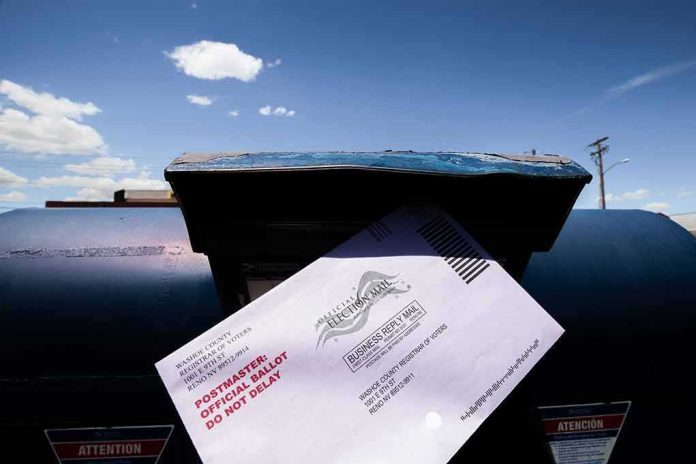
Federal prosecutors say a Utah mail carrier dumped about 300 voters’ ballots into a church dumpster, and the paper trail backs them up.
Story Snapshot
- A federal grand jury indicted a former mail carrier for allegedly discarding hundreds of ballots.
- The mail was found in a church parking lot dumpster in Utah County on June 3, 2026.
- Court reporting says the carrier admitted he tossed mail to “lighten his workload”.
- The defendant pleaded not guilty; the case is moving through federal court.
The Charge: What Prosecutors Say Happened
The Department of Justice announced an indictment against Damon Matai Seei, a former United States Postal Service carrier in Utah. The charge alleges unlawful secretion, destruction, and delay of mail. Prosecutors say Seei threw away mail he was trusted to deliver, including roughly 300 mail-in ballots meant for registered voters before the June primary. The indictment was returned September 16 and unsealed days later. The charge is a federal felony that can bring prison time if proven.
Prosecutors place the disposal at a church parking lot dumpster in Utah County on June 3, weeks before the election. That setting matters because it shows separation from any normal postal route or facility. The government’s framing is simple: voters were waiting for ballots that never came because a carrier dumped them. Multiple outlets reported the same core details about the ballot count, the location, and the timing, which supports the basic timeline.
The Paper Trail: Admissions, Turnout Clues, and Recovery
Local reporting, based on court records, says Seei admitted in an interview that he threw away mail to lighten his workload. The same accounts say he knew ballots were in the pile when he dumped them. Utah County’s clerk reportedly saw a cluster of complaints from voters who never received ballots and a dip in turnout in the affected area, which prompted review. Some voters later cast in-person ballots, but not all were able to pivot in time.
These reported facts track with a common-sense chain. Voters complain. Election staff check participation. Investigators find a cache that matches a route. That does not prove a political plot. It does show how one bad act can ripple through a civic process that runs on trust. On the strength of the record so far, the intent claim rests most on the defendant’s reported statements and the location of the dump site, not on any partisan motive.
Defense Angle: Workload Excuse and What It Does Not Change
Seei pleaded not guilty and remains entitled to contest the charge. Media summaries of government filings say he claimed he was overwhelmed by heavy mail and wanted to toss advertising. He said he is not political and did not mean to disrupt voting. The government’s theory does not require a political motive. Federal mail law focuses on the act: knowingly throwing away entrusted mail is the line you cannot cross, whatever the reason.
American conservative values stress duty, accountability, and equal protection for each voter. By that yardstick, the excuse of “lightening workload” fails. Everyone is busy; not everyone dumps the public’s mail. If prosecutors can prove he knew ballots were in that trash, the case should be straightforward. If the defense shows confusion and no knowledge, penalties should fit the facts. That is how the rule of law keeps faith with both voters and workers.
What This Case Says About Mail Voting Reliability
Mail-in voting handles millions of pieces. Most reach voters without drama. But the system depends on human hands at every step. One person’s shortcut can block hundreds of citizens from easy access to a ballot. That is why chain-of-custody rules, postal auditing, and quick complaint channels matter. When voters report missing ballots fast, officials can react, find patterns, and offer in-person options before deadlines close.
"When you work for the United States Postal Service, you can’t throw away people’s mail or discard hundreds of mail-in ballots. That’s what happened in Utah, where former USPS worker Damon Matai Seei, 34, of Payson, Utah, decided to chuck away tons of mail for residents of Eagle…
— Dave Miller (@66dlm327350) September 23, 2026
Policy debates should focus on prevention, not panic. Clear route tracking, scanner logs, and spot checks deter misconduct. Strict but fair penalties set the norm. Backup voting options reduce harm when a carrier fails. None of that requires fearmongering. It requires simple guardrails and a culture of service. Voters deserve a system that assumes good faith but plans for a bad day. This Utah case is that bad day. The response should fix the weak points and protect every ballot.
Sources:
pjmedia.com, justice.gov, washingtonexaminer.com, newsmax.com, cbsnews.com