
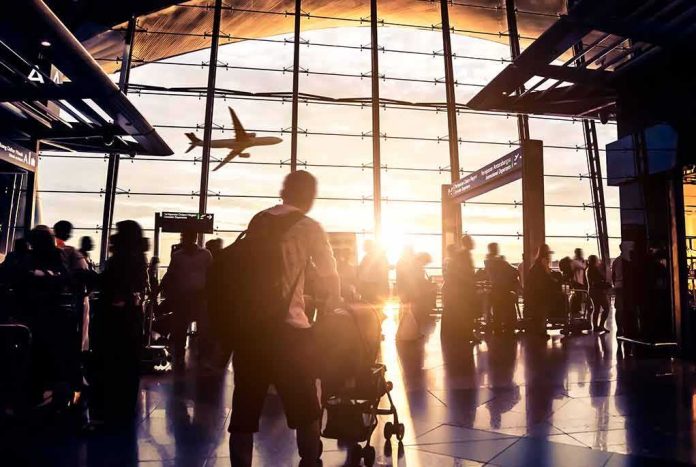
Flights across the Northeast began moving again after a repaired telecom line brought air traffic control back online.
Story Snapshot
- Transportation Secretary Sean Duffy said repairs restored communications and flights were resuming.
- A failed primary circuit and a cut backup fiber line at Philadelphia’s air traffic facility triggered ground stops.
- Airports restarted operations in stages, with delays lingering into the evening.
- Philadelphia’s control hub regained service, allowing traffic to ramp back up across the region.
What Broke, Where It Broke, And Why It Mattered
Federal Aviation Administration controllers in Philadelphia lost their main communications circuit on Monday. The backup fiber line, which should have kept systems running, was also down after a cut. That double hit forced ground stops at major Northeast airports, including Newark, Philadelphia, and others tied to that sector. When a terminal control facility like Philadelphia’s goes dark, it cannot safely manage arrivals and departures, so traffic slows or stops by design to protect lives.
Philadelphia’s facility handles approach and departure flows for some of the busiest skies in the country. Losing both the primary circuit and the backup created a bottleneck that spread beyond one city. Airports relying on that airspace manager had to pause or meter flights. Teterboro, Newark, and Philadelphia saw the harshest impact. New York’s John F. Kennedy and LaGuardia felt the ripple as airlines and controllers worked to hold aircraft on the ground and reroute traffic safely.
The Repair And The Restart
Transportation Secretary Sean Duffy announced Monday evening that technicians had repaired the telecom lines. He said airport operations across the Northeast were resuming, while warning that clearing the backlog would take time. Local outlets and aviation trackers backed that timeline as flights began to depart and arrive again. The message was clear: the safety risk had been handled, the system was turning back on, and the long tail of delays would unwind through the night.
Reporting from the region described a staged recovery. Philadelphia’s ground stop lifted first, then more flights moved at LaGuardia, while Newark and John F. Kennedy eased restrictions more slowly. This is how the National Airspace System heals after a shock. Controllers restore the technical link, then raise traffic rates in steps. Airlines follow with crew and gate resets. Passengers still see lines because the system must absorb hours of stacked flights in a tight window.
What “Operations Resuming” Really Means For Travelers
“Operations are resuming” signals that controllers can once again clear aircraft to push, taxi, take off, and land. It does not promise instant normal schedules. The backlog of diversions, out-of-position crews, and missed connections must be sorted. That recovery often takes the rest of the day. On Monday, outlets reported departures restarting while some airports still held selective pauses. That mix fits the playbook for a safe and steady ramp rather than a flip of a switch.
Duffy: Northeast airports resume operations after FAA grounded flights over telecom line cut by Amtrak worker –
Major airports across the Northeast were affected on Monday, including JFK and LaGuardia. According to Duffy, an Amtrak construction crew cut into a fiber line in New…
— Elena (@helen44767171) September 22, 2026
Travelers looking for a simple answer want to know who fixed what and when they can go. The strongest facts point to a failed primary circuit and a severed backup fiber line tied to the Philadelphia approach control. Crews repaired the lines. Duffy announced the restart. Flights began to move, and delays eased as the evening went on. Airports and airlines then worked through the pile of late planes and crews, which is the slow, practical grind behind every “all clear” headline.
Sources:
foxbusiness.com, yahoo.com, brooklyn.news12.com, airwaysmag.com