

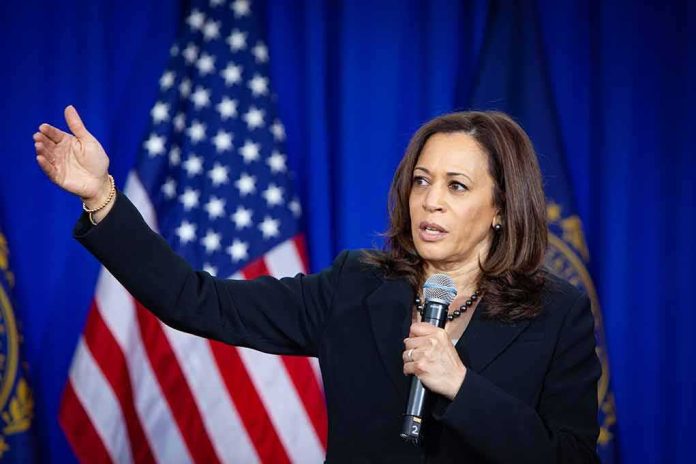
Kamala Harris said Republicans are “cheating” by making voting harder and redrawing maps, and that line lit the fuse.
Story Snapshot
- Harris accused Republicans of “cheating” through voting rules and redistricting.
- She said Republicans want fewer people to vote because they fear “the power of the people”.
- Republicans say their aim is secure, trusted elections, not suppression.
- Studies show some rules change access, while average impacts on winners are often small.
What Harris Said And Why It Caught Fire
Kamala Harris charged that Republicans are “cheating,” tying it to voting rules and redistricting. She said they are “trying to make it more difficult for people to vote so they won’t vote because they are afraid of the power of the people”. She repeated that theme while campaigning in Michigan, adding that opponents were “throwing obstacles in our way”. The message was not new for her, but the word “cheating” turned a policy fight into a moral one. That single word guaranteed headlines and heat.
Harris also linked the Supreme Court’s recent direction to weaker voting rights protections. She argued a Court that “gutted the Voting Rights Act” paired with Republican-led changes puts access at risk. She told civil-rights leaders she did not expect Congress to restore the law “any time soon”. Her call to action pressed early voting and mail voting as tools to blunt new hurdles, while she warned about suppression dynamics in state rules and map lines.
What Republicans Say They Are Doing
Republican officials and committees frame their agenda as making it easy to vote and hard to cheat. The Republican National Committee says election integrity means accurate rolls, secure ballot procedures, and strong safeguards for mail voting, including signature checks and secure drop boxes. Party statements highlight proof of citizenship, voter identification, and maintenance of voter lists as common-sense steps to protect trust and deter fraud. North Carolina Republicans said they enacted reasonable safeguards to guarantee integrity, not suppress voters.
That framing resonates with many conservatives who see clean rolls and identification as basic. They view uniform rules as fair to every voter. They argue that trust is the foundation of turnout. If people doubt the system, they stay home. From that view, sunlight, audits, paper trails, and strong chain-of-custody rules build confidence and prevent chaos on the back end. The claim that such steps equal “cheating” strikes them as a political charge, not an honest read of the policies.
Sorting Rhetoric From Results
Independent research gives both sides a partial win. Studies find some voting rules can raise friction for certain groups, yet the average effect on who wins elections is often small across many settings. That does not mean rules are trivial. Local choices on polling sites, district lines, and mail-ballot handling can tilt access within close races. Administration quality also matters. The same law can feel fair in one county and punishing in another if lines are long or ballots get rejected at higher rates.
Harris’s charge that “these folks are cheating” is a political claim, not a court finding. The public record here shows sharp rhetoric and broad references to obstacles, but not a list of statutes with measured turnout impact attached to each one. Republicans, for their part, insist their measures protect the vote. They should welcome transparent audits and public reporting on wait times, rejection rates, and map fairness. If the rules truly protect voters, the data should show it.
The Test That Actually Matters
Voters deserve two things at once: secure elections and simple access. A serious standard is clear and even rules, a short path to cast a ballot, fast and fair counts, and public proof the system worked. That means visible chain-of-custody, paper backups, routine audits, and accurate rolls that remove dead and moved voters while making it easy for eligible citizens to register and vote. That also means tracking effects in the open with county-level data and fixing bottlenecks fast.
KAMALA HARRIS IS CRITICIZING EFFORTS TO REMOVE INELIGIBLE VOTERS FROM THE ROLLS.
She argued that election officials have relied on existing tools for decades.
That raises an important question:
HOW DO WE PROTECT BOTH VOTER ACCESS AND ELECTION INTEGRITY?
— BIGDADDYNEVAASK (@bigdaddynevaask) September 23, 2026
Calls of “cheating” or “suppression” should trigger a checklist, not just a clap line. Which rule? What changed? Where is the data on turnout, wait times, rejections, and map competitiveness? What do courts say? Harris’s warning grabbed attention and fired up allies. Republicans say they want both trust and access. Common sense says prove it. Show the numbers. Publish the audits. Keep the line short and the rolls clean. Let every eligible voter vote, and make every ballot count.
Sources:
thegatewaypundit.com, washingtontimes.com, cnn.com, washingtonpost.com, thegrio.com, washingtonexaminer.com, republicanpolicy.house.gov, protectthevote.com, academic.oup.com, republicannationalcommittee.org