

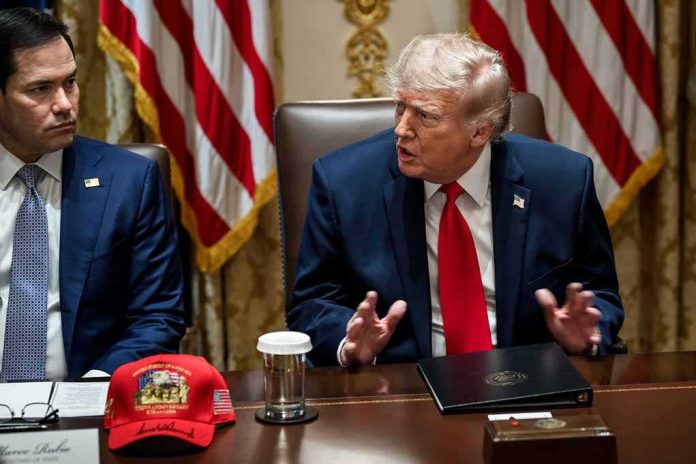
Washington won the Arctic’s front door without changing the flag flying over it.
Story Snapshot
- The United States, Denmark, and Greenland moved to sign a security deal in New York.
- President Trump said the accord gives the United States “permanent control” over Greenland’s security.
- Danish and Greenlandic leaders said sovereignty remains with the Kingdom of Denmark.
- The deal expands U.S. basing and access while barring adversary military footholds, according to reporting.
What Washington Says It Secured
President Trump announced the agreement and framed it as granting the United States “permanent control over security, and all other needs, in Greenland.” He posted that message as media reported the three governments had reached terms and would sign during the United Nations week in New York. Major outlets reported that the accord enables a larger United States military presence on the island and blocks non-North Atlantic Treaty Organization bases or troops from setting up there, according to State Department sources cited in coverage.
Reporters also relayed that the package modernizes access that the United States already held under the 1951 defense framework. Officials described strengthened basing and overflight rights linked to Arctic and North Atlantic defense. That line tracks with decades of cooperation around Thule Air Base and missile warning, which always ran under Danish sovereignty. The new deal, based on reports, aims to shut the door to rival militaries and risky strategic investment while giving United States forces room to operate.
What Copenhagen and Nuuk Drew As Red Lines
Denmark and Greenland answered the rollout with a joint message: the island’s sovereignty is not on the table. The Danish Prime Minister and Greenland’s premier said the agreement recognizes the sovereignty and territorial integrity of the Kingdom and the Greenlandic people’s right to self-determination. Reuters reported their position again the next day, adding that key details, including any authority over resources, had not been disclosed. The thrust is plain: stronger security coordination, not a handover of the island.
That stance narrows the meaning of “permanent control.” It suggests a durable United States lead on defense planning and presence, but not ownership, rule, or mineral control. From a conservative, common-sense view, that fits the mission: keep hostile powers out of a vital sea lane and radar arc, while respecting allies’ sovereignty. The policy result matters more than the label. If the text cements long-term access and investment screening against China and Russia, it serves American security and avoids the cost and chaos of a sovereignty fight.
Why Greenland Matters Now
Arctic shipping lanes are opening, undersea cables are multiplying, and long-range missiles and bombers treat the polar route as a highway. Greenland sits at the choke point. The United States already relies on missile warning and space tracking from the island. A broader footprint improves early warning, anti-submarine patrols, and resupply across the North Atlantic. Danish leaders called the package a way to “strengthen our common security” in the Arctic and the North Atlantic, a theme repeated across official statements and reporting.
Trump, Denmark and Greenland sign a deal Tuesday giving the US “permanent control over security” in Greenland. No purchase. No sovereignty transfer. Two new US military bases. Denmark calls it “good for NATO.” Trump calls it “infinite.”
He spent a year threatening to take the… pic.twitter.com/BBOu6tgPbd
— imrollo (@rollomars) September 21, 2026
The deal also appears to include explicit guardrails against non-North Atlantic Treaty Organization bases or troop rotations, and tighter scrutiny of sensitive infrastructure. That responds to years of concern about Chinese interest in ports, airfields, and minerals on the island. While the final legal text was not public at the time of the reports, the direction is clear: let allies in, keep adversaries out, and update Cold War-era access for a faster, more contested Arctic theater.
The Fine Print Still to Watch
Journalists reported that the governments planned to sign the agreement at the United Nations, with Danish and Greenlandic procedures to follow. They also noted the absence of the full document in public. That gap leaves questions about jurisdiction on bases, rules for overflight, and any annexes on investment or telecommunications. But the track record points to continuity: expand access and missions while reaffirming that Copenhagen holds sovereignty and Nuuk’s self-rule stands.
Language choices aside, outcomes will settle the debate. If American crews gain regular basing and overflight, if non-allied militaries are kept out, and if sensitive projects face strict screening, then the policy goal is met. That is how lasting security deals work among allies: clear rights for defense, firm respect for sovereignty, and shared interest against common threats. Call it permanent control or permanent access; the test is whether it permanently keeps the bad guys out.
Sources:
theguardian.com, reuters.com, cnn.com, nypost.com, thehill.com