

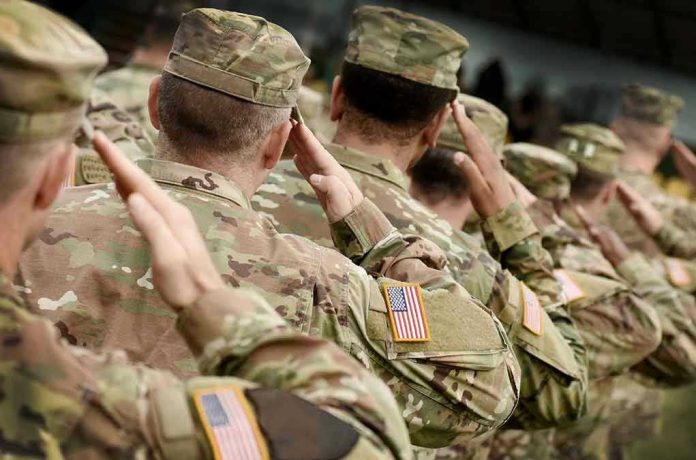
American combat boots are hitting Nigerian soil not to fight, but to teach others how to survive a surging extremist war that has already claimed thousands of lives.
Story Snapshot
- Approximately 100 U.S. troops arrived in Nigeria on February 16, 2026, for non-combat training operations at Nigeria’s formal invitation
- The deployment targets combating Boko Haram, Islamic State West Africa Province, and newly aggressive Sahel militants including JNIM
- Full operational command remains with Nigerian forces, reflecting a sovereignty-conscious approach following U.S. airstrikes and intelligence deployments in late 2025 and early 2026
- Northern Nigeria’s security crisis has killed thousands since 2009, with recent escalation from cross-border Sahel militants and violent bandit groups
Why Nigeria Invited American Military Trainers
Nigeria extended the invitation because its military faces an unprecedented convergence of threats. Boko Haram and its Islamic State splinter have terrorized the north since 2009, killing thousands according to United Nations documentation. Recent years introduced violent bandit networks profiting from kidnapping and illegal mining, alongside Sahel-based militants like Jama’at Nusrat al-Islam wal-Muslimin, which launched its first Nigerian attack in 2025. Nigerian Defense Headquarters spokesman Maj. Gen. Samaila Uba confirmed the deployment represents continuation of longstanding partnership, not emergency intervention, with explicit retention of Nigerian command authority over all operations.
The arrival of roughly 100 American personnel with equipment follows months of escalating U.S. engagement. December 2025 saw U.S. airstrikes targeting Islamic State affiliates in northwestern Nigeria. By January 2026, Africa Command confirmed intelligence officers already embedded in-country. The February 11 announcement by Nigerian authorities, first reported by The Wall Street Journal, anticipated up to 200 troops. The confirmed arrival of approximately 100 signals the initial wave of what appears a phased capacity-building effort. This deployment distinguishes itself from prior U.S. support by putting trainers directly alongside Nigerian forces rather than conducting remote intelligence or airstrikes.
What Makes This Deployment Different From Past Operations
Previous American involvement in Nigeria leaned heavily on intelligence sharing and occasional kinetic strikes, keeping U.S. personnel distant from Nigerian units. This training mission embeds Americans within Nigerian military structures for extended capacity development. Regional precedents exist in Niger and Mali, where U.S. training programs operated before political upheavals forced withdrawals. The Nigerian government’s explicit invitation and retention of full command authority attempt to avoid perceptions of foreign occupation that plagued other African partnerships. U.S. officials speaking anonymously to media confirmed the strict non-combat mandate, a politically sensitive distinction given recent criticisms by former President Trump regarding Nigeria’s alleged failures protecting Christian communities.
Those Trump-era accusations, which Nigerian authorities rejected, oversimplified a complex crisis. Northern Nigeria is predominantly Muslim, and data shows Muslims constitute the majority of extremist violence victims, contradicting narratives framing the conflict purely along Christian-Muslim lines. Analysts criticize faith-based explanations for ignoring the economic drivers including illegal mining competition, government protection failures, and turf wars among militant factions. The deployment occurs as inter-militant conflicts intensify, with established groups like Boko Haram and ISWAP battling newer arrivals like Lakurawa and JNIM for territorial control and resource access. This chaotic landscape demands sophisticated training, not simplistic religious framings.
The Strategic Calculus Behind American Involvement
Washington’s motivations extend beyond altruism. Preventing Sahel extremism from gaining permanent Nigerian footholds serves broader U.S. counterterrorism strategy across West Africa. Nigeria’s population exceeds 200 million, making it Africa’s most populous nation and a critical stability anchor for the region. Allowing militant networks to consolidate control in northern Nigeria risks creating a launching pad for attacks across neighboring countries and potentially threatening maritime security in the Gulf of Guinea. The training mission costs significantly less than direct combat operations while potentially delivering substantial security returns if Nigerian forces effectively apply American tactics and intelligence methods against extremist networks.
Short-term impacts include immediate capability enhancements for Nigerian units receiving American instruction in counterinsurgency tactics, intelligence gathering, and coordinated operations against dispersed militant cells. Long-term implications hinge on whether training translates into sustained operational improvements. Security experts note training alone cannot address underlying governance failures, economic desperation, and political corruption that fuel recruitment into extremist groups. Northern Nigerian civilians, enduring kidnappings, mining disruptions, and indiscriminate violence, require more than military solutions. Government legitimacy depends on protecting citizens, not merely deploying foreign trainers. The arrival of American troops signals renewed commitment, but residents and analysts demand comprehensive approaches addressing root causes beyond tactical military responses.
The discrepancy between initially reported troop numbers and confirmed arrivals reveals operational fluidity. The Wall Street Journal and U.S. officials anticipated approximately 200 personnel, yet Nigerian military confirmed roughly 100 arrived with equipment on February 16. This likely reflects phased deployment, with additional personnel arriving contingent on initial mission success and evolving security needs. The equipment accompanying troops remains unspecified in official statements, though training missions typically include communications gear, surveillance technology, and non-lethal demonstration equipment. Transparency gaps surrounding deployment details and operational timelines reflect both operational security concerns and political sensitivities around foreign military presence on African soil.
Sources:
US Will Send Troops to Nigeria to Train the Military to Fight Extremism
US troops arrive in Nigeria to help train its military
Nigeria’s military confirms U.S. troops arrive in the African country following its request for help