

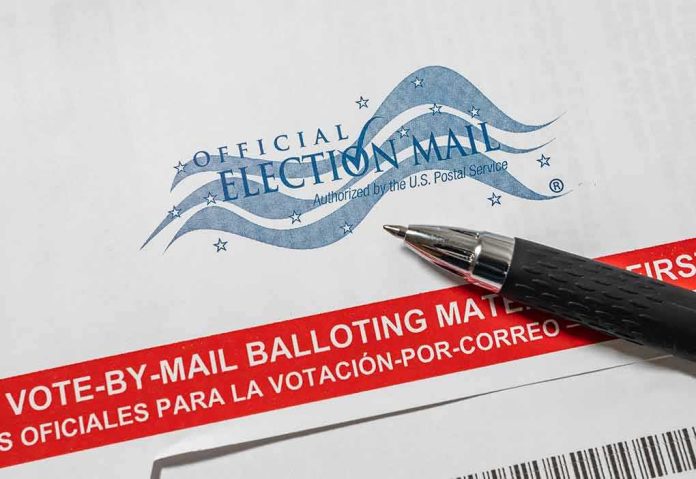
The Supreme Court cracked open the door for tighter mail-in voting rules, and the clock is now the battlefield.
Story Snapshot
- The Court granted President Trump partial emergency relief on his mail-voting order.
- The order centers on citizenship verification and standardized ballot handling.
- Lower courts had blocked major parts; one injunction still limits implementation.
- The ruling is temporary; the full legal fight continues past the midterm sprint.
What The Supreme Court Actually Did
The Supreme Court granted a stay that lets key parts of President Trump’s executive order move forward for now. Reuters described it as lifting a block on parts of the policy, not a final ruling on legality. The case sits on the emergency docket, which means speed and timing matter as much as doctrine. The Court has not decided the merits. That matters because the order could shape mail voting during the midterm crunch, then face a deeper review later.
The stay also shows how the Court treats late-election changes. In June, the Court allowed states to keep grace periods for mail ballots, signaling it will manage mail rules case by case. This ruling fits that pattern. It is less “big swing” and more “do not freeze the status quo if security steps look modest and time is short.” But the scope is partial. Another injunction still restricts parts of the plan in some places, so the win is real but not total.
What Trump’s Order Tries To Do
Executive Order 14399 directs the Department of Homeland Security and the Social Security Administration to compile a list of confirmed eligible voters to help states verify citizenship. It also tells the United States Postal Service to limit ballot handling to voters on approved mail ballot lists and to use secure envelopes with tracking barcodes. The administration frames this as clean, basic election hygiene: confirm who can vote, send ballots only to those approved, and track every envelope. The White House signaled that federal funding could be tied to compliance.
Supporters see common sense. Every secure system uses verification, controlled distribution, and tracking. This order applies that logic to ballots. That aligns with conservative values on citizenship, law and order, and clear rules that treat every voter the same. If an absentee process depends on the mail, tracking and list checks are not “suppression.” They are the seatbelt and speedometer of a high-speed civic process. The aim is fewer misdirected ballots and faster audits, which helps trust even when results are close.
The Legal Pushback And Remaining Limits
Opponents say the Constitution gives states, not the federal executive, control over elections. A federal judge in Boston blocked core parts and said the president lacked power to generate voter lists for states. The judge also said the Postal Service lacked authority to impose binding mail-vote rules. A federal appeals court kept that block for 23 suing states, describing the plan as building a federal eligible-voter list and limiting mail ballots to those on it. Those rulings remain part of the landscape today.
Advocacy groups argue federal databases are out of date and could wrongly exclude eligible voters, which they call disenfranchisement risk. They also warn the Postal Service could shift from neutral carrier to gatekeeper, which could collide with state law. These claims are serious, but they are claims, not proof. The emergency stay signals the Supreme Court sees a plausible legal path for parts of the order, at least while the courts sort out the big questions.
What Matters Next Before The Midterms
Implementation speed and clarity will decide whether this stay becomes a lasting win or a stumble. The administration must publish tight instructions for how the Postal Service screens ballot mail, how states update lists, and how military and overseas voters get handled without delay. The agencies must prove the citizenship list reduces error, not voter access. If the data show fewer misfires and cleaner tracking, the integrity case strengthens. If errors hit eligible voters, the narrative flips fast.
Conservative common sense favors bright lines: citizens vote, rules are even, and systems track what they send. The Supreme Court gave Trump room to test that model. The wise path now is transparency. Release the match logic. Publish error rates. Show the barcode chain works across blue and red states. If the facts hold up, the country gains a cleaner mail system without closing the door on lawful voters. That is a standard both sides should be able to live with.
Sources:
facebook.com, reuters.com, whitehouse.gov, supremecourt.gov, cnn.com, constitutioncenter.org