

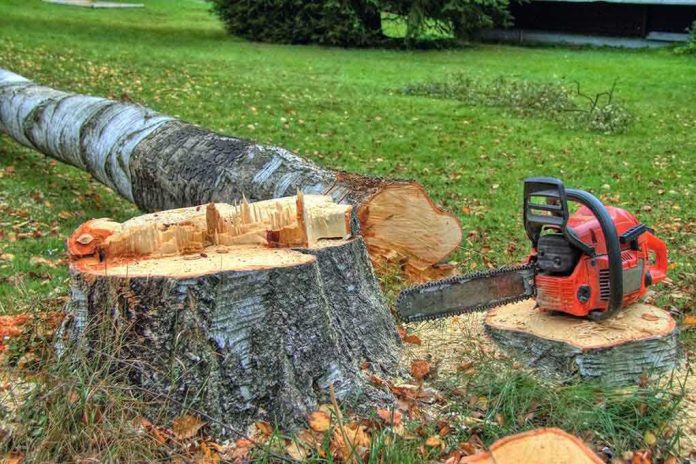
A federal judge hit the brakes after hundreds of trees fell in a single day at a public golf course in the nation’s capital.
Story Snapshot
- A judge ordered an emergency pause after large-scale weekend tree cutting at East Potomac Golf Links.
- Government lawyers filed late-Friday notice for Saturday work, drawing sharp rebukes from the court.
- The National Park Service says the work follows a 2019 restoration plan, not a new redevelopment.
- Counts vary: filings and reports cite about 430 to 529 trees removed, with more planned.
The Flashpoint: Timing, Scale, And A Court’s Demand For Order
U.S. District Judge Ana Reyes stepped in after crews felled hundreds of trees at East Potomac Golf Links over a holiday weekend. Department of Justice lawyers alerted the court at about 4:55 p.m. Friday that cutting would start Saturday. Plaintiffs said that gave no fair chance to seek relief before the work began. Reyes imposed a temporary halt and demanded sworn testimony on who approved the action and why the notice came so late.
The dispute centers on a prior instruction to notify the court before major work. Reports say the judge expected notice before removing more than 10 trees or doing substantive changes. The government disclosed the plan late Friday and cutting began the next morning. Reyes then extended the stop order and considered requiring a 72-hour notice window for any future significant work at the site.
What Was Cut And Why The Tallies Differ
Numbers became a battleground. Court papers from preservation plaintiffs said crews cut 529 trees on Saturday, including mature species they viewed as valuable. Government lawyers reported about 430 trees had been cut, with plans for close to 299 more. Another account referenced a cap at 529 total removals. The spread stems from different sources and stages. The court will likely force a reconciled tree inventory before any next step.
The National Park Service says labels like “mass clear-cutting” miss the point. Officials argue the work follows a 2019 cultural-landscape plan meant to restore a historic links-style course. The Interior Department and Park Service describe the removals as focused on non-contributing, invasive, hazardous, or declining trees, with aims to open historic views and protect contributing vegetation. That rationale, if documented and vetted, can align with common-sense stewardship: clear what harms the resource, preserve what defines it.
Inside The Courtroom: Credibility, Chain Of Command, And Next Steps
Reyes signaled concern about credibility and process. She ordered National Park Service superintendent Kevin Griess to testify under oath about authorization and reasons for the timing. Reporting also pointed to testimony by senior Interior officials on who gave the green light. The judge’s move fits a narrow goal: restore order, ensure notice, and prevent irreversible changes while facts are nailed down under oath and on the record.
From a governance lens, this is not a fight over whether trees ever get trimmed. It is about how an agency executes big steps on public land while under judicial supervision. Conservative instincts favor clear rules, accountable chains of command, and respect for property-like interests in historic settings. If a prior notice regime existed, then last-minute filings that trigger irreversible work invite court pushback. A fair process protects both restoration goals and public trust.
What Matters Now: Evidence, Not Adjectives
The path forward runs through documents, stump maps, and sworn testimony. The court will want the operative notice directive in black and white, the tree inventory before and after, and the exact tie between each removal and the 2019 plan. The Park Service can strengthen its case with clear species lists, condition ratings, and maps of protected “contributing” trees left standing. Plaintiffs can press on counts, health status, and whether the removals exceeded the scope of restoration.
The controversy sits in a familiar gap between “maintenance” and “alteration.” Agencies often brand work as routine to move fast; preservation groups stress visible change that cannot be undone. Courts referee that line by testing facts, not rhetoric. The judge paused the saws, not to stop stewardship forever, but to make sure the government follows its own plan, honors the court’s notice terms, and proves that what is gone needed to go in the first place.
Sources:
cbsnews.com, nbcnews.com, golfdigest.com, apnews.com, parkplanning.nps.gov, washingtonexaminer.com, raskin.house.gov, ibtimes.co.uk