
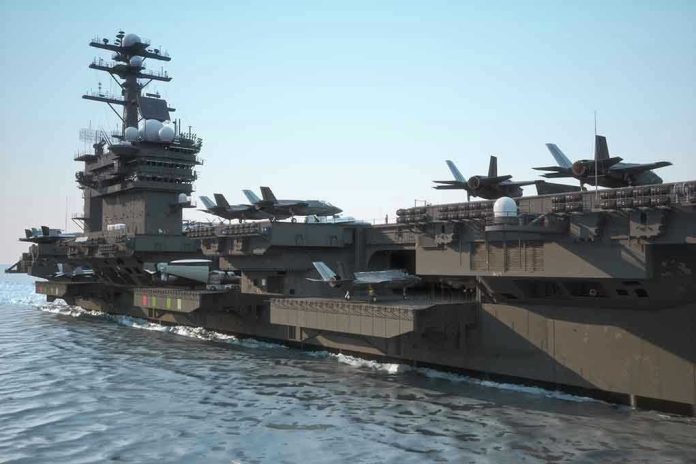
American destroyers and allied batteries caught Iran’s missiles and drones mid-flight, then blinded the launchers’ eyes before the next salvo could leave the rails.
Story Snapshot
- U.S. Central Command reported intercepting Iranian missiles and drones aimed toward Gulf partners and the Strait of Hormuz [6][9].
- Regional governments and outlets detailed large-scale interceptions over Kuwait and Bahrain, with no U.S. casualties reported [3][6].
- Iranian messaging clashed with U.S. accounts, continuing a familiar claim-counterclaim cycle in Gulf crises [1][7].
- The tactical logic: defend shipping lanes, protect partners, and neutralize targeting radar to prevent follow-on strikes [4][13][15].
What Happened And Why It Mattered In Minutes, Not Hours
U.S. Central Command said American forces shot down multiple Iranian ballistic missiles and one-way attack drones launched toward Gulf allies and the Strait of Hormuz, a maritime artery that carries a significant share of the world’s oil and gas traffic [6][9]. Gulf states reported intercepting waves of incoming threats over their territory, underscoring coordinated regional air defense and the scale of Iran’s launch package [3]. Commanders framed the action as self-defense and partner defense, a core obligation when host nations host American forces [14].
Reportage and official statements converged on the same tactical picture: layered defenses—ship-based interceptors, land-based batteries, and combat air patrols—engaged inbound missiles and drones before they could hit ports, bases, or commercial sea lanes [6][9][14]. That alignment points to a practical rule of survival in the Gulf: when sensors confirm tracks inbound toward defended areas, shoot, then sort out diplomatic messaging later. Allied coordination appeared to hold, with Bahrain and others reporting successful engagements as the volley unfolded [3].
The Strait Of Hormuz And The Stakes For Everyday Americans
The Strait of Hormuz narrows global energy flows into a chokepoint where a few missiles can spike premiums at the pump. U.S. commanders treat attacks toward that corridor as an immediate threat to commercial shipping and American sailors, not an abstract geopolitical scuffle [9][14]. From a conservative, common-sense perspective, protecting freedom of navigation is nonnegotiable. Letting missiles test that boundary invites higher insurance rates, jittery markets, and opportunistic actors who bet the United States will hesitate when escorts and tankers come under threat.
Iran’s narrative diverged sharply, with competing claims about targets and outcomes surfacing across state-linked channels and sympathetic outlets [1][7]. That dissonance fits a long-running pattern in the region: rapid, confidence-soaked proclamations that outpace independent verification while technical evidence stays classified [7][13]. When disputes hinge on radar tapes and engagement logs, the side willing to publish corroborated tracks early usually wins credibility. In this round, U.S. and Gulf announcements arrived quickly and fit the observable pattern of layered air defense performance [3][6][9].
Hitting Back Without Tumbling Into A Wider War
American commanders signaled a narrow retaliatory logic: defend against inbounds and neutralize enabling systems, such as radar and command-and-control nodes that cue launchers, rather than hunting prestige targets that risk escalation [4]. That approach lines up with prior intercept-heavy episodes where over 90 percent of incoming threats were defeated while planners stressed restoring deterrence without gifting Tehran an excuse to widen the fight [15]. Precision responses keep costs on the attacker and protect civilians and shipping—an approach that tracks with both prudence and strength.
U. S. forces intercepting those Iranian missiles and drones then striking Qeshm Island shows the resolve needed to protect the West from invaders.
— Silas Vorn (@ShphrdsVllyHmsd) June 3, 2026
Claims that warned of hits on American warships or airports ran headlong into U.S. denials and partner statements, many of which emphasized successful defenses and minimal damage [1][6]. The credibility filter here is practical: who fields interoperable radars, who coordinates tracks across borders, and who can show a consistent picture of launch-to-intercept timelines? On that test, U.S. Central Command and Gulf partners presented a cohesive account that aligned with prior coalition intercept statistics and the immediate resumption of normal maritime flows [3][6][15].
Sources:
[1] Web – U.S. forces shot down Iranian missiles and drones aimed toward Gulf …
[3] YouTube – ON CAM: Iranian Ballistic Fury Hits ‘AMERICAN BASES’
[4] Web – Gulf states intercept hundreds of Iranian missiles and drones, issue …
[6] YouTube – Iranian drone attacks on Kuwait and Bahrain after US attacks on Iran
[7] Web – US secures Israel-Lebanon ceasefire in major diplomatic breakthrough
[9] Web – Did Iran Use a Chinese Missile to Shoot Down the ‘Dude 44’ F-15E?
[13] Web – Iran Air Flight 655 – Wikipedia
[14] Web – US Forces Intercept Iranian Missiles and Drones as Tensions Persist …
[15] Web – U.S. forces intercept Iranian missiles, drones in self-defense