

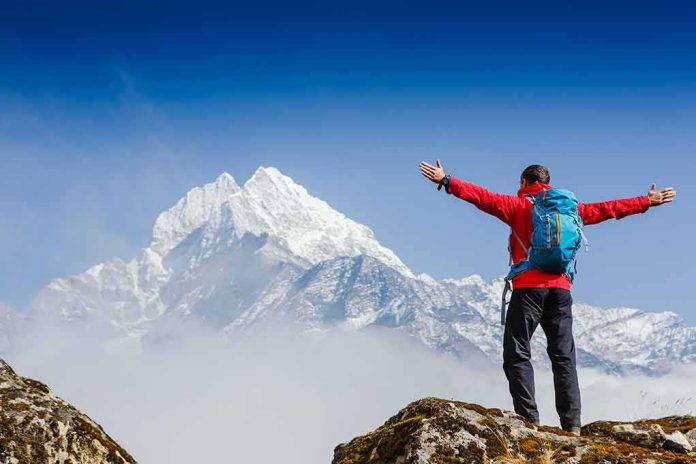
A trekking pole meant to steady his footing instead punched through his own torso, and the ER nurse still had to walk 10 miles down a mountain to save his own life.
Quick Take
- David Cifaldi, 32, a Billings, Montana wound care nurse, was impaled through his torso by his own trekking pole while climbing Granite Peak on July 20.
- He used his emergency room training to check his own wound, decided it was not life-threatening, and chose to hike out instead of waiting for a helicopter.
- Friends Jesse Ross and Brad helped guide him down and watched the wound during the roughly 6.5-hour, 10-mile descent.
- Doctors at Intermountain Health in Billings surgically removed the pole after he reached the trailhead and got transported to care.
A Slip On Rocks Turns Into A Life-Or-Death Moment
Cifaldi was climbing Montana’s tallest mountain, Granite Peak, with two friends on July 20 when he lost his footing on loose rocks near 11,800 feet. As he fell, his own trekking pole drove through his torso. Most people in that situation would panic. Cifaldi, an emergency room nurse, says something different clicked into place instead.
He told reporters his training took over almost immediately. “I think my nurse brain kicked in,” he said, describing how he checked his own wound the way he would check a patient’s. He confirmed the pole had not hit anything critical and decided he was stable enough to move under his own power rather than wait where he was.
Ten Miles, Six-And-A-Half Hours, No Shortcuts
That decision meant a grueling walk back down rugged terrain, through boulder fields and snowfields, with a pole still lodged in his body. His hiking companions, Jesse Ross and Brad, stayed close the entire way. One used a satellite communicator to alert search and rescue, while the other kept checking the wound as they moved. The trio covered roughly 10 miles in about six and a half hours before reaching help.
That kind of walk is punishing even for a fit, uninjured hiker on flat ground. Doing it with an object stuck through your torso, at altitude, over loose rock, says something about both the man’s physical conditioning and his mental discipline under pressure. It also says something about the friends who refused to leave his side and kept monitoring him step by step.
Why He Skipped The Helicopter
Reports note the group opted against calling in a helicopter evacuation, a choice tied to the steep cost such rescues can carry. That detail has sparked chatter online about the price tag attached to mountain rescues in America, a legitimate policy conversation for another day. But it should not overshadow the core fact here: a trained medical professional made a real-time, high-stakes call about his own body and stood by it for six and a half hours.
Once the group reached the trailhead, Cifaldi got transported to a local hospital before being transferred to Intermountain Health in Billings, where surgeons carefully extracted the trekking pole. The successful surgery backs up his own field assessment that the injury, while serious, had not struck anything immediately fatal. He is now recovering.
What The Public Record Still Leaves Open
Local television stations in Montana and Texas ran versions of this story within a day of each other, and national outlets picked it up soon after. That kind of quick, repeated coverage can feel like independent confirmation, but much of it traces back to the same small circle: Cifaldi, his two hiking companions, and a handful of press interviews. No hospital record, search-and-rescue log, or device timestamp has been made public to independently pin down every detail of the timeline.
https://twitter.com/Kentuckyoffgrid/status/2081416274567917830
None of that changes the basic, well-supported facts: a man got impaled by his own gear on a remote peak, used his medical judgment to avoid panic, and walked out under his own power with friends at his side. The finer print, like the exact wound depth or the precise minute rescue crews got the satellite alert, remains undocumented in public records so far. That is a normal gap in early reporting on a wild story, not a reason to doubt the man survived a genuine ordeal through grit, training, and friendship.
Sources:
nypost.com, instagram.com, oregonlive.com