

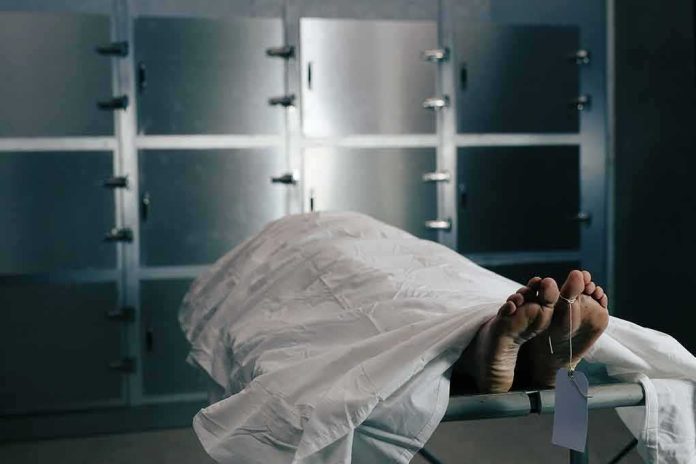
A Phoenix jury convicted a hospital security guard of four felonies for sexual conduct with a corpse in a morgue freezer.
Story Snapshot
- Jurors found Randall Bird guilty of four crimes against the dead tied to a morgue incident.
- Investigators reported Bird’s DNA on the deceased woman’s genital-area swabs.
- Co-workers said they confronted Bird inside a locked morgue freezer with the body bag unzipped.
- The Medical Examiner documented post-mortem rib fractures during evidence collection.
Jury Verdict Anchored By Forensic Evidence And Witness Accounts
The jury returned guilty verdicts on four felony counts tied to sexual conduct with a corpse at Banner University Medical Center in Phoenix, Arizona. Prosecutors presented DNA results that identified Bird as the male contributor on genital-area swabs from the deceased woman, according to police accounts cited in news reports. Two hospital security witnesses reported discovering Bird in the morgue freezer during his shift. Their observations, combined with the DNA findings, formed the core of the state’s case.
https://www.youtube.com/watch?v=tQhUenu-J3A
Security staff reported that the morgue freezer door was locked from the inside, the light was on, and Bird appeared sweaty and nervous when they entered. Reports based on court records say the body bag was unzipped and the woman’s gown was displaced, exposing her from the waist down. That scene aligned with the allegation of sexual contact rather than routine handling. These points helped jurors evaluate intent and opportunity in a controlled area that logs entries and exits.
DNA Placement And Timeline Narrowed The Location Of Contact
Investigators reported Bird’s DNA on external genital and vulvar-vestibular swabs, a detail that prosecutors used to connect him to the charged acts. Coverage also stated the body arrived at the hospital morgue zipped inside the bag, which narrowed the possible location and time of contact to the freezer area after intake. That sequence undercut claims of incidental transfer from other hospital spaces. Forensic labs often cannot timestamp DNA, but location and logistics can frame when contact likely occurred.
The Maricopa County Medical Examiner performed sexual-assault evidence collection and documented post-mortem rib fractures, according to reporting on the exam. The available coverage does not detail the number or exact cause of those fractures. Handling and transport can sometimes cause damage after death. Prosecutors focused on the sexual contact charges, with the fractures noted as part of the broader forensic picture. Jurors weighed the totality: DNA location, witness accounts, and the physical scene.
The Law And The Line Between Access And Abuse
Arizona law makes necrophilia a crime, including sexual contact with a dead human body, other than contact needed for normal post-death care such as storage or preparation. This statute draws a bright line for morgue and hospital workers. Access is for custody and dignity, not exploitation. Cases like this are rare, and researchers caution against broad claims about frequency. Studies show no reliable general rate, but offenders often exploit jobs that give them unsupervised access to remains.
Hospitals and families trust morgues as the last stop for care. Conservative common sense says stewardship is not optional; it is sacred. When a worker crosses that line, a jury’s job is to restore order with facts, not feelings. Here, the combination of reported DNA on intimate swabs, the locked-freezer confrontation by co-workers, and the unzipped body bag supported the verdict. That evidence spoke more clearly than any excuse of a sudden medical episode or clumsy handling could.
What This Case Means For Hospitals And Families
Hospitals should treat morgue security as critical infrastructure. Leadership can reduce risk with strict badge controls, dual-custody procedures, tamper-evident seals on body bags, and cameras at entries. Training must emphasize that every action near human remains is logged, auditable, and accountable. Families need assurance that institutions act fast when red flags appear. The swift firing reported in coverage sends a needed signal: the dignity of the dead is non-negotiable, and violations draw immediate consequences.
Sources:
thesmokinggun.com, kbtx.com, metro.co.uk, foxnews.com, fox10phoenix.com, azleg.gov