

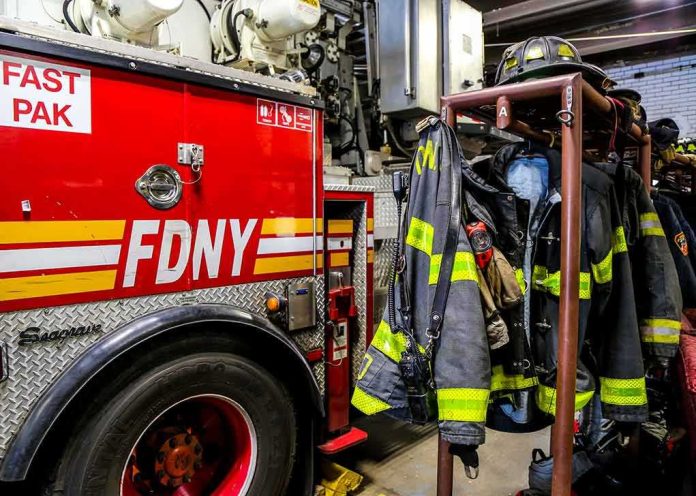
FDNY firefighters pulled a six-months-pregnant woman alive from a mountain of brick and dust in Brooklyn as cameras rolled and a city held its breath.
Story Snapshot
- Firefighters reached and extracted a conscious woman from rubble on Flatbush Avenue.
- Her husband identified her as six months pregnant, and she was taken by ambulance.
- The collapse killed multiple people and drew more than 250 responders to the scene.
- Rescuers used dogs, drones, hand tools, and rapid teamwork to find survivors.
A rapid rescue in the middle of a deadly collapse
Firefighters arrived to a three-story building collapse around 4 p.m. at 1321 Flatbush Avenue, where the structure had fallen toward an adjacent construction site at 2625 Bedford Avenue. Crews tunneled and cleared paths to reach trapped people. Around 6:15 p.m., firefighters made voice contact with a woman who was conscious and alert. Minutes later, they lifted her onto a stretcher, covered her, and moved her to an ambulance as cameras recorded the sequence.
The woman’s husband told reporters she was six months pregnant and still alive as crews moved her from the debris field. The extraction became the defining image of the night, showing what a trained search team can do under pressure. Major outlets shared the video, confirming the timeline and the visual record of the lift. The moment did not erase the loss around them. It did show that smart, fast decisions can win a fragile window of life.
How FDNY searched a moving maze of broken structure
Commanders called in teams with clear roles and kept the scene organized. Crews used drones to scan voids above and between slabs. Hand teams sounded floors, then advanced with axes, saws, and shoring to prevent further collapse. Search dogs worked along tight lanes cut through debris. Medics staged close to the work face for immediate transfer. More than 250 first responders rotated to keep the pace steady and safe while light changed and dust settled.
Search leaders set strict priorities: find live voices, hold the structure, and move patients. They cleared debris by hand near likely survivable spaces to avoid crushing voids. They paused heavy tools when crews heard tapping or faint replies. That discipline reduces secondary collapse risk and buys time for victims whose air and space can vanish with one wrong cut. The method here matched best practice taught after many hard lessons in urban rescues.
What we know about the building, the site, and the toll
The collapse involved a 96-year-old, three-story building next to active work. Reports describe excavation and demolition next door that preceded the failure. The city’s Department of Buildings began an investigation and ordered broad site checks. The death toll rose as crews dug through the rubble, and officials also reported multiple injuries. Those figures reflect the harsh math of collapse scenes, where the first hours mix rescues with grim recovery.
Eight people died when a Brooklyn building fell. Its north wall was rated poor.
– A city inspection report found visible cracks in three of the building's walls.
– The mayor says he is incredibly troubled that construction kept going despite that report.
– Officials still… pic.twitter.com/bdxnP8Mebz— Unbiased Headlines (@UnbiasedHdlns) November 13, 2026
The address pairing of 1321 Flatbush and 2625 Bedford appears across coverage, as does the evening rescue window that produced the stretcher image. Officials and outlets aligned on the core timeline. That consistency matters, because it lets the public trust the basics while investigators sort the cause. One brief caution is fair: outlets described the rescued woman’s condition in different ways as the night went on, which often happens in fast-moving events.
Why this rescue matters beyond one powerful photo
Cities need proof that training, gear, and chain of command work when everything else breaks. This rescue gave that proof. It showed how disciplined teams can save a life in a narrow span of minutes. It also showed the value of simple tools used with skill. A clear call-out, a steady advance, and hands that move debris with care can beat the clock. That is common sense emergency work and aligns with the duty we expect from local services.
Policy makers should keep two tracks moving at once. First, fund and train for the first hour after failure, because that hour sets the survival curve. Second, demand clear records from inspections and site work, with quick action when rules are ignored. A strong city backs both response and prevention. The public saw the response on full display on Flatbush Avenue. The prevention side will unfold on a slower timeline, but it deserves equal focus.
Sources:
facebook.com, bbc.com, abc13.com, cbsnews.com, cnn.com, cdapress.com, pbs.org