

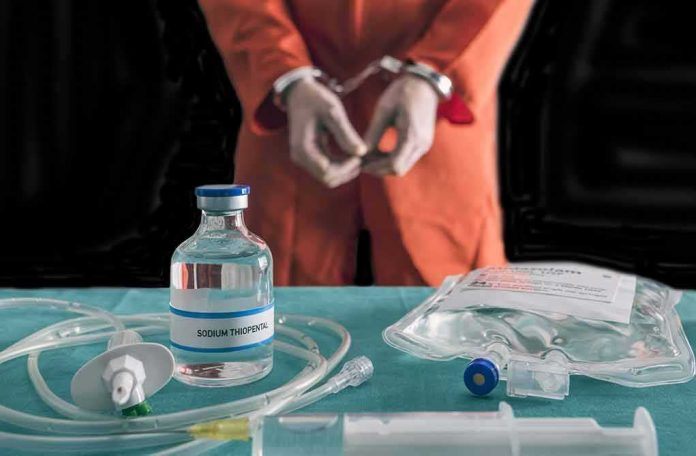
The night Tennessee could not find a vein for death exposed something most Americans never think about: what it actually takes, step by step, to turn a court sentence into a human being’s last breath.
Story Snapshot
- Executioners secured one intravenous line but could not place the second backup line required by Tennessee’s own protocol, forcing a halt.[1]
- Officials tried and failed to insert a central line in the prisoner’s torso before calling everything off.[1]
- Witnesses and attorneys describe more than an hour of needle probes before the warden stopped the process.[1][3]
- Governor Bill Lee granted a one-year reprieve, leaving the death sentence intact but the method under a cloud.[2]
When The Machine Of Justice Stalls In Real Time
On paper, the Tony Carruthers execution looked routine: a man convicted of brutal 1994 kidnappings and murders in Memphis, a warrant, a schedule, a protocol. Inside the chamber, the picture changed fast. The Tennessee Department of Correction reported that medical personnel quickly established a primary intravenous line in Carruthers, then hit a wall. They could not locate a suitable vein for the backup line that state rules require before lethal drugs can flow.[1] The machinery of death jammed on a detail smaller than a drinking straw.
Execution staff followed the 2025 Tennessee protocol, which says the primary line carries the chemicals and a backup must stand ready in case the first fails. When arms and standard sites did not cooperate, the team escalated. They attempted to place a central line, a catheter that runs into a large vein in the torso or neck, again pursuant to protocol.[1] That effort also failed. At that point, officials stopped the execution rather than improvise a work-around that could collapse the legal and medical legitimacy of the process.[1][2]
One Hour Of Needles, And A Question Of Cruelty
News accounts and witness descriptions agree on one chilling timeline: attempts to establish full intravenous access dragged on for more than an hour before the warden pulled the plug.[1][3] Carruthers’ lawyers rushed to federal and state courts, arguing that continuous punctures in search of a vein crossed the line into cruel and unusual punishment barred by the Constitution.[1] They also claimed the physician under contract with the prison lacked the proper qualifications to place the central line that the protocol itself made essential.[3] Those allegations are exactly the kind that, if true, offend both basic decency and conservative expectations of competent government.
Caution is needed here. The public does not yet have the execution room logs, medical notes, or sworn testimony from the team. The record comes mostly through the prison system’s short statement and reporters’ paraphrases, plus defense advocates who have every reason to emphasize suffering. That does not mean they are wrong; it means citizens should demand more documentation before reaching final judgment. A state that wields the power to kill should not ask for blind trust about what happened behind a closed steel door.[1][2][3]
Why A Backup Line Became A Moral Tripwire
Tennessee’s own rules created the pressure point. The protocol mandates two intravenous lines and requires that any failure be reported up the chain, with the option to move to a central line if needed. That kind of redundancy reflects common sense: if you are going to use lethal drugs, you do not want a clogged line midstream. At the same time, insisting on multiple access points raises the odds of exactly what played out here—multiple punctures, escalating invasiveness, and, eventually, a spectacle critics can call a “botched execution.”
NASHVILLE, Tenn.— Gov. Bill Lee granted a one-year reprieve Thursday after Tennessee halted the planned execution of death row inmate Tony Carruthers amid reported problems establishing IV access for the lethal injection. https://t.co/HDR9I44dko
— wake1up (@n2oneness) May 22, 2026
Supporters of capital punishment will point out that the lawful sentence did not vanish that morning. Governor Bill Lee’s action was a one-year reprieve, not mercy in the final sense.[2] The conviction stands; the death penalty remains on the books. From that perspective, a temporary pause after a failed medical procedure looks like the justice system doing what conservatives often ask it to do: stop when something important is not right, correct the process, then re-engage rather than tear down the entire institution in a rush of outrage. The challenge is proving to the public that the correction is real, not cosmetic.
What Responsible Justice Should Look Like After This
This episode did not occur in a vacuum. Nationally, lethal injection has repeatedly faltered at the same point: finding veins in older prisoners, people with long histories of drug use, or simply bad vascular anatomy.[3] Each failure invites a familiar pattern: officials cite protocol, lawyers allege torture, advocacy groups seize on the story to question the entire death penalty, and families of victims watch the state struggle to do what it promised them decades ago. That loop wears on trust across the spectrum.
A serious conservative response would not be to shrug and push for another date on the calendar. It would be to insist on full transparency from Tennessee’s correctional authorities: release the protocol, the incident report, and the internal review that surely followed.[1] Confirm that medical staff are trained and credentialed for the procedures they attempt. Either refine the method so it can be carried out quickly and reliably, or have an honest statewide debate about whether the state still has the practical capacity to use the death penalty without drifting into the very cruelty the Constitution forbids. Whatever Tennesseans decide, this failed search for a vein has already done one valuable thing: it forced everyone to look directly at how justice is administered, not just how it is pronounced.
Sources:
[1] Web – Tennessee halts man’s execution after failing to find a vein for …
[2] YouTube – Tony Carruthers granted reprieve from execution after failed …
[3] YouTube – Witnesses describe moments before Tony Carruthers’ execution …