

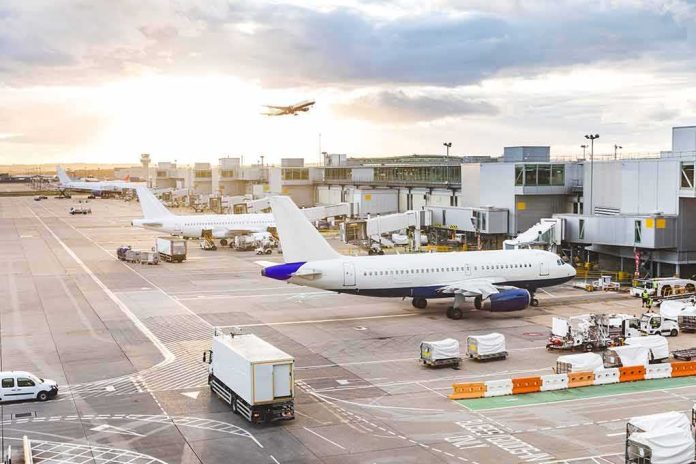
A single broken link in air traffic communications froze America’s departures coast to coast.
Story Snapshot
- The Federal Aviation Administration (FAA) ordered a nationwide ground stop for safety.
- Transportation Secretary Sean Duffy cited a communications issue at Air Route Traffic Control Centers.
- Departures were held nationwide; international arrivals were managed case by case.
- This kind of national halt is rare and echoes the 2023 NOTAM failure precedent.
What triggered the national pause
The Federal Aviation Administration ordered all airports to halt departing flights after a communications problem hit the network that links Air Route Traffic Control Centers, the facilities that manage aircraft between airports. Transportation Secretary Sean Duffy said technicians were investigating and framed the order as a direct response to the disruption. The FAA described the action as taken for “reasons of safety” and under “extraordinary circumstances,” which signaled a system-level concern, not a routine delay.
The operational directive from the FAA’s Air Traffic Control System Command Center left little room for confusion. All departing traffic stayed on the ground until further notice, while inbound international flights were handled one by one. That structure matches a serious systems event: stop new volume, meter what is already airborne, and buy time to validate fixes. The language and scope matched prior safety-first playbooks for foundational system failures.
Why the FAA treated this as more than a glitch
Air Route Traffic Control Centers sit at the center of the national airspace. When their communications go dark or unreliable, controllers cannot safely pass aircraft from one sector to the next. That risk compounds fast across regions. The FAA’s wording—extraordinary circumstances and safety—signals a threshold crossed. Agencies use that phrase to justify rare controls that trade immediate disruption for a wider margin of safety. That is the conservative choice when minutes can turn small technical faults into real hazards.
Newsrooms across the country aligned on the core facts. Reports from major outlets cited the same backbone: a communications issue affecting multiple or all Air Route Traffic Control Centers, a nationwide ground stop covering departures, and a live technical probe. The consistent framing across outlets matched the FAA’s and Secretary Duffy’s statements. Coverage focused on what travelers saw and what controllers needed: time and space to restore a trusted flow of data and voice across facilities.
How rare a nationwide ground stop really is
Modern aviation almost never pauses the entire departure stream. The cleanest comparison is January 11, 2023, when the Federal Aviation Administration halted nearly all departures after the Notice to Air Missions system failed. That pause lasted under two hours while databases were rebuilt and tested. The Government Accountability Office documented that event as the first national stop since September 11, 2001, which shows how unusual a nationwide order remains even in an age of dense air traffic.
The FAA lifted the nationwide ground stop at 8:19 p.m. ET, but a lot of people still won’t get where they were going this weekend.
By about 8:47 p.m., FlightAware listed 6,048 cancellations for Friday and another 1,169 already on the board for Saturday, covering flights within,…
— kautious (@kautiousCo) November 14, 2026
That base rate matters. When a national stop happens, it is not a corporate choice, a staffing hiccup, or a weather call. It reflects a foundational system slipping below a safe standard. The moral logic lines up with common-sense safety and with conservative governance: slow down, verify, then resume. The cost lands in missed weddings and blown meetings, but the alternative risks cascading confusion between airplanes at speed. Aviation keeps its stellar record by making the hard stop early, not the hard apology later.
What passengers and airlines should expect next
Ripple effects persist after a nationwide stop even when the order lifts. Crews time out, airplanes are out of place, and gates clog. Airlines triage: first to reposition aircraft and crews, then to rebuild schedules. JetBlue, like peers, faces late-night cancellations and a messy morning recovery. The public sees lines and alerts; operations teams see a chessboard with timers on every move. Expect rolling delays into the next day and select cancellations as networks reset.
Federal agencies will review the failure and the response. The standard path after a system-level event includes a technical root-cause report and an operational review, similar to the process that followed the 2023 Notice to Air Missions outage. Past Government Accountability Office work pressed the FAA to modernize aging systems, strengthen redundancy, and tighten vendor oversight. Those themes will shape fixes and timelines again because resilience, not luck, keeps the next glitch from turning national.
Bottom line for travelers and taxpayers
The FAA’s call locked in the safest option when core communications faltered. That decision grounded planes and protected people. The recovery will take longer than anyone likes, but rebuilding confidence beats guessing at 35,000 feet. The rare nature of a nationwide stop underscores both the gravity of the issue and the prudence of the response. The country pays for reliability up front or pays more in chaos later. Choose the first, every time.
Sources:
pjmedia.com, cnbc.com, 6abc.com, cbsnews.com, nbcnews.com, houstonpublicmedia.org