
Seven thousand two hundred fifty pounds of cocaine never made it to our shores because a Coast Guard crew cut the route short at sea.
Story Snapshot
- Coast Guard Cutter Richard Dixon stopped a suspected smuggling boat near Puerto Rico.
- Crews seized about 7,250 pounds of cocaine worth about $54.5 million.
- Five people were detained after air and marine teams helped the interdiction.
- The bust fits a long pattern of large seizures in the Puerto Rico corridor.
What Happened Off Puerto Rico
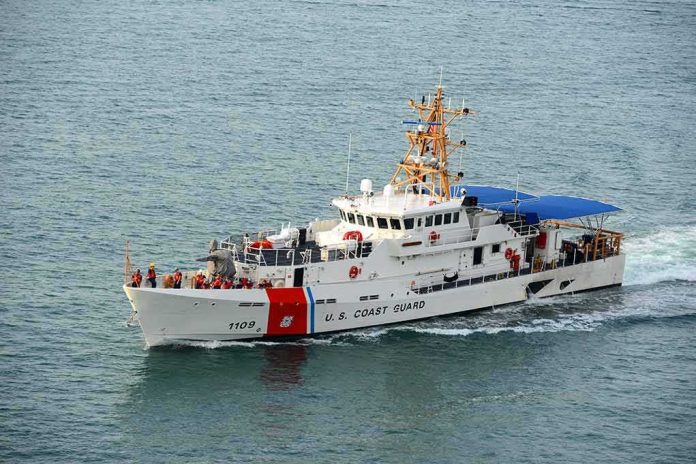
U.S. Coast Guard crews intercepted a suspected smuggling boat about 50 miles off Puerto Rico on Aug. 22. The Coast Guard Cutter Richard Dixon led the stop with support from Customs and Border Protection air and marine teams. Crews found more than 7,000 pounds of cocaine aboard. The haul measured about 7,250 pounds with an estimated value of $54.5 million. Five people were detained during the operation, and the vessel was later destroyed as a hazard to navigation, according to reporting.
Coast Guard teams train for this exact mission set: find, stop, and search fast boats that run drugs from South America to U.S. territory. The agency focuses assets on the “transit zone” and the maritime approaches to Puerto Rico. That corridor remains a prime route for cocaine loads headed to the mainland. Interdictions often involve air surveillance, small-boat launches, and armed boarding teams operating with tight rules and tight timelines.
Why This Bust Matters Beyond One Night
The scale of this seizure would stock a major U.S. city’s wholesale market for months. Cutting off three and a half tons at sea spares American streets, families, and police departments the downstream impact. This is border security where it works best: outside the harbor, before contraband hits warehouses or highways. The Coast Guard’s method targets supply chains at weak points, where smugglers risk exposure, fuel limits, rough seas, and thin crew margins.
The Puerto Rico theater shows this is not a one-off win. Coast Guard press releases from the same region document repeated interdictions, named cutters, and handoffs to the Drug Enforcement Administration for prosecution. In one case north of Puerto Rico, partners seized twenty-nine bales weighing about 2,083 pounds. In another, a cutter offloaded 2,513 pounds after stopping a thirty-foot go-fast boat near Loiza. These cases show a steady pipeline from seizure to federal custody.
The Playbook: Partners, Process, and Prosecution
Operations like this rely on tight interagency teamwork. Coast Guard crews at sea coordinate with the Homeland Security Task Force in the San Juan Region, Customs and Border Protection air and marine units, and the Drug Enforcement Administration. Aircrews spot targets. Cutters sprint to intercept. Boarding teams secure suspects and contraband. Agents take custody ashore for lab work and prosecution. Recent releases show weapons seizures, stowaway arrests, and named defendants flowing into federal court from this exact pipeline.
Coast Guard seizes 7K pounds of cocaine worth more than $54 million near Puerto Rico, five arrested https://t.co/3ztjPX4Lf6 #FoxNews
— Liz V (@ShoreEJV) August 27, 2026
Taxpayers should expect this rhythm to continue. The Government Accountability Office has tracked a long surge in Coast Guard patrol hours focused on Puerto Rico and the U.S. Virgin Islands, reflecting a clear priority on transit-zone drug enforcement. More hours mean more finds, which pressure cartels to reroute, repackage, or risk longer runs. That cat-and-mouse costs them time and money and buys communities stateside a margin of safety they can feel.
What This Says About Strategy And Values
Stopping cocaine at sea protects communities without asking them to carry the fight on their blocks. That aligns with common-sense policing and conservative principles: enforce the law, secure the border, and back the people in uniform. When a cutter ends a voyage before the stash hits a dock, local sheriffs fight fewer gunfights over turf, and fewer kids face first offers from street dealers. That is quiet, real security—measured in the crimes that never happen.
Sources:
facebook.com, foxnews.com, news.uscg.mil, content.govdelivery.com, justice.gov