

Six deportees refused to step off a plane in Liberia—and the flight carried them on to Equatorial Guinea under a U.S. third-country deal.
Story Snapshot
- Twenty deportees landed in Liberia; six refused to deplane and were flown to Equatorial Guinea, officials and witnesses said.
- Liberia agreed to take up to 1,200 third-country deportees over 12 months under a U.S. arrangement.
- Equatorial Guinea already holds more than 30 U.S.-sent deportees from earlier flights, according to reporting.
- Third-country removals have scaled under statutory authority, with dozens of partner nations since 2025.
Refusal on the Tarmac, Reroute in the Air
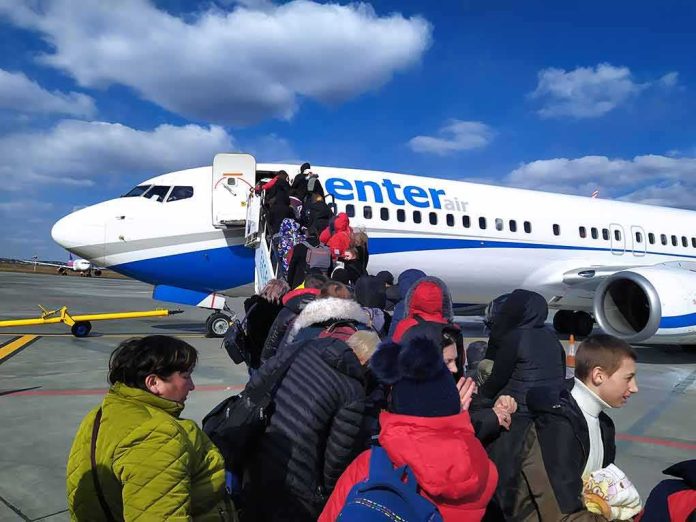
United States officers flew a group of deportees to Liberia last week. Twenty arrived, but several refused to leave the aircraft. Crew and escorts then continued the flight to Equatorial Guinea, a country that also accepts third-country deportees under deals with Washington, according to people on the plane and legal contacts tied to those aboard. Reuters reported that five resisted deplaning; other outlets cited six. Either way, authorities relied on existing transfer agreements to resolve the standoff.
Deportees who refused to exit a US flight in Liberia are sent to Equatorial Guinea https://t.co/onLrMIniQP
— Robert Don Gifford (@GiffordLawFirm) August 26, 2026
Liberian authorities had prepared to receive larger numbers across the year. The government said it would host up to 1,200 people as “guests” who could leave the country if they chose, a point meant to calm public concerns about detention or forced labor. The same week, reporters noted that Equatorial Guinea already housed more than 30 deportees sent earlier by the United States, with authorities there coordinating lodging and security while cases remained unresolved.
Why Third-Country Removals Exist
The Immigration and Nationality Act lets the Department of Homeland Security deport a noncitizen to a country that is not the person’s homeland if conditions are met, including that the receiving country agrees to take them. This tool grew under President Trump’s current term, with nearly a dozen partner countries at first and many more by mid-2026. Human rights groups tracked a sharp rise in these transfers, estimating an increase of about 90 percent over roughly a year.
Supporters say third-country removals close loopholes, speed consequences, and deter illegal crossings. That view tracks with a basic conservative instinct: set clear rules, enforce them, and remove incentives to game the system. If one nation will not accept someone, find a partner who will. That is not cruelty; it is the order that a sovereign border requires, provided the deals meet legal and safety standards set by Congress and the courts.
The Liberia–Equatorial Guinea Chain
Liberia’s agreement laid out a capacity and timeline, signaling a planned pipeline rather than one-off flights. When several passengers refused to deplane, escorts executed a fallback that the contracts allowed: continue to another receiving nation. Reporting identifies Equatorial Guinea as that slot, and it had prior arrivals on the ground. The quick pivot kept control of the operation and avoided a prolonged confrontation in a foreign airport, where local police would face pressure to intervene.
Deportees Sent to Tiny African Nation After Refusing to Get Off Plane
—Six migrants deported from the United States refused to leave a plane in Liberia last week and were instead flown to Equatorial Guinea.
—The group included four Cuban men, one Brazilian man and one…— Sue Ellen (@SueEllenBelI) August 27, 2026
Critics point to conditions after arrival. United Nations experts warned in 2025 and 2026 that third-country placements can risk return to danger and urged tight screening for torture risks or political persecution downstream. That is a fair guardrail. The fix is not to abandon enforcement. The fix is to hardwire stronger vetting, faster status checks, and transparent, auditable standards for housing, medical care, and free movement that meet the agreements on paper.
What Comes Next and Why It Matters
The Liberia episode shows how policy meets real life at 30,000 feet. Resistance on a jetway will happen again. The system needs firm steps that do not reward defiance but still uphold U.S. law and dignity standards. Three moves stand out: publish the core terms of these deals so the public can see the rules; set response timelines for asylum or protection claims made en route; and require receiving countries to certify conditions with independent spot checks.
Clear rules, real consequences, and visible safeguards can coexist. That balance serves the national interest, calms chaos at the border, and respects basic rights. The reroute from Liberia to Equatorial Guinea proved the logistics work. Now Washington should prove the oversight works, too. That is how you keep order without losing your compass—and how you avoid the next standoff from becoming the next scandal.
Sources:
thegatewaypundit.com, nbcnews.com, reuters.com, youtube.com, cnn.com, theguardian.com, foreign.senate.gov, scholarship.law.bu.edu