

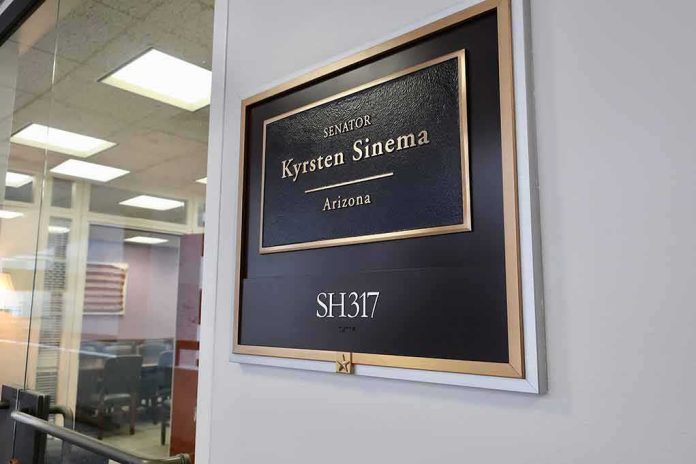
A $10,000 bond, a late-night arrest, and a senator’s admitted romance turned a private mess into a public flashpoint.
Story Snapshot
- Reports say Matthew Ammel was released on a $10,000 bond in North Carolina.
- Court-based reporting says the arrest included assault-related charges tied to medical personnel.
- Ammel’s ex-wife alleges Kyrsten Sinema traveled to post the bond and moved him to Arizona.
- Sinema acknowledged a “romantic and intimate” relationship with Ammel in court filings.
The Arrest, The Bond, And The Claim That Lit The Fuse
North Carolina records-based reporting says Matthew Ammel was arrested on allegations that involved an assault on a medical worker and was later released after posting a $10,000 bond. Separate coverage tied to court documents details charges that included assault by strangulation and assault against emergency personnel. The core flashpoint came from a filing cited in media reports. In it, Ammel’s ex-wife alleges former Senator Kyrsten Sinema traveled to North Carolina, posted his bond, and then moved him into her Arizona home.
The bond amount appears across multiple outlets that cite court records, anchoring the timeline of arrest and release. The allegation that Sinema herself posted the bond traces to the ex-wife’s claims referenced in court-linked reporting, not to a published bond receipt naming the payer. The story moved fast because it blends a concrete fact — release on bond — with a personal claim about who paid it. That mix is rocket fuel when a public figure’s private life sits at the center.
Sinema’s Admitted Relationship Raises The Stakes
Sinema acknowledged in court filings a “romantic and intimate” relationship with Ammel that began while he was still married. That admission gives the allegation sharper edges. It also supplies motive that readers will infer even if a bond receipt never surfaces. Coverage says Ammel worked close to Sinema as security and later as a Senate fellow, which explains proximity and access that make the narrative plausible to many observers. The political fallout followed the personal timeline, as it often does.
Conservative readers value accountability and equal treatment under the law. If a senator did step in to post bond for a romantic partner accused of violence, that choice deserves hard scrutiny. Personal loyalty never excuses poor judgment. Yet prudence also demands clean proof for specific acts. The facts support that Ammel posted bond and walked out. The claim that Sinema paid it rests on the ex-wife’s allegation as reported by outlets citing court materials. The bond record itself would settle the question.
Why North Carolina’s “Homewrecker” Law Supercharges The Story
North Carolina still allows alienation of affection claims, which let a spouse sue a third party for wrongfully breaking a marriage. The law focuses on whether the outsider’s acts destroyed the love and affection in the marriage, not just on whether an affair occurred. That framework encourages filings that describe travel, money, housing, and influence as proof of wrongful intrusion. Once Sinema admitted a romantic relationship, every linked act can be cast as part of that intrusion, including the alleged bond payment.
Kyrsten Sinema bailed out her boyfriend, Matthew Ammel, after he was arrested for allegedly assaulting a physician. Court docs say she posted his bond hours after his involuntary hospital commitment. #KyrstenSinema #BreakingNewshttps://t.co/fL0PGxGXHO
— The Informed Citizen (@staysaneticg) August 16, 2026
Sinema’s legal strategy has stressed geography. She acknowledged the romance but argued for tossing the lawsuit because the relationship did not occur in North Carolina in the way the statute requires. That is a classic defense in these cases, and it rests on a simple rule: you must tie key conduct to the forum. The allegation about flying in to post bond, if documented, would be one of the cleaner links to North Carolina conduct. That is why the bond payer detail matters so much.
What Matters Now: Paper, Timeline, And Common Sense
The immediate facts stand: Ammel faced serious assault-related accusations, and media tied to court records say he posted a $10,000 bond and was released. Sinema admits the romance, which sets the context and raises public interest. The live question is whether she personally posted the bond, as the ex-wife alleges and court-linked stories repeat. The surest test is mundane: the booking log, the bond instrument, and the jail ledger that lists the payer or the bonding company.
Three practical checks would bring clarity fast. First, match the arrest date, charge sheet, and bond form to the release timestamp. Second, identify the surety on the bond. Third, track travel records that show whether Sinema was in North Carolina during the release window. If those records line up, the narrative hardens. If they do not, the claim narrows. Either way, adults can hold two ideas at once: private life is private, and public choices carry public weight.
Sources:
feedpress.me, aol.com, foxnews.com, azcentral.com, yahoo.com, dailymail.co.uk