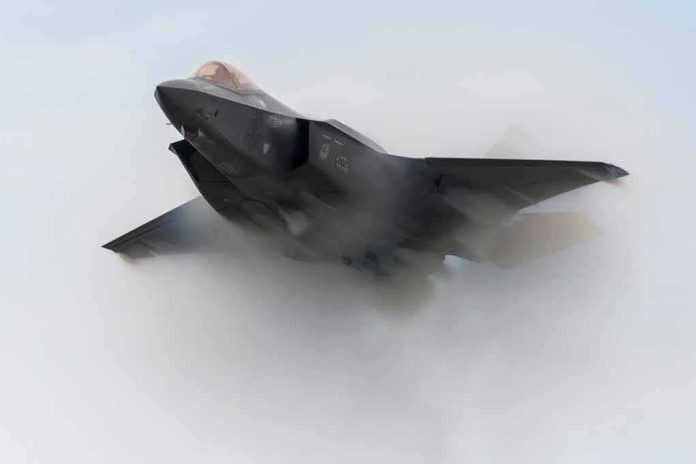
One hour in an American F-22 Raptor can burn through more money than many people earn in a year, and that eye-watering price tag tells a bigger story about how Washington buys power in the sky.
Story Snapshot
- The Government Accountability Office pegs F-22 operating cost at about $85,325 per flight hour, far above other U.S. fighters.
- The Raptor’s tiny fleet, complex stealth skin, and custom parts drive costs through the roof.
- Different Pentagon documents use different cost definitions, which is why you see numbers from $44,000 to over $85,000 an hour.
- The core question is whether unmatched air dominance is worth a fighter that is twice the cost of an F-35 and four times an F-16.
The Fighter That Turns Minutes Into Millions
The F-22 Raptor was built to do one thing better than any plane on earth: win the air war before it starts. It can sneak in, spot enemy fighters first, fire first, and leave without being seen. But that edge does not come cheap. Government Accountability Office data puts its operating cost at about $85,325 per flight hour, nearly double an F-35A Lightning II and almost four times a modern F-16. Every training sortie is a tax-funded burn‑rate on steroids.
That number is not just fuel and a few spare tires. It wraps in fuel, maintenance, spare parts, and the support brain behind the jet. In simple terms, each hour in the air drags a long tail of mechanics, software techs, and logistics crews behind it. Compare that with an F-16, a mass‑produced workhorse that costs around $22,000 per hour to fly, and you can see why the Raptor earns headlines as the four‑times‑as‑expensive option for the same sixty minutes of flight.
Why This Jet Is So Painfully Expensive
The F-22 is a financial outlier because it is a production outlier. The United States originally planned for hundreds more airframes, but the fleet was capped under 200, which killed the economy of scale that makes complex machines cheaper to support. Each jet is basically a hand‑built, boutique item. On top of that, its stealth skin uses delicate radar‑absorbent coatings and specialized maintenance routines that demand 10 to 30 hours of work for every hour in the air. That means paid labor and hangar time pile up fast.
Export controls made things worse. While allies can buy F-35s and spread the cost of parts and upgrades, they were barred from buying F‑22s. That leaves the United States Air Force as the only customer, stuck with a thin supply chain and one‑off components. Analysts point to this “boutique logistics” model as a major cost driver. From a conservative, common‑sense view, it is the same problem you see when government pays to keep a custom fleet alive instead of buying in bulk.
The Cost Numbers Are All Over The Map
Readers who dig into F‑22 costs often find a confusing mess of numbers. Some reports cite about $44,000 per flight hour based on early United States Air Force estimates. Others, including later Defense Department and oversight documents, point to figures in the $59,000 to $60,000 range as the program matured. Then more recent Government Accountability Office and media summaries land on the $85,325 “fully loaded” cost that has now become the headline figure.
These gaps are not proof that anyone is lying; they are proof that “cost per flight hour” is not one simple number. The United States Air Force itself notes that some early figures baked in one‑time base setup costs for the new system. Other rates are reimbursable prices used when other agencies fly the jet, which sit far lower than true ownership cost. Each report slices the pie differently, and that explains why you can see the F‑22 priced everywhere from mid‑five figures up to more than eighty thousand dollars per hour.
Capability Versus Cost In A Tight Budget Era
Supporters of the Raptor argue that you cannot judge the jet only by its hourly bill. They point out that it delivers air superiority that enemy pilots simply cannot match, and that losing that edge would cost far more in lives and equipment than a big fuel and maintenance budget ever will. On paper, that logic lines up with a strong national defense outlook: you buy the best gear so American pilots never fight fair, and you accept higher costs as the price of staying ahead.
Critics push back with a different kind of math. They see a small fleet with a mission‑capable rate that has struggled and an hourly price tag that dwarfs other options. When you are paying twice the F‑35 rate and four times the F‑16 rate for each hour in the air, they ask whether taxpayers are funding prestige more than practical strength. From a conservative, budget‑minded angle, that concern is hard to dismiss. Stealth and dominance matter, but so does making sure defense dollars buy real readiness and not just expensive hangar queens.
Sources:
19fortyfive.com, secure.afa.org, flyajetfighter.com, statista.com, youtube.com