

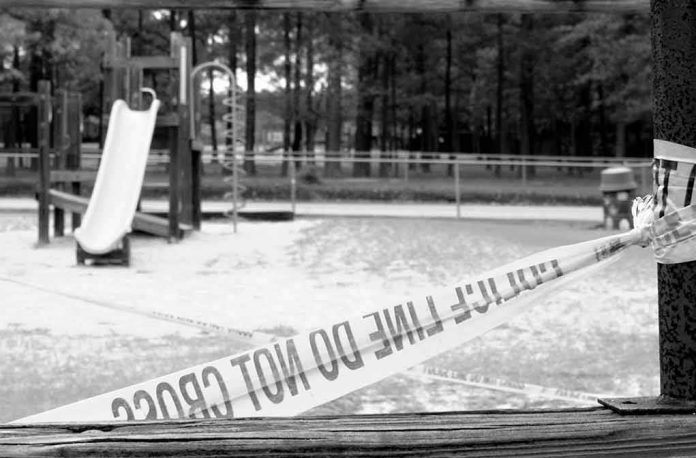
A Queens park meant for water guns and basketball turned into a murder scene, and the most disturbing part may not be the bullet, but the mob of kids who chose to film it.
Story Snapshot
- A 15-year-old, Jaden Pierre, was beaten and shot during a teen water-gun clash at Roy Wilkins Park, prosecutors say.
- An 18-year-old, Zahir Davis, now faces murder, gang assault, and weapons charges; several other teens are also charged.[1][2][3]
- Detectives say cellphone videos show a group attack and a pistol-whip that may have turned into a fatal discharge.[2]
- The case exposes how gangs, phones, and a hollow justice culture collide in America’s big cities.[1][2][3]
From Play Fight To Homicide In Seconds
Roy Wilkins Park in St. Albans was supposed to host a social-media-promoted water and gel gun fight, the kind of harmless spring chaos parents used to shrug off.[2][3] Prosecutors say 15-year-old Jaden Pierre helped organize the event, but the fun snapped into violence when old grudges surfaced.[2] Police and the Queens District Attorney’s office say a group of teenagers swarmed Jaden, punching, kicking, and berating him as others gathered around, some cheering, some recording.[1][2] Within minutes, he was dying on the pavement.
Queens District Attorney Melinda Katz says one teen in that crowd, 18-year-old Zahir Davis, escalated the beating into a homicide.[1] According to her office, Davis joined in the group assault, then pulled a handgun from his bag and shot Jaden in the chest.[1] Jaden collapsed and never got back up. Medics rushed him to Jamaica Hospital, where he was pronounced dead.[2] In the official telling, this was not a random shot in the dark; it was a group attack that ended with a single, decisive trigger pull.[1]
Gang Ties, Old Fights, And A Flight To Jamaica
Detectives say this did not start in the park; it started in a simmering feud between Davis and Jaden, with alleged gang ties pouring gasoline on teenage conflict.[2] Police describe Davis as a reputed member of a local crew known as BG4, operating in southeast Queens, and suggest prior fights between the two teens helped set the stage for the confrontation.[2] After the shooting, authorities say Davis boarded a flight to Jamaica, leaving the country the very next day.[1][2] He was arrested when he returned to John F. Kennedy International Airport.[1][2]
Prosecutors treat that trip as more than a vacation. The District Attorney’s office says Davis fled “to evade responsibility,” language that screams consciousness of guilt in any courtroom.[1] For many Americans, especially those who still believe actions reveal character, that timeline matters. You do not leave town hours after a kid dies at your feet unless you know something is badly wrong. Defense lawyers may eventually argue otherwise, but the facts as presented line up with a straightforward reading: when things got deadly, he ran.[1][2]
Cellphone Cameras, Crowd Mentality, And What The Video Cannot Yet Prove
Investigators say cellphone footage from that afternoon has become a central piece of the case.[1][2] The District Attorney’s office alleges that multiple teenagers beat Jaden while others watched and recorded, turning a crime into content.[1] Local reporting, citing police sources, says the video appears to show Davis pistol-whipping Jaden, and that the gun may have fired during that beating rather than after a calm, deliberate aim.[2] That detail opens a crucial question: was this an intentional firing or a reckless, lethal show of dominance gone wrong?
The public has not seen that footage in full. No frame-by-frame analysis, no chain-of-custody records, no sworn testimony tying each newly arrested teen to specific actions at specific seconds has been released.[1][2][3] What exists now is a prosecutor’s narrative, buttressed by reporters quoting detectives. That is how most high-profile youth cases unfold: authorities tell the story first, and the public often treats that as the final version. A conservative view grounded in due process says: respect the outrage, but resist letting a press release become a verdict.
“Gang-Fueled Beatdown” Or Chaotic Teen Brawl? The Stakes Of The Label
The charges support a theory of coordinated group violence. Davis faces murder in the second degree, gang assault in the first degree, and weapon possession.[1] A 16-year-old, unnamed because of his age, is charged with attempted gang assault in the first degree and assault in the third degree, accused of repeatedly punching and kicking Jaden as part of the group.[1] Police and local coverage say more teens have now been arrested in connection with that same assault sequence, though their roles remain publicly vague.[3] The “gang” label is doing heavy lifting here, legally and culturally.
An 18-year-old was arraigned on an indictment charging him with murder in the second degree, gang assault and weapon possession for the shooting death of 15-year-old Jaden Pierre in Roy Wilkins Park in St. Albans on April 16.
He faces up to 25 years to life in prison if… pic.twitter.com/rdjI32jv5F
— Queens DA Katz (@QueensDAKatz) May 20, 2026
Once a prosecutor calls something a gang assault, many people stop asking hard questions. The term triggers a kind of moral auto-pilot: bad kids, bad choices, lock them up. That instinct is understandable; Jaden is dead, and someone must answer for it. Yet the evidence shown so far is still summarized, not laid bare.[1][2][3] The gang allegation rests largely on police intelligence and prior conflicts, not yet on fully disclosed proof that an organized crew ordered or coordinated a hit.[2] Harsh punishment requires more than a scary label.
What This Case Says About Culture, Responsibility, And Justice
A conservative reading of this tragedy centers on responsibility at every level. If the state’s account holds, Davis and any teen who joined that beating deserve serious consequences—because a civil society cannot function if mobs of kids can swarm one peer, record his humiliation, and accept a gun in their midst as just another prop.[1][2] At the same time, a healthy justice system demands that each defendant’s role be proven, not inferred from gang rumors or social-media clips.[1][2][3] Collective outrage cannot replace individualized evidence.
This case also exposes a deeper cultural rot. A water-gun fight turned fatal not just because one young man allegedly brought a firearm, but because dozens of others treated violence as entertainment.[1][2][3] When a crowd lifts phones instead of helping, that is not just a legal problem; it is a moral failure. Fixing it will take more than another press conference or another “task force.” It will take families, churches, and communities re-teaching something basic: you do not stand by while the strong brutalize the weak—and you definitely do not hit record.
Sources:
[1] Web – TEENAGER INDICTED FOR MURDER OF 15-YEAR JADEN …
[2] Web – Man, 18, charged with murder of 15-year-old at Queens park in St …
[3] Web – Multiple Arrests Made After 15-Year-Old Killed in April Shooting at …