
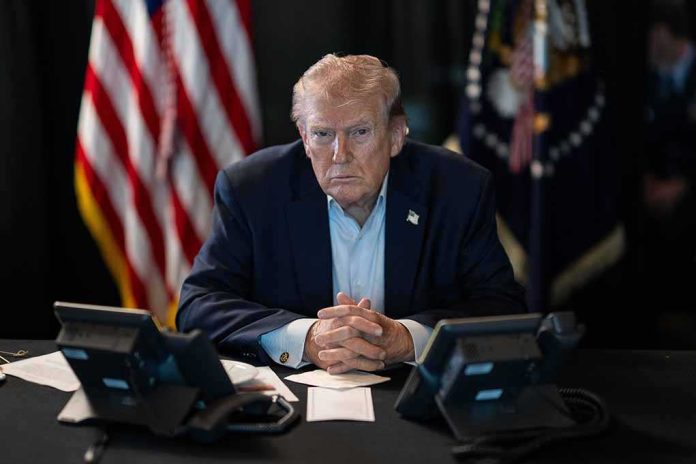
President Trump told a Nebraska crowd that Iran could “take out” Los Angeles and San Diego, calling it “a small price to pay” for keeping the country safe.
Quick Take
- Trump made the remarks Monday at a campaign rally in Grand Island, Nebraska, while defending the cost of the Iran war.
- He tied rising gas and fuel prices to the conflict, then said Iran could strike a U.S. city as part of that cost.
- California Governor Gavin Newsom and the mayors of Los Angeles and San Diego condemned the comments as dangerous.
- The White House says Trump meant it as a warning about what happens if Iran gets a nuclear weapon, not permission to attack.
What Trump Actually Said At The Rally
Speaking to supporters, Trump linked the economic strain of the Iran war to national safety. He said prices were “a little bit high” but worth it. Then he added the line that set off a firestorm: “They can take out a city, let ’em take out Los Angeles, let ’em take out San Diego. This is a very small price to pay.”
Trump’s team later said the president was describing a future risk, not inviting an attack. He was warning what could happen if Iran builds a nuclear weapon and goes unchecked, according to his Rapid Response Team. That explanation matters. Presidents often use blunt, even reckless-sounding language to make a point about deterrence. The question is whether tone matched the stakes of naming two major American cities by location.
Why California Leaders Erupted
Governor Newsom wasted no time firing back, calling Trump “deranged and dangerous” on social media. He argued the president was effectively saying America’s enemies should be allowed to hit California soil. That is a serious charge against any sitting president, and it reflects how raw the relationship between Trump and California’s Democratic leadership has become this year.
Los Angeles Mayor Karen Bass said the comments “could potentially compromise our safety” and accused the president of suggesting a foreign government attack her city. San Diego Mayor Todd Gloria pushed back just as hard, writing that his city “is not collateral damage” and is “never a small price to pay.” Both mayors treated the remark as a direct threat to residents, not a rhetorical flourish about foreign policy.
The Bigger Pattern Behind The Words
Wartime leaders have long used sacrifice language to make costly conflicts feel necessary. Scholars who study presidential rhetoric say phrases like “small price to pay” work by making criticism feel morally uncomfortable, not by offering a real cost-benefit argument. That history helps explain why Trump’s line landed as deterrence talk to supporters and as a careless threat to critics. Both readings can be true depending on who is listening and what they already believe about the war.
Nuclear deterrence experts note that effective warnings rely on precise, credible signals, not loose rally rhetoric. When a president names specific cities in a speech meant to fire up a crowd, the line between a deterrence message and a political gaffe gets blurry fast. For a leader trying to show strength on Iran, clarity matters just as much as toughness, especially when American cities are the example used.
At a campaign rally in Nebraska, Donald Trump said Iran could “take out” Los Angeles or San Diego and called that “a very small price to pay” for keeping the country safe. The remark came while he was discussing higher prices caused by the war, but he explicitly named two major… pic.twitter.com/teLs68vquL
— DARKCOM (@DARKCOMBUZZ) October 6, 2026
From a plain, common-sense standpoint, warning that enemies could strike U.S. cities if left unchecked is a legitimate argument for a strong Iran policy. But naming Los Angeles and San Diego at a campaign rally, paired with “small price to pay,” gave Democrats an easy opening to paint the message as callous rather than cautionary. A tighter phrase making the same deterrence point could have avoided the entire controversy while still landing the warning.
The exchange now sits inside the larger fight over the Iran war’s cost, from fuel prices to military strain, and over how much risk Americans are being asked to accept. Trump’s defenders see tough talk aimed at stopping a nuclear Iran. His critics see a president treating millions of Californians as expendable. Both camps agree on one thing: the words themselves are now part of the record, repeated across rally footage and news reports alike.
Sources:
wpde.com, goodmorningamerica.com, cnn.com, thehill.com, turnto23.com, wtoc.com, journals.rcsi.science