

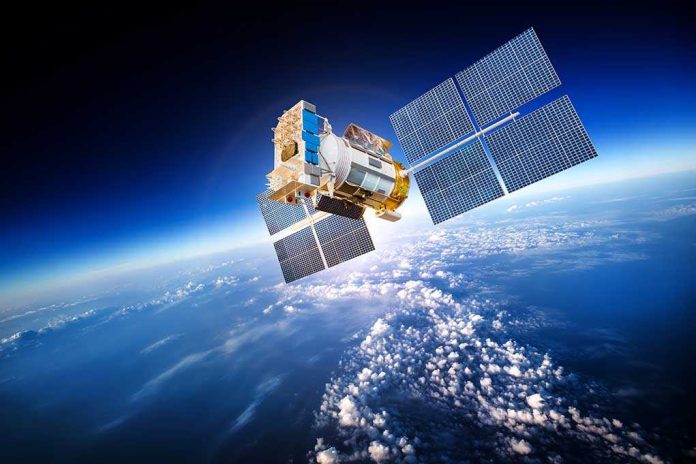
The most advanced satellites on Earth are now quietly rehearsing combat moves overhead, without firing a single shot—yet.
Story Snapshot
- Chinese satellites recently performed synchronized “dogfighting” maneuvers in low Earth orbit that U.S. officials say look like space combat practice.
- Commercial space tracking—not spies—first documented the satellite ballet, proving anyone with the right tools can now watch great‑power space tactics.
- U.S. and Chinese satellites already shadow, flank, and counter‑maneuver each other in orbit, raising the risk of a future crisis starting 300 miles up.
- What looks like harmless “rendezvous and inspection” on paper could become the opening move in a space war that knocks out GPS, communications, and modern life as you know it.
Dogfighting Without Bullets: What China Just Practiced In Orbit
General Michael Guetlein did not reach for diplomatic language when he briefed Washington insiders this spring; he called what China did in orbit “dogfighting.” He was talking about a 2024 exercise where three Shiyan‑24C satellites and two Shijian‑6 05 spacecraft in low Earth orbit slipped in, out, and around one another in tight formation, under obvious control, executing what the Space Force classifies as rendezvous and proximity operations that look a lot like practice runs for satellite‑on‑satellite action.[1][3][4]
Those Chinese spacecraft never fired a weapon or rammed a target, but that misses the point. The capability on display was timing, geometry, and discipline: five independent space vehicles coordinating maneuvers like a formation of fighters. U.S. officials say those same skills could let a Chinese satellite sidle up to a critical American asset—an early‑warning sensor, a communications hub, or a key navigation node—and then blind it, jam it, grab it, or simply threaten to nudge it off course during a crisis.[1][3][4]
From “Peaceful Use” To A Real-Time Orbital Chess Match
The Outer Space Treaty of 1967 banned nuclear weapons overhead and wrapped space in the language of “peaceful purposes,” but it never barred militaries from orbit or from building conventional means to target each other’s satellites.[2] The Cold War stayed mostly symbolic in space, with a few crude anti‑satellite tests; what is happening now is different. China, Russia, and the United States have invested for two decades in co‑orbital satellites, robotic inspectors, and proximity techniques designed to look benign on paper while giving commanders a hand directly on the opponent’s eyes and ears.[3][4]
The 2024 Shiyan‑Shijian maneuvers did not come out of nowhere. Chinese satellites have been edging closer to more complex behavior since at least 2013, with earlier Shijian and Shiyan missions testing inspection and approach profiles.[4] By 2022, the interaction flipped: when a maneuverable U.S. GSSAP satellite, US‑270, approached China’s Shiyan‑12 pair in geostationary orbit, Chinese operators detected the move, processed the threat, decided on a response, and executed their own counter‑maneuvers within roughly a day, effectively shadowboxing a U.S. system in real time instead of acting as a passive target.[5]
Why This Matters To You Long Before The Shooting Starts
Americans tend to think of space as a backdrop—launches on the evening news, pretty images from telescopes—not as contested ground their retirement accounts, airline schedules, or 911 calls depend on. Yet GPS timing underpins banking; satellites guide container ships and airliners; communications birds feed military and civilian networks alike.[2] If a future Taiwan crisis sees Chinese satellites stalking U.S. systems that provide targeting and missile warning, the temptation to preempt or to misinterpret a close approach as an attack could escalate fast, long before any missile crosses a coastline.[4]
American conservative instincts—peace through strength, clarity over wishful thinking, and deterrence over paralysis—line up cleanly with how this problem should be viewed. Chinese planners frame their actions as defensive, aimed at deterring U.S. intervention in regional conflicts.[4] Yet rehearsing the ability to disable another nation’s satellites looks less like arms control and more like coercive leverage. When one side can threaten to flip the switch on space services that modern economies require, it holds a strategic choke point that demands a serious, well‑funded response.
The New High Ground: Budgets, Doctrine, And A Crowded Sky
Guetlein used the dogfighting example for a reason: to argue that the U.S. lead in space is shrinking, and could actually reverse if Washington does not adapt.[1][3] The Space Force now talks openly about “space superiority,” not as a vanity project but as a shield for the joint force below.[1][2][3] That shield will not be a single exquisite satellite but proliferated constellations, maneuverable platforms, better commercial and military tracking, and, unavoidably, on‑orbit capabilities tailored to protect or, if necessary, disable.
Commercial players are no longer spectators. The very dogfighting drill Guetlein described was first characterized through commercial space‑situational awareness data, not a classified briefing binder.[1][3] Private firms now sell the orbital equivalent of traffic cameras, watching every suspicious lane change. That transparency cuts both ways: it lets democracies expose irresponsible behavior, but it also normalizes a world where cat‑and‑mouse encounters, “bodyguard” satellites, and dual‑use servicing vehicles become an accepted cost of operating above 300 miles, even as each new close pass nudges crisis stability in the wrong direction.[4][5]
Sources:
Defense News – China demonstrated ‘satellite dogfighting,’ Space Force general says
Satnews – US on High Alert: China’s Satellites Display Unprecedented Combat Maneuvers in Space
DefenseScoop – China practicing on-orbit ‘dogfighting’ tactics with space assets
Kratos – Dogfighting in Space: The Future of Maneuver Warfare
Space.com – Are we already witnessing space warfare in action?