
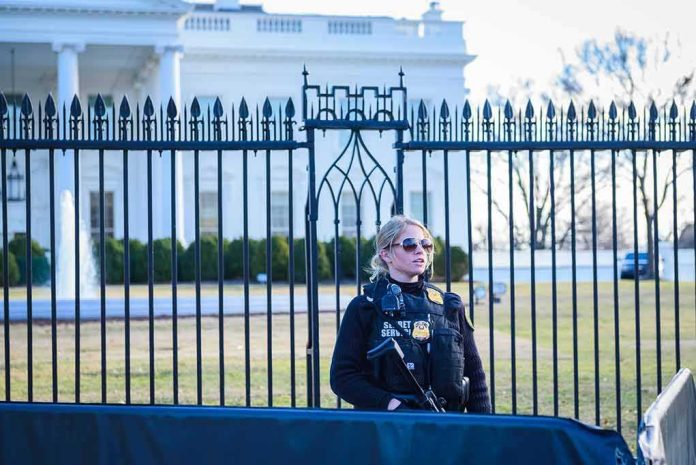
Three U.S. Secret Service communications officials, including the communications chief, were escorted from headquarters and stripped of clearances as an investigation into potential misconduct tied to sensitive presidential security details moved into high gear.
Story Snapshot
- Three Secret Service communications staffers placed on leave and barred from headquarters.
- Agency cites “potential misconduct” under internal review by its professional responsibility office.
- Reporting links the probe to sensitive details about President Trump’s secret Turkey-to-Britain plane swap.
- At least one account says the Federal Bureau of Investigation and Central Intelligence Agency are involved.
What Happened And Why It Matters
Secret Service leadership removed three non-law-enforcement employees from duty and suspended their clearances. Multiple outlets identified one as Chief of Communications Anthony Guglielmi, the agency’s top spokesperson. The Secret Service confirmed the trio is on administrative leave during an Office of Professional Responsibility inquiry into potential misconduct. Coverage described them as “do not admit,” a status that blocks entry to headquarters while the review proceeds. Such steps signal a serious information-security issue, not a routine coaching moment.
The reported focus links to the most sensitive story in presidential protection this year. President Trump quietly switched planes in Turkey and flew on a different military aircraft while Air Force One acted as a decoy, after warnings about an Iranian plot. Trump later said the Secret Service and the military wanted him on a different plane due to a threat. Moving a president by deception is rare. Details of that operation, if exposed in real time, could endanger lives and reveal defensive playbooks.
The Reported Scope Of The Investigation
One account said both the Federal Bureau of Investigation (FBI) and Central Intelligence Agency (CIA) are involved, an unusual signal for a standard administrative matter. Interagency participation implies potential criminal exposure or counterintelligence equities. Another thread connects the case to earlier reporting that intelligence officials had doubts about the specific Iran threat even as the Secret Service raised its guard. That mix—sensitive methods, debated threat streams, and a high-profile protectee—makes any disclosure more serious.
The Secret Service’s on-record language stays narrow: potential misconduct under internal review, with no charge announced. That phrasing matches how national-security cases often begin. Agencies first lock down access, pull clearances, and isolate systems. Then they trace who handled what, when, and how. If facts cross into criminal territory, agents refer the case to prosecutors. If not, they finish with discipline, training, or policy fixes. That is standard tradecraft, not theater.
What The Plane Swap Revealed About Risk
The Washington Post detailed the covert Turkey-to-Britain flight, including how the decoy plan worked and why it was used. Reuters matched core elements and highlighted the catering-truck boarding tactic that masked Trump’s movement on the ground. Those specifics matter. They expose adversaries to the idea that decoys and deception are options. They also hint at timing, routes, and communications patterns that foreign services study for gaps. Sharing that kind of detail during an active trip would be reckless by any professional standard.
American conservative values place a premium on order, accountability, and duty. Protecting a president sits at the top of that list. If insiders shared restricted movements or methods, that would betray colleagues and put the commander in chief at risk. If, on the other hand, the review shows sloppiness without malice, clear rules and measured penalties still protect future missions. The common-sense north star is simple: safeguard the protectee first, then sort out disputes under the law.
How This Fits A Wider Pattern
Leak probes often start exactly like this one: fast removal, clearance actions, and tight lips. During a 2025 Pentagon leak inquiry, leaders put additional officials on leave as the investigation grew. That pattern shows a bias for caution when classified channels may be at risk. The Secret Service has also faced past discipline waves after internal data misuse, which left scars and stricter oversight for how employees handle sensitive files. Today’s posture reflects those lessons.
A brief caveat belongs here. Public reports have not named a charge or produced an affidavit. The agency’s statement frames this as a professional-responsibility matter for now. That said, the coordination reports, the high-value target, and the real-world tactics at issue justify strong, immediate controls. The country expects the Service to move first to secure the mission, then speak when facts are set. That order protects both the president and due process.
Sources:
thegatewaypundit.com, yahoo.com, washingtonpost.com, nytimes.com, democracynow.org, bbc.com, aa.com.tr, oig.dhs.gov