

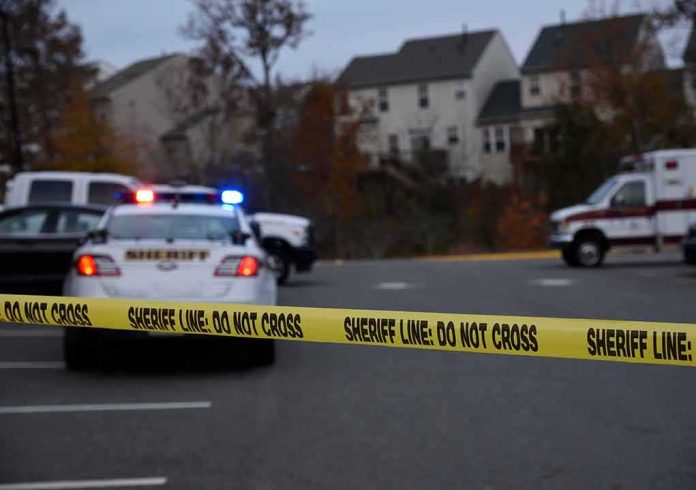
A quiet desert warrant turned into yet another California ambush, leaving one detective wounded and one suspect dead as the war on law enforcement quietly grinds on.
Story Snapshot
- A San Bernardino County sheriff’s detective was shot during an investigation in the Antelope Valley desert.
- The gunfire erupted around 3:15 p.m. near Avenue R and 130th Street East, east of Palmdale.
- The wounded detective was airlifted to a Lancaster hospital and listed in stable condition.
- The suspected shooter died at the scene, and Los Angeles County homicide detectives took over the case.
Detective shot in a remote warrant operation
On a hot August afternoon, a San Bernardino County sheriff’s detective rolled up to a remote property in the Antelope Valley and found gunfire instead of answers. The detective was part of a team working an investigation near Littlerock, a rural area east of Palmdale dotted with old buildings, trailers, and desert scrub. Deputies were serving a search warrant tied to that investigation when shots broke out, turning a planned operation into a fight for survival.
The shooting happened a little after 3 p.m. in the 13000 block of East Avenue R near 130th Street East, far from busy streets and quick help. Reporters at the scene described sunbaked dirt, scattered structures, and law enforcement units stretched out across the landscape. This was not a random drive-by on a city corner. It was a focused operation that suddenly met violent resistance, which is exactly what many deputies fear when they knock on a door in the middle of nowhere.
Gunfire, a wounded detective, and a dead suspect
During the warrant service, at least one suspect opened fire and struck the detective near the lower rib area, according to briefing details later shared with media. Fellow deputies and medics moved fast. They had the detective airlifted by helicopter to Antelope Valley Hospital in Lancaster, where doctors worked to stabilize him. Officials reported the detective in stable condition, which means he survived the initial trauma but still faces a long road back.
The suspected shooter did not leave the scene alive. Authorities stated that the suspect was pronounced dead on site, though they have not publicly detailed whether the fatal shot came from deputies, was self-inflicted, or happened in some other way. That missing detail matters for legal review but not for the basic reality: when the dust settled, one detective lay wounded and the person believed to have attacked him was dead in the dirt.
Multiple agencies, one fragile public trust
The Los Angeles County Sheriff’s Department homicide bureau stepped in as the primary investigative agency, even though the wounded detective works for San Bernardino County. This cross-county setup is common in the Antelope Valley, where jurisdiction lines cut across open desert and different sheriff’s departments often overlap. The arrangement also means information flows through more than one chain of command before it reaches the public.
Reporters noted dozens of Los Angeles County deputies converging on the scene, along with San Bernardino County units, building a large joint response across the sand. That scale sends a message: an attack on one detective is treated as an attack on the badge itself. For many conservative readers, this is exactly how it should work. When law enforcement comes under fire doing court-ordered work, the state has a duty to answer with full force, investigate, and protect the people who stepped up to wear the uniform.
A pattern of ambushes and rising risk for deputies
This latest desert shooting lands in a painful pattern. In Palmdale alone, deputies have already faced outright ambush attacks in recent years. Los Angeles County Deputy Ryan Clinkunbroomer was shot and killed while sitting at a red light in his patrol car outside the Palmdale station, a targeted attack that shook the region. In West Covina, Deputy Samuel Aispuro was shot in the back while riding his motorcycle, another surprise strike with no clear warning.
San Bernardino County sheriff's detective wounded, suspect killed in shooting near Palmdale https://t.co/jCc7sh7xqq
— Antelope Valley Bulletin (@AV_Bulletin) August 6, 2026
Nationally, ambush-style attacks on law enforcement have become a recurring headline, from Compton to the Antelope Valley and beyond. These are not split-second struggles over a traffic ticket. They are attacks on officers simply because they are officers. When a detective serving a lawful warrant in a remote desert gets shot, common sense says the problem is not “too much policing.” The problem is a culture that increasingly treats those who enforce the law as open targets.
Unanswered questions and what accountability should look like
Key facts remain under wraps. Officials have not released the detective’s name, the suspect’s identity, or the warrant documents that explain why this rural property drew law enforcement attention. They have not publicly described the full sequence of shots or confirmed whether any other suspects were detained or escaped. That silence can frustrate locals and fuel rumors, especially in a community already scarred by past deputy shootings and social media drama.
From an accountability standpoint, the path forward is clear. Agencies should release the basic warrant records, the use-of-force review, and a clear timeline once the detective’s safety and the investigation allow it. That transparency respects the public and also protects the majority of deputies who do their jobs under growing danger. It draws a bright line between real misconduct and lawful, necessary self-defense in the field. Without that line, every desert gun battle risks getting dragged into politics instead of hard facts.
Sources:
youtube.com, laist.com, dailynews.com, nbclosangeles.com