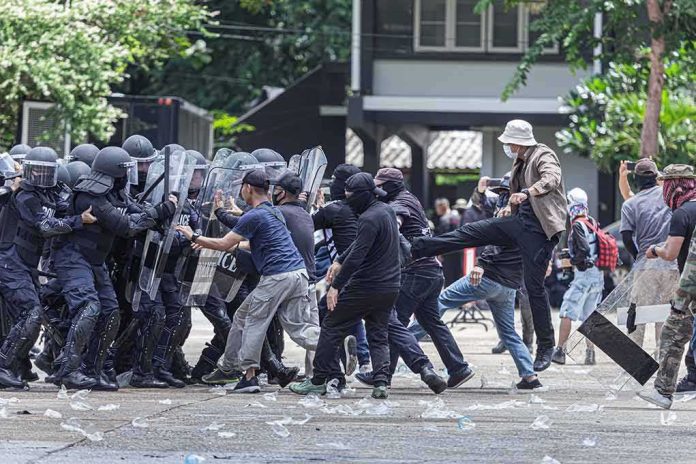
Argentina fans threw stones and bottles at police near Buenos Aires’ famous Obelisk monument after the national team lost the 2026 World Cup final to Spain 1-0 — and what followed was three hours of chaos that left 15 officers injured and 15 fans in handcuffs.
Story Snapshot
- Groups of Argentina fans hurled rocks and glass bottles at police near the Obelisk after the July 19 final loss to Spain
- Police fired rubber bullets, tear gas, and water cannons to break up the crowds
- At least 15 people were arrested and 15 police officers were injured during three hours of unrest
- Argentina’s federal security chief claimed the violence was planned, but released no evidence to back that up
What Happened Near the Obelisk on Final Night
Thousands of Argentina fans gathered near the Obelisk in central Buenos Aires to watch the final. When the final whistle confirmed Spain’s 1-0 win, grief turned ugly fast. Groups began throwing stones and glass bottles at police officers on the scene. Main roads around the Obelisk were shut down as the situation spun out of control. Businesses in the area took damage before police moved in hard.
Police responded with rubber bullets, tear gas, and water cannons to push back the crowds. The three-hour disturbance ended with at least 15 people detained and at least 15 officers hurt. The extent of injuries to fans was not immediately clear, which leaves open the question of whether the level of force used was fully proportional — a question worth asking, even if the fan violence itself is not in dispute.
The ‘Planned Violence’ Claim That Needs More Proof
Federal security chief Sergio Berni told radio listeners that the violence was planned. He pointed to organized fan groups known as barra brava — hardcore supporter crews tied to clubs like Chacarita and Independiente — as the organizers. Barra brava groups are well-documented troublemakers in Argentine soccer. But Berni released no intercepts, no meeting records, and no hard evidence to back his claim. Without that, it reads more like narrative management than confirmed fact.
The claim deserves scrutiny. Argentine authorities have a history of framing post-match violence as organized in order to justify aggressive crowd control. That does not mean Berni is wrong. It means the public should demand the receipts before accepting the framing. Grief-fueled rage and organized provocation can look identical from a distance. Only evidence tells them apart.
This Is Not New — Argentina Has a Pattern
This kind of scene is not a shock to anyone who follows Argentine soccer. After Argentina lost the 2014 World Cup final to Germany, fans clashed with police in Buenos Aires in nearly identical fashion — at least 30 people arrested, several officers injured. The Obelisk has been ground zero for both celebration and destruction for decades. Academic research confirms that violent fan behavior is a systemic problem in Argentine soccer, not a random flare-up.
Argentina fans also drew complaints during the 2026 World Cup tournament itself, with Egyptian and Cape Verdean supporters accusing Argentine fans of violence and racism during group stage matches. The July 19 riot did not come out of nowhere. It came out of a culture where, as one academic study put it, violent acts in the soccer context are “normalized and imbued with positive sociocultural connotations.” That is a serious structural problem that no single police response will fix.
Milei Called Them Heroes. Police Called Them Rioters.
President Javier Milei posted on social media calling the Argentina squad “heroes” despite the defeat. That framing — honoring the team while police were still clearing tear gas from the streets — created an odd political contrast. It does not excuse throwing rocks at officers. But it does reflect the genuine emotional weight Argentines place on their national team. When that emotion cracks, it cracks hard and fast.
The claim that Argentina received systematic “help from the referees” in the 2022 and 2026 FIFA World Cups is a common narrative pushed by rival fans, but it doesn’t hold up as evidence of rigging. Controversial decisions occur in every tournament; Argentina’s successes are… https://t.co/ix3hqN2dAE
— Carl-Johan Melander (@cjmelander) July 20, 2026
The core facts here are not seriously in dispute. Fans threw projectiles. Police responded with force. People got hurt on both sides. What remains unclear is whether the violence was truly organized or purely spontaneous — and whether every level of the police response was warranted. Those questions matter. But they do not change the bottom line: throwing rocks at police officers is wrong, full stop, no matter how bad the loss felt.
Sources:
youtube.com, telegraph.co.uk, bbc.com, instagram.com, vice.com