

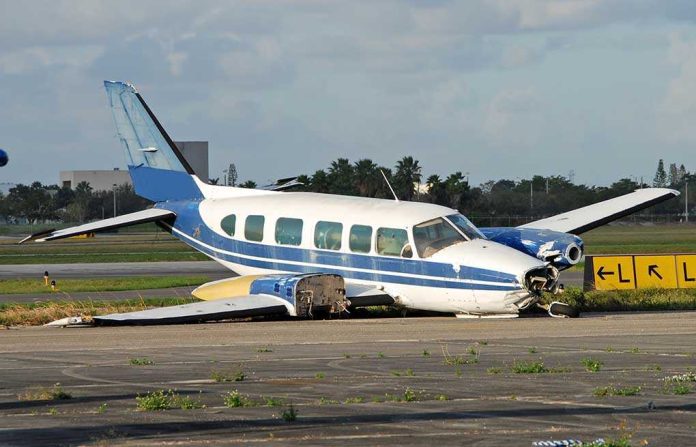
A twin‑engine Beechcraft fell out of the Florida sky and crushed a Toyota Camry on I‑95 at rush hour—yet nobody died, and that “miracle” should change how you think about risk, responsibility, and dumb luck on American highways.
Story Snapshot
- A Beechcraft 55 with engine trouble crash‑landed onto a moving Toyota Camry on I‑95 near Cocoa, Florida.
- The car was crushed, but the 57‑year‑old driver suffered only minor injuries; the pilot and passenger walked away unhurt.
- FAA investigators are probing sudden engine failure and maintenance as possible causes.
- The video‑viral “miracle” survival masks serious questions about liability, training, and highway risk.
When The Sky Literally Falls On Your Commute
The 57‑year‑old driver of a 2023 Toyota Camry was doing what millions of Americans do every weekday: crawling through rush‑hour traffic, southbound on Interstate 95 near Cocoa and Merritt Island. Without warning, a Beechcraft 55 twin‑engine plane with reported engine trouble descended toward the freeway and slammed directly onto her car’s roof, crushing the vehicle and skidding along the asphalt. She survived with minor injuries, while the 27‑year‑old pilot and his 27‑year‑old passenger walked away.
Dashcams and bystander phones caught the impact and its aftermath, and the footage rocketed across social media within hours. Viewers watched the low‑flying aircraft line up with southbound lanes, then abruptly meet the Camry in what looked like a guaranteed fatal impact. Instead of a fireball and multi‑vehicle pileup, first responders found a mangled sedan, a battered airplane, and three people alive and talking. The public called it a miracle, but investigators called the FAA.
Why This Crash Was Rare, Deadly Serious, And Weirdly Hopeful
The Beechcraft 55 is a workhorse of general aviation: fast, capable, and demanding respect when an engine quits. Reports so far describe “sudden engine failure” or “technical difficulties” that left the pilot too low and too far from a runway, forcing a hard choice: put the plane down on a busy interstate or risk losing control over homes, businesses, and more traffic. He chose I‑95, a long, straight strip of concrete that looks like a runway until you account for brake lights, overpasses, and innocent motorists.
Highway landings are not unheard of in American aviation, especially in states like Florida where coastal weather and heavy small‑plane traffic intersect with a web of freeways. Most of those landings end with dented guardrails, shaken pilots, and amazed state troopers. This one stands out because the aircraft landed squarely on a single moving car. No chain‑reaction pileup. No gasoline‑fed fire. No secondary deaths from panicked swerves. From a cold, risk‑analysis perspective that aligns with conservative common sense, it is hard to argue the outcome could have been much better once the engine failed.
The Conservative Question: Who Pays When Luck Runs Out?
The viral narrative celebrates survival and “quick thinking,” but the Camry driver’s reality is uglier: a crushed car, a hospital stay, and the knowledge that her own good driving did nothing to prevent a plane from dropping onto her roof. FAA investigators will dig into maintenance records, pilot decision‑making, and whether any warning signs were missed. If they find corners cut on upkeep, that aligns with a familiar pattern: when people treat regulation as red tape instead of guardrails, innocent bystanders pay the price.
From a conservative perspective, the core questions are responsibility and restitution. The aircraft owner and insurer will face claims not just for the destroyed plane, but for the Camry, the driver’s medical care, and possibly state costs for highway damage and closure. A functioning civil liability system should make the innocent whole without turning every rare accident into a pretext for sweeping new federal controls on general aviation. The facts, not the virality of the video, should drive any policy response.
What This Means For Everyday Drivers, Pilots, And Policy
For motorists, the lesson is uncomfortable but simple: some risks cannot be abolished, only managed. You can obey every traffic law and still find a twin‑engine Beechcraft descending into your lane. The good news is that these events remain rare, and this one proved something important: skilled pilots, disciplined emergency responders, and solid vehicle crash standards can turn a would‑be mass casualty into a survivable shock. That balance between individual competence and limited regulation is exactly where American transportation works best.
For pilots and regulators, this crash will likely become a case study. Twin‑engine training already stresses how little time a crew has when one side goes quiet at low altitude. Expect renewed emphasis on when not to use a highway—congested urban stretches with heavy rush‑hour traffic—and on pre‑flight maintenance rigor. For policymakers, the smart move is not blanket crackdowns, but targeted fixes: enforce existing maintenance rules, improve emergency coordination between aviation and highway agencies, and let liability law do its job. The sky fell on I‑95, and because people did their jobs, three Americans went home alive.
Sources:
Video shows moment plane lands on car on highway during rush hour
Plane lands on Interstate 95 in Brevard County, crashes into vehicles: Officials