

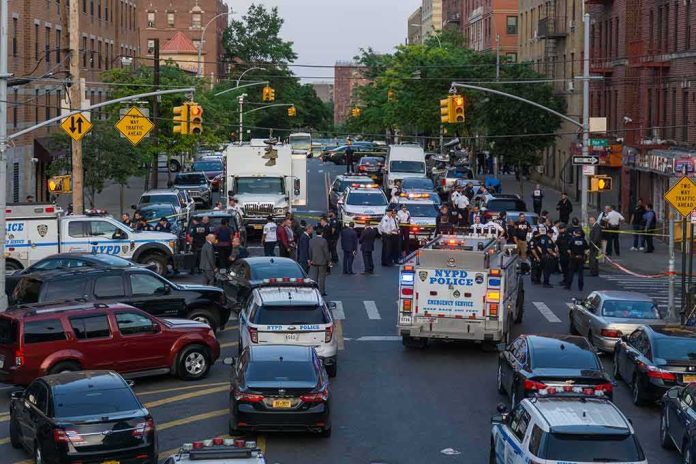
New York City just scrapped the police unit built for fast protest response and terror scares—and replaced it with civilians and a 30-cop speech-rights team.
Story Snapshot
- The city disbanded the NYPD Strategic Response Group and reassigned about 500 officers.
- Counterterrorism duties shift to the Intelligence and Counterterrorism Bureau.
- A new civilian division will lead protest response without weapons or arrest powers.
- Police union leaders warn the change invites danger when crowds turn violent.
What City Hall Changed, In Plain Terms
Mayor Zohran Mamdani and Police Commissioner Jessica Tisch shut down the New York Police Department’s Strategic Response Group, which handled citywide protests, rapid mobilizations, and some counterterrorism roles. The administration will move counterterrorism tasks, including heavy-weapons coverage for critical sites, to the Intelligence and Counterterrorism Bureau. Officials say the old blend of protest policing and terror response sent the wrong signal and fed conflict at marches. Mamdani promised a cleaner split between free speech events and real threats.
The city will stand up a civilian-led Community Dialogue and De-escalation Division to plan and manage protest response. That unit will not carry weapons and cannot make arrests. It will work with a new First Amendment Support Team of about 30 officers trained in communication and de-escalation, still inside the New York Police Department. Commissioner Tisch said the roughly 500 Strategic Response Group officers will be reassigned, many to counterterrorism posts, while police remain available if a protest turns violent.
Why Supporters Say This Will Lower The Temperature
Mamdani argues that New Yorkers using their First Amendment rights should not face the same posture used for terror risks. He frames the change as a promise kept to separate protest management from counterterrorism. The plan also limits certain aggressive protest tactics, pushing a dialogue-first model. Research on crowd policing shows that early, heavy force can harden group behavior and raise conflict, while communication and graded steps can reduce it. That principle underpins the new approach, even if outcomes will depend on execution.
Supporters add that a visible civilian lead can lower fear in crowds and deter confrontation before it starts. The First Amendment Support Team gives command a focused tool for protest events without bringing the full weight of a tactical unit. The Mayor’s team insists none of this weakens the city’s guard against true threats because counterterrorism missions move intact to specialists and not into a vacuum. Tisch stated she would not compromise New Yorkers’ security, pointing to reassigned Strategic Response Group officers and existing rapid response options.
Why Police Union Leaders Call It A Risk
The Police Benevolent Association, which represents rank-and-file officers, slammed the decision. Union President Patrick Hendry warned that telling cops to wait until a protest turns violent puts officers and the public at greater risk. That claim draws on a hard-earned field lesson: when disorder sparks, seconds matter. Conservative common sense aligns with that concern. Government’s first duty is safety. If the new model delays decisive action, City Hall owns the risk and the blame.
Breaking News
New York's woke mayor Mamdani disbands elite police unit and launches new 'civilian friendly' approach to rowdy protesters
Mayor Zohran Mamdani has disbanded an elite New York City police unit and instead revealed a new 'civilian-led approach' to protesters.… pic.twitter.com/PfrVlNjra0
— News News News (@NewsNew97351204) November 16, 2026
The union also argues the Strategic Response Group gave commanders a flexible, trained surge option for fast-moving situations. Losing that early deterrent could embolden bad actors who hide in otherwise peaceful crowds. That fear is not idle in a city of eight million people. New Yorkers remember when small sparks became street-wide fires. Balancing speech and safety is not theory here; it is a nightly test. The reform will be judged the first time a march sours at speed.
The Real Test: Streets, Not Slogans
City Hall’s case rests on cleaner roles, calmer posture, and better coordination between civilians and the First Amendment Support Team. The Police Benevolent Association’s case rests on speed, deterrence, and the cost of waiting too long. Both contain truth. Evidence supports dialogue-first tactics when crowds are peaceful and police communicate well. But crowds can pivot fast, and then only trained, ready officers can stop harm. New York must hit both notes: talk early, move fast when needed.
What To Watch In The Next 90 Days
Watch the handoff of counterterrorism coverage to the Intelligence and Counterterrorism Bureau, and whether visible security at key sites dips or stays steady. Track how the civilian division and the First Amendment Support Team plan events in advance, share maps, and set clear limits before marches. Note whether commanders keep a rapid, uniformed reserve within minutes, not miles. If the city gets this mix right, the streets could stay calmer. If not, the gap will show up after dark.
Sources:
lifesitenews.com, nbcnewyork.com, cbsnews.com, edition.cnn.com, newsweek.com, newsday.com, washingtonexaminer.com, silive.com