

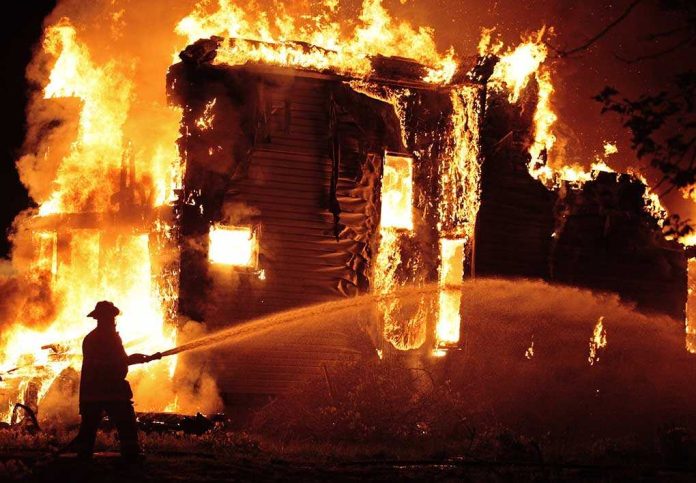
Four people died and dozens fled their homes while much of north Georgia barely noticed that, for a week, the region quietly lived through a slow‑motion fire disaster.
Story Snapshot
- Nearly 500 wildfires erupted across Georgia in a single dry, windy week, many in the north.
- At least four people were killed in cold‑weather residential fires tied to the same conditions.
- Dozens of residents were displaced or evacuated as brush fires crept into neighborhoods.
- Hidden risks from rail sparks, older housing, and dry forests collided with thin local resources.
Cold, Dry, And Suddenly On Fire
North Georgia residents woke up to frost on their windshields, not smoke in the sky, but the ingredients for disaster were already in place: weeks of dryness, low humidity, and gusty winds over a forested region littered with leaves and pine needles.[3] The Georgia Forestry Commission counted nearly 500 wildfires statewide in just one dry week, with many clustered in the mountains and foothills. This was not a single headline blaze; it was a swarm of small fires quietly surrounding everyday life.
Foresters and meteorologists had warned that March would stay high‑risk if real rain did not arrive, and they were right.[3] Leaf‑off season exposed bare, sun‑dried fuels, while years of limited controlled burning left more dead vegetation on the ground. For homeowners, that meant a simple spark from a burn pile, a fallen branch on a line, or a careless ember could jump quickly from yard to woods to porch before volunteers could get a truck in gear.
When Home Becomes The Front Line
The most sobering part of this story is not the forest; it is the front door. In Lumpkin County, an 82‑year‑old woman died when her mobile home near Dahlonega caught fire, traced to unattended cooking during the same wildfire emergency window.[4] State Insurance and Safety Fire Commissioner John King called it Georgia’s 17th fire death of 2025, a number running ahead of recent years by early March. The victim fit a grim pattern: older, rural, in a manufactured home where a small mistake can turn fatal in minutes.
Cold weather pushed families indoors, turning up space heaters and stoves in older houses and trailers that often lack modern wiring and working smoke alarms.[4] While forests burned on TV, the most lethal fires were inside kitchens and living rooms. A devastating Coweta County house fire, part of the same winter pattern, killed six people and injured five more, underlining that Georgia’s fire crisis was as much about housing vulnerability and household habits as wildland flames. Weather set the stage; everyday life supplied the ignition.
Rail Sparks, Rural Roads, And Stretched Crews
Walker County showed how quickly infrastructure can turn a dry corridor into a firing line. Sparks from a passing train ignited combustible debris along roughly a four‑mile stretch of track between Rossville and areas near Chickamauga, spawning multiple brush fires that marched toward homes.[2] Several houses on Chris Lane were evacuated as a precaution, with residents briefly uprooted while flames licked at fence lines and backyards.[2] No one died there, but it was a close‑run test of how prepared a rural county really is.
Local departments, many staffed with a mix of career and volunteer firefighters, quickly hit their limits. Walker County called in mutual aid from 36 different fire agencies across north Georgia and neighboring Hamilton County, Tennessee to keep the fires from overrunning neighborhoods.[2] The Georgia Forestry Commission was already stretched by hundreds of other incidents, deploying bulldozers and crews where terrain and narrow mountain roads made access slow and dangerous.[3] This was a textbook example of why small counties, not Washington, carry the first burden when national headlines are nowhere in sight.
Hidden Disaster, Conservative Lessons
Georgia has seen this movie before. During the 2016 drought, the state recorded over 2,400 wildfires, spent $2.6 million on suppression in a few months, and watched the Rough Ridge fire scorch about 24,765 acres in the Cohutta Wilderness.[1] Yet despite that precedent, the 2025 outbreak still caught many residents treating burn bans and safety advisories as background noise. Personal responsibility and local stewardship, long‑standing conservative values, were too often replaced by “it won’t happen here” until the smoke was at the door.
The uncomfortable truth is that most of these fires began with human hands: cooking left unattended, yard debris burned on the wrong day, rail lines with flammable clutter in the right‑of‑way.[2][4] State and local authorities did their jobs—warning, responding, improvising—but they cannot retrofit older homes with alarms, clear private brush, or police every stove and burn barrel. Aligning with common‑sense priorities means focusing less on flashy federal programs and more on local codes, homeowner education, targeted fuel reduction near communities, and holding infrastructure operators accountable when their sparks light up the countryside.
Sources:
Killed, injured in north Georgia wildfires
1 Dead In Nearly 500 Wildfires During Dry Week In GA
Lumpkin County Fire Death is 17th This Year
Wildfire Today – Georgia coverage