
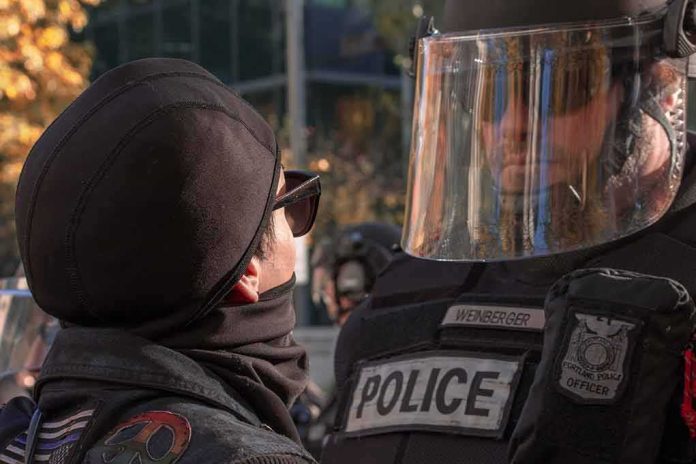
Riot police forcing through a student human chain in Paris turned a school gripe into a national stress test over how France treats its kids and its classrooms.
Story Snapshot
- Students protested overcrowded classes, teacher shortages, and crumbling buildings.
- Blockades and marches spread from Paris to cities including Lyon and Marseille.
- Government leaders acknowledged some demands and promised targeted fixes.
- Hundreds of schools faced closures or heavy disruption during peak days.
Police lines meet student barricades as protests spread
Police in armor pressed against teenage blockades outside high schools around Paris as the protest wave hit a new peak. Students linked arms, dragged trash bins, and slowed traffic near campuses. Images showed officers using shields to push through a human chain at a school in eastern Paris. Lyon, Marseille, and Nantes saw street marches by mid-morning as the movement spread beyond campus gates. Authorities reported arrests after scattered fires and clashes during the worst episodes.
Students named three core grievances again and again: crowded classrooms, missing teachers, and run-down buildings. Reporters on the ground repeated the same list across outlets, and officials did not deny the problem set. The language was blunt—“overcrowding,” “shortages,” “dilapidated.” These are basic conditions any parent understands. When a math teacher is out for weeks or a lab ceiling leaks, teenagers notice. They also vote with their feet, which explains why the protests kept drawing numbers.
Scope of disruption and where it hit hardest
Student unions and officials gave numbers that show a movement with national reach. Reports counted hundreds of closures early on and disruption at more than a thousand schools as the week wore on. The figures varied by day and by definition, but the trend pointed one way: scale. Lessons were suspended in many places, and traffic knotted near choke points. Lyon appeared in dispatches as one of several cities where high schoolers joined street actions beyond campus blockades.
Parents and commuters felt the impact fastest. Buses took detours. Classes stacked substitutes or went dark. Head teachers scrambled to keep order at gates. Police commanders faced a hard balance: keep roads open and protect property while avoiding scenes that inflame teenagers already angry about school conditions. When tear gas drifts past a gym, the headline writes itself—and it can bury the reason the kids walked out in the first place.
What the government conceded and what it did not
Education Minister Édouard Geffray said some student demands are legitimate. Prime Minister Sébastien Lecornu ordered ministers to tackle top complaints, like faster replacement of absent teachers and relief on the length of the school day. These moves admit real stress inside the system. But they also aim to narrow the fight to fixes that can be delivered fast, such as staffing stopgaps and schedule tweaks, while larger building repairs and class-size changes take longer and cost more.
This is the classic pinch in public services: short-term triage against long-term decay. Replacing a missing teacher is urgent. Renovating a wing with bad plumbing is slow and pricey. If the state spends on crowd control before plumbing, teenagers will notice that too. A conservative reading of civic order says both can be true: protect streets, and fix the root problem. The public expects government to walk and chew gum at once—and to publish timelines so families can track progress.
Why Lyon matters in a Paris-centered story
Lyon’s streets and school gates showed this was not only a capital-city drama. National outlets cited Lyon among cities where marches and clashes occurred. That matters because copycat action feeds momentum. When students in different regions echo the same issues—missing teachers, crowded rooms, shabby buildings—it signals a system-wide problem, not a local squabble. Coverage did not list every school by name, but it located Lyon inside the broader wave beyond Paris proper.
French students are continuing nationwide protests over education conditions, with demonstrations reported in several cities and school blockades disrupting classes. In Lyon, police used tear gas as tensions rose during protests, while students in Paris blocked access to several… pic.twitter.com/sVHI0P1gKJ
— Ocean News (@OceanNewsUK) October 6, 2026
The next chapter hinges on trust and speed. If officials fill vacant posts quickly and publish a repair plan with dates and budgets, pressure can ease. If teens keep finding locked doors and empty desks, marches will resume. Order on the street and order in the classroom are not rivals. They rise together. The durable answer starts with a teacher in every room and a building that works. That is not a radical demand. It is the floor of a serious country.
Sources:
san.com, dw.com, yahoo.com, aa.com.tr, nypost.com, english.mathrubhumi.com, indianexpress.com, efe.com