

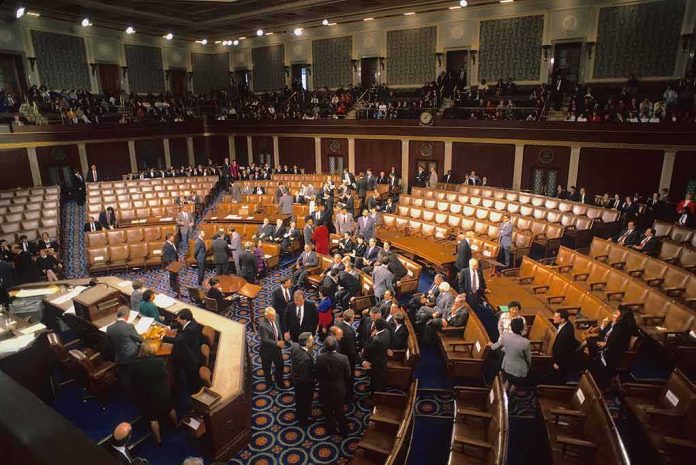
A House rule built to keep Capitol restrooms split by biological sex has turned into the flashpoint for claims that a future Democratic majority would make reversing it their very first move.
Quick Take
- Speaker Mike Johnson’s November 2024 policy reserved single-sex Capitol restrooms, locker rooms, and changing rooms for people matching that biological sex.
- The rule directly affects Rep. Sarah McBride of Delaware, the first openly transgender person elected to Congress.
- McBride said publicly she would follow the rule even though she disagreed with it.
- A commentary outlet now predicts a Democratic-led House would make changing the rule a top priority, though no Democratic leader has confirmed that plan.
A House Rule Built Around Biological Sex
Speaker Johnson laid out the policy in plain terms on November 20, 2024. “All single-sex facilities in the Capitol and House Office Buildings — such as restrooms, changing rooms, and locker rooms — are reserved for individuals of that biological sex,” he said. The statement came shortly after McBride’s election made her the first openly transgender member of Congress, and reporters confirmed it was aimed squarely at her situation.
Johnson also pointed to alternatives already built into the Capitol complex. Every member office has its own private restroom, and unisex facilities exist throughout the building. That detail matters because it shows the rule did not strip anyone of restroom access entirely. It simply drew a line on which shared, single-sex spaces apply to whom, while leaving private options open for every member, including McBride.
McBride’s Compromise And The Resolution Behind It
McBride did not fight the policy publicly. “I’m not here to fight about bathrooms. I’m here to fight for Delawareans and to bring down the costs facing families,” she said. “Like all members, I will follow the rules outlined by Speaker Johnson, even if I disagree with them.” Her statement came the same week Rep. Nancy Mace introduced a resolution widely reported as targeting her access to women’s facilities on federal property.
Mace’s push reflected a broader Republican effort already underway in Congress. She has also led bills like the Protecting Women’s Private Spaces Act, aimed at restricting restroom access on federal property based on sex rather than gender identity. That legislative pattern shows this was not a one-time reaction to McBride’s election, but part of a sustained Republican priority on single-sex facilities.
A Prediction Circulating Online, Not A Confirmed Plan
More recently, a commentary program called “Queer News Tonight” predicted that a newly seated Democratic majority would treat reversing the bathroom rule as a first order of business. That claim spread quickly across conservative social media, framed as proof that Democrats would prioritize symbolism over kitchen-table concerns like costs and jobs.
No House Democratic leader, incoming Speaker, or Rules Committee member has publicly announced a plan, resolution, or scheduled vote to change the restroom policy. The prediction originated from a media commentary source, not from an official Democratic caucus statement, leadership memo, or filed legislation.
What The Polling Actually Shows
Public opinion on this issue is more layered than either side’s talking points suggest. Pew Research found in 2025 that 49 percent of Americans favor requiring transgender people to use restrooms matching their sex at birth, while 26 percent oppose such rules. That is not an overwhelming landslide, but it is a clear plurality favoring the approach Johnson’s policy already reflects.
That gap between a real, implemented House policy and a predicted future reversal is the whole story here. Republicans built a concrete rule around biological sex, McBride complied without a fight, and polling shows meaningful public support for that approach. Whether a future Congress touches it remains a prediction, not a vote on the books, and conservative voters watching this debate have every reason to take the House’s current, functioning policy as the baseline worth defending.
Sources:
twitchy.com, latimes.com, apnews.com, whyy.org, congress.gov