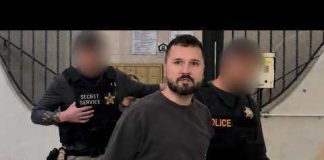

Two masked immigration officers in hoodies tackled a 57‑year‑old traveler at a Las Vegas airport, then walked away and left him half‑handcuffed on the floor as stunned bystanders demanded to know who they were.
Story Snapshot
- Plainclothes immigration officers tackled and handcuffed Phu Nguyen at Harry Reid International Airport
- A growing crowd confronted the officers, who abandoned the arrest and walked off, leaving Nguyen partially restrained
- Police later removed the handcuff and found no criminal warrants, while federal officials blamed “anti‑ICE agitators”
- Nguyen was lawfully arrested the next day at Los Angeles International Airport for overstaying his visa
The attempted arrest that shocked a terminal
On the evening of July 13, Harry Reid International Airport’s Terminal 3 turned from travel hub to makeshift battleground. Two people in hoodies and masks grabbed a gray‑haired man, forced him to the floor, and fought to get handcuffs on him as travelers watched in alarm. Only later did federal officials confirm the pair were Immigration and Customs Enforcement officers targeting Phu Nguyen, a 57‑year‑old Australian citizen born in Vietnam, for overstaying his visa.
Bystanders did not know who the men in hoodies were. In the viral video, voices yell, “Show your badge!” and “What are you doing?” as the struggling man cries out on the ground. The scene did not look like a standard airport police action. No uniforms, no clear markings, and no obvious explanation. That confusion turned into anger, and in moments a crowd formed around the officers, phones out, questioning and filming every move.
ICE walks away while the man stays cuffed
As the crowd grew louder, the operation unraveled. Video and police statements match on one stunning point: the officers left without their target. Witnesses recorded the men in hoodies standing up, breaking off the arrest, and walking away, leaving Nguyen on the floor with a handcuff still locked to one wrist. Las Vegas police say they were called at 6:03 p.m. to a “disturbance” and found an elderly man in the terminal with a cuff on one arm.
Officers with the Las Vegas Metropolitan Police Department removed the handcuff, checked Nguyen, and found no outstanding criminal warrants. Police then notified federal immigration authorities and let him go on his way. Viewed through a common‑sense lens, that detail matters. Local cops did what they always claim to do: restore order, check for actual crimes, and avoid turning a confused scene into something worse. To many law‑and‑order conservatives, this is exactly how local and federal roles are supposed to work.
Federal officials blame a hostile crowd, then finish the job
The Department of Homeland Security later gave its version of why officers walked away. In a statement, the agency said the crowd around the officers included “anti‑ICE agitators” and claimed that agents stopped the arrest “to de‑escalate the situation and for officer safety.” ICE’s Los Angeles office went further on social media, saying Nguyen’s arrest at Las Vegas was disrupted by people trying to help him “evade ICE officers,” but that he would still be caught.
Nevada U.S. Senator Jacky Rosen Demands Answers from TSA Administrator Nominee on Las Vegas Airport ICE Arrest, Says, “ICE’s Violent Attempted Arrest Of An Elderly Man At Harry Reid International Raises A Lot Of Serious Questions”https://t.co/MLSFdsmXLd
— SIERRA SUN TIMES (@SIERRASUNTIMES) July 19, 2026
Federal officials kept that promise. On July 14, immigration officers detained Nguyen when his flight landed at Los Angeles International Airport. DHS says Nguyen entered the United States in May 2013 on a visa that expired in May 2015 and never left. He now sits in immigration custody in California while removal proceedings play out. From a rule‑of‑law perspective, this part is straightforward: a visa overstay is a civil immigration violation, and the government has authority to arrest and deport people in that position.
Plainclothes tactics raise hard questions about trust
While the basic facts are not in dispute, the method has sparked outrage. Video from Las Vegas shows two masked, plainclothes officers tackling an older man in a public terminal, identifying themselves to onlookers only after demands and only with shouted words, not clearly displayed credentials. That tactic fits a broader pattern of more aggressive, less visible immigration enforcement in public spaces, including airports, where nervous travelers already feel watched.
Critics argue that when government officers hide their identity, they erode public trust and invite chaos. If an average American cannot tell the difference between a federal officer and a random thug in a hoodie, enforcement has gone off the rails. Many conservatives who support strong borders still insist on clear badges, uniforms, and visible authority. Order requires not just force, but also clarity about who is allowed to use that force and under what rules.
Safety, sovereignty, and the line between them
This Las Vegas incident forces a tough balance. On one side is a basic truth that resonates on the right: a nation that does not enforce its immigration laws is a nation that gives up control of its borders. Nguyen’s long‑expired visa and pending deportation underline that immigration rules mean little if overstays are ignored. Federal officers did, in the end, arrest him and begin removal proceedings. That is a necessary part of a functioning system.
On the other side is the question of how those arrests happen in front of the public. Tackling a nonviolent visa overstay in a crowded terminal, with no visible uniforms and no clear warrant shown to bystanders, looks reckless to many people, including those who usually support immigration enforcement. DHS saying “officer safety” explains why agents backed off, but it does not fully answer why the scene was allowed to spin out of control in the first place.
Sources:
youtube.com, news3lv.com, thenevadaglobe.com, onemileatatime.com, citizen.com, ice.gov, ajc.com