

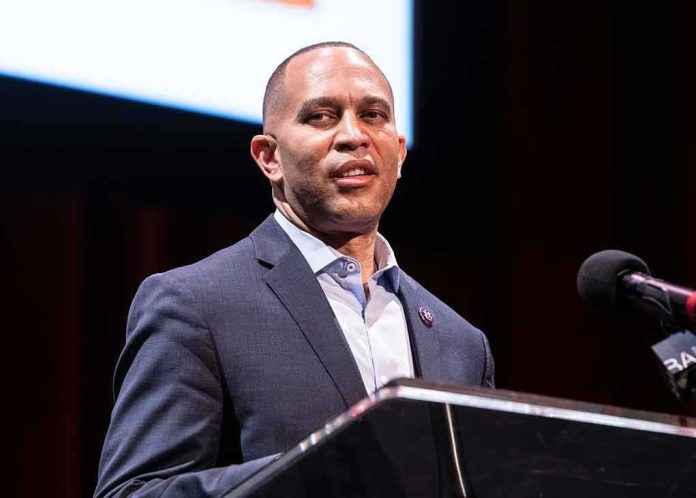
A head nod and two short words from Hakeem Jeffries lit a powder keg over third-country deportations.
Story Snapshot
- Video from Florida shows Jeffries nodding after a question about “bringing back” deportees.
- Jeffries has attacked the policy as extreme and backed blocking more enforcement funds.
- Courts have flagged due-process flaws in third-country removals, raising legal doubts.
- The clip is brief and ambiguous; no Democratic plan orders mass repatriation.
What Jeffries Did And What He Did Not Say
A reporter asked Hakeem Jeffries if Democrats would bring back people sent to third countries like nations in Africa. Jeffries nodded several times and said, “We do.” The clip lasted seconds. It did not show a full answer or a policy plan. The outlet that posted it is partisan, and one repost admits he never said the word “yes” out loud. The gesture set off headlines, but it does not equal a bill or a mandate.
Jeffries has called the program “extreme immigration enforcement” and “inhumane.” He also said enforcement should be fair, just, and humane. Those are common lines in Democratic messaging. They signal a push for hearings, oversight, and limits on funds. They do not, on their face, order flights to bring everyone back. Treat the nod as a tell about priorities, not a signed contract for mass return.
The Legal Crack In Third-Country Removals
Human Rights Watch described courts requiring the Department of Homeland Security to give real notice of transfer and a chance to raise fear of harm. That goes to due process. National Public Radio reported a federal appeals court ruling that said the policy failed that test. The court focused on notice and a chance to be heard. That kind of ruling invites Congress to press for fixes, case reviews, or targeted relief. It does not order a blanket return of all transferees.
Democrats can point to those rulings to justify hearings and spending leverage. They can also argue that people denied fair process deserve another day in court. That claim aligns with American conservative values about due process and clear rules. Government should follow the law before using force. If the rules were skipped, case-by-case remedies make sense. But fairness does not equal a free pass or a mass undo button for every removal.
Money, Oversight, And Political Leverage
Jeffries opposed a Republican package to pour tens of billions more into immigration enforcement at Immigration and Customs Enforcement and Customs and Border Protection. He framed it as reckless budgeting and said Democrats would fight it. The Africa Report quoted Senator Jeanne Shaheen calling the reported $410 million program “costly, wasteful and poorly monitored.” That line of attack builds a case for audits and guardrails before more money goes out the door.
Budgets are where policy meets reality. Pull funding, and flights slow. Add oversight, and procedures change. But no cited Democratic proposal orders the government to fly deportees back. The record shows a funding fight, not a repatriation line item. If Democrats gain power, they could pause expansion, demand reviews, and seek targeted returns for people harmed by bad process. That is a narrower path than the “bring them all back” frame.
The Administration’s Case For Third-Country Removals
Department of Homeland Security General Counsel James Percival says the practice is an essential public-safety tool. He argues it is needed when home countries refuse returns, when going home is unsafe, or when logistics block removal. The administration says the State Department gets diplomatic promises from receiving countries that people will be safe. Officials also say this tool helps remove hard cases, including violent criminals accused of rape and murder.
🇺🇸✈️🌍 Deported to a country he'd never seen, then sent where a judge said he'd be in danger
📰 What happened
Moussa Diawara, 57, is from Mali and lived in the US for 25 years. He has no criminal record. He came to the US at 32 on a tourist visa and overstayed it. He married,… https://t.co/vrrkeTb39Q— Miss Lara B. 🏳️⚧️ (@RealLaraBridge) October 26, 2026
That case has weight with many voters. If a person has a final order and a serious record, the public expects removal. But courts have now pressed the government on the basics: notice and a chance to raise fear of harm. The rule of law demands both safety and process. The right fix is to tighten procedures, publish clearer criteria, and keep this tool for the narrow group it is meant to address. That approach fits common sense and public safety.
What To Watch Next: Policy, Not A Head Nod
Watch for three signals that matter more than a clip. First, a Democratic policy paper that states whether they seek to end new third-country transfers, re-open closed cases, or fund targeted returns for people denied due process. Second, appropriations text that ties dollars to notice, hearings, and reporting to Congress. Third, court orders that define if and when the government must offer return or reprocessing for specific people. Until then, big claims outrun the evidence.
Sources:
thegatewaypundit.com, fatelephant.com, theafricareport.com, npr.org, jeffries.house.gov, abcnews.com, usatoday.com, apnews.com, washingtonpost.com