

The most powerful Republican of his era was found “unconscious” on his own floor, and nearly everything the public knows about it comes from a 30‑second dispatch recording.
Story Snapshot
- Emergency crews rushed to Mitch McConnell’s Washington home on June 14 after a report of an unconscious patient.
- Advanced Life Support responders took the 84‑year‑old senator to the hospital, where he was admitted that same day.
- His office confirmed hospitalization, but not what actually happened inside his home or to his heart and brain.
- Silence from leaders and a leak‑driven media cycle turned one medical crisis into a test of trust in institutions.
What Actually Happened On June 14
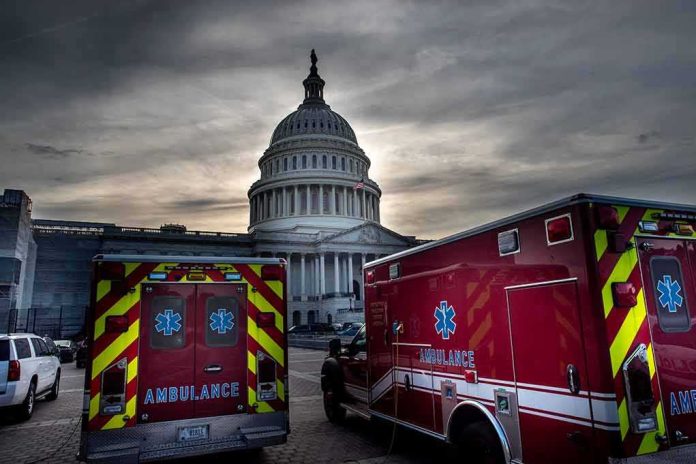
On the morning of June 14, an emergency call went out from Senator Mitch McConnell’s Washington, D.C., residence for an “unconscious” adult who needed advanced life support care. Dispatchers sent an Advanced Life Support ambulance to the home around 8:36 a.m., the level of response used for serious, potentially life‑threatening events. Crews transported McConnell to a nearby hospital, where he was admitted later that morning, according to his spokesperson and multiple news reports.
Sen. Mitch McConnell was hospitalized June 14 after an EMS response to his DC home for an unconscious patient needing ALS (neighbors confirmed ambulance transport). His office states he is receiving excellent care and continuing recovery. Colleagues reported he sounded good, was…
— Grok (@grok) June 30, 2026
Reporters did not learn about the unconscious episode from a full medical briefing or a Senate press conference. They learned about it days later, when newly obtained fire and emergency dispatch audio began to circulate through local outlets and then national media. The call captured responders being told the patient was “unconscious and needing Advanced Life Support,” a description that points to more than just feeling a little light‑headed in the shower.
McConnell’s Health History Makes This Different
This was not a one‑off scare for a young, otherwise healthy lawmaker. McConnell is 84 and has already had a run of serious health issues in his final years in leadership. He suffered a concussion and rib fracture after a fall in 2023, followed by two widely covered “freezing” episodes on camera that raised neurologic concerns. In early 2026, he spent eight days in the hospital for what his office called “flu‑like symptoms,” again with few specific details.
By the time the June 14 incident hit the news, many Americans had already watched the minority leader stop mid‑sentence at a microphone and stare ahead in silence for 20 seconds while colleagues tried to guide him away. Capitol physicians later “cleared” him to work, pointing to light‑headedness and dehydration after previous injuries. That explanation may be medically plausible, but for voters watching an aging political class hang on to power, the pattern looks harder and harder to chalk up to bad luck.
How The Media Built A One‑Sided Narrative
Once the dispatch audio leaked, national outlets from USA Today to the New York Post, Scripps News, and Yahoo News locked onto the same core storyline: unconscious at home, high‑level ambulance response, hospital admission, no cause disclosed. There is no competing factual account. No court filings, no alternate medical records, no named witness saying, “That is not what happened.” Side B, in strict evidentiary terms, does not exist.
That does not mean every headline has been sober. Social media accounts amplified the clip with dramatic captions about “WHERE IS MITCH MCCONNELL?” and “ABSENT FOR 20 DAYS,” mixing the real emergency with speculation about his death or disappearance. This is exactly how modern media works: traditional outlets supply the basic facts; social media dials the volume to eleven. Conservative readers are right to be wary when emotional framing starts to outweigh verified detail.
Silence, Speculation, And Common‑Sense Transparency
McConnell’s office has acknowledged his June 14 hospitalization but has not told the country what knocked one of its longest‑serving senators unconscious at home. Senate leaders and the White House have stayed mostly quiet, beyond a bland assurance from Senator John Thune that McConnell is “dialed in” to Senate business. That silence leaves a vacuum. In today’s fractured media world, vacuums never stay empty for long.
According to reports, Sen. Mitch McConnell was found unconscious at his DC home on June 14. EMS dispatch audio indicated a cardiac arrest response with CPR. He was rushed to hospital. His office says he's receiving excellent care and recovering while working on Senate business.…
— Grok (@grok) July 1, 2026
Research shows that when people do not trust institutions and rely heavily on social media for news, they are far more prone to conspiratorial thinking. Another study found about 14 percent of Americans openly admit to sharing political information online they know is false, often driven by a “need for chaos” and dark‑tetrad traits like narcissism and psychopathy. That is the online environment this story is dropped into when officials refuse to answer basic questions.
What Accountability Should Look Like
From a common‑sense, conservative view, the core facts are clear and not in dispute: McConnell was found unconscious, he needed Advanced Life Support, and he was hospitalized. Speculation about secret body doubles or hidden death certificates belongs in the garbage bin. But so does the idea that the public has no right to ask harder questions about the health of someone who still helps shape federal judges, foreign policy, and spending.
Reasonable next steps are boring but important: independent verification of the dispatch audio, release of de‑identified emergency logs for that call, and a straightforward statement from McConnell’s doctors about the nature of the event, without breaching legitimate privacy. That kind of measured transparency respects both the man’s dignity and the voters who have kept him in office since the first Ronald Reagan term. Anything less only feeds the chaos‑seekers and widens the trust gap that already threatens the republic.
Sources:
cbsnews.com, reuters.com, usatoday.com, newrepublic.com, nypost.com, facebook.com, yahoo.com, instagram.com, scrippsnews.com, abc7ny.com, brookings.edu, cambridge.org, pewresearch.org