
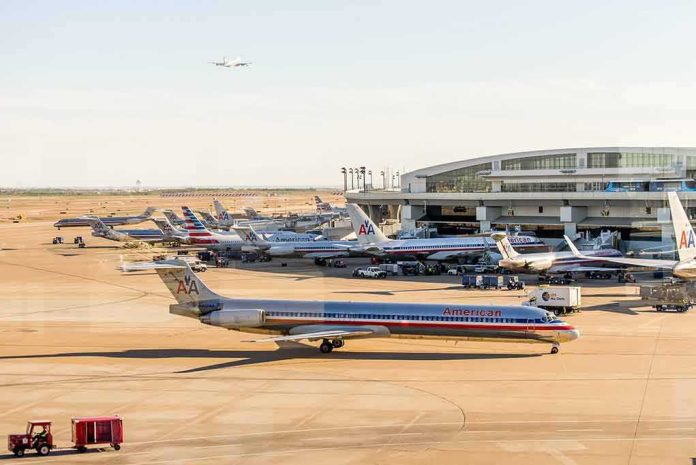
An American Airlines jet screamed toward takeoff speed, then slammed on the brakes because another aircraft rolled onto the same runway.
Story Snapshot
- Air traffic control said a business jet crossed an active runway without clearance [3].
- American Airlines Flight 308 aborted takeoff after spotting the jet on the runway [3].
- The aircraft came within about one-third of a mile, a serious safety threat [1].
- The Federal Aviation Administration opened a formal investigation [1].
How A Clear Takeoff Turned Into A Near Miss
American Airlines Flight 308 lined up at Miami International Airport with takeoff clearance and power set. A business jet rolled onto the same active runway. The airline crew saw it and rejected the takeoff, likely near high speed, which is the hardest point to stop. An air traffic controller told the business jet, “You just crossed an active runway,” and clarified the instruction had been for a cargo flight, Amerijet 461, not the jet that crossed [3]. That sequence squarely placed safety judgment in the cockpit.
Audio posted from the tower frequency captured the core dispute. The business jet pilot insisted he was told to cross. The controller responded that the crossing clearance was for a different aircraft, which means the jet’s crew misheard or stepped on a call sign [3]. American Airlines confirmed the crew aborted after seeing another aircraft on the runway, which matches the audio and the timeline reported by major outlets [3]. Reports said the two planes closed to about one-third of a mile, tight at takeoff speeds [1].
What The Facts Support, And What Is Still Missing
Three hard facts anchor this case. The controller said the business jet crossed an active runway without clearance. The controller also said the crossing instruction was meant for Amerijet 461. The American Airlines crew rejected takeoff after receiving clearance and seeing traffic ahead [3]. The gap is the paperwork. No full Federal Aviation Administration transcript or official report is public yet, so the exact call sign phrasing and timing remain unverified outside media audio and summaries [1]. That limits certainty on the source of the pilot’s misunderstanding.
NetJets confirmed the business jet was not under its direct control at the time. A third-party maintenance provider handled operations, which muddies training standards, call sign usage, and familiarity with local taxi routes [1]. That detail matters because maintenance flights sometimes use different procedures, and crews may be less current on the airport’s complex layout. The Federal Aviation Administration launched a formal probe, which should settle the clearance sequence and identify where human factors failed [1]. Until then, any claim of flawless instruction or blameless piloting is premature.
Why Miami Keeps Testing Runway Discipline
Miami’s airfield is large, busy, and complex. Runways meet taxiways at many points, and crossing movements stack up during banks of arrivals and departures. Research on runway incursions shows airfield geometry and conflict points raise risk. Airports with intersecting runways and intricate taxi paths see more incursions than simpler fields [9]. Miami saw a dozen runway incursions in a recent period, according to Miami-Dade County documents, which puts this event inside a known risk pattern, not a freak outlier [12]. That pattern demands crisp phraseology and slower, cleaner handoffs.
American Airlines plane forced to abort takeoff after another jet veers onto same runway at Miami airport https://t.co/ZGlokPyEjp
— TruthWillCome2.0 (@SandyCee2400) June 29, 2026
Clear communication and strict readbacks protect lives, not bureaucracy. Call signs must be front and center in every instruction, and crews must challenge anything unclear. Conservative common sense backs a simple rule: when in doubt, stop short and ask. The American Airlines crew did that in the hardest moment and kept everyone safe [3]. Regulators should avoid reactionary rules that add noise to the frequency. Instead, double down on unbroken basics: unambiguous call signs, full readbacks, targeted training at complex airports, and smarter geometry fixes where feasible [9][12].
What To Watch As The Investigation Unfolds
Expect the Federal Aviation Administration to release a timeline that lines up transmissions, positions, and speeds. Watch for whether clipped audio, stepped-on calls, or a rushed taxi push caused the mix-up. Look for whether the maintenance operator followed the same radio discipline as frontline carriers. If the record shows the controller tagged Amerijet 461 clearly and the jet still rolled, pilot error will be hard to avoid. If the record shows overlapping or ambiguous calls, training and phraseology will take center stage [3][1]. Either way, the fix should be precise and practical, not punitive theater.
Sources:
[1] Web – American Airlines plane forced to abort takeoff after another jet …
[3] Web – Runway Incursion Forces Aborted Takeoff at Miami – Instagram
[9] Web – Runway Incursion in Miami Forces American Airlines Flight to Abort …
[12] Web – Runway Incursion Forces Aborted Takeoff at Miami – Facebook