
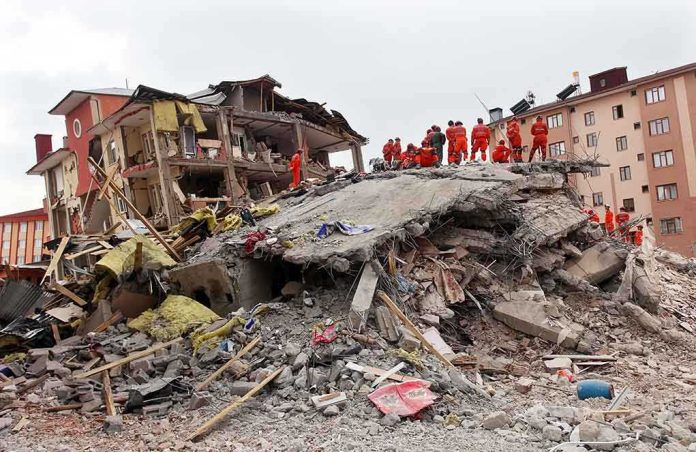
A nameless slab of broken concrete became the cradle of an 18-day-old boy who refused to die.
Story Snapshot
- A mother and her 18-day-old baby survived 32 hours under rubble in La Guaira, Venezuela
- The newborn was lifted out first, reunited with his father, then the mother was freed about 90 minutes later
- The rescue unfolded as twin earthquakes killed over a thousand and left tens of thousands missing
- Conflicting reports about another rescued baby show how chaos warps truth in real time
A family buried alive becomes the face of a shattered nation
The earthquakes that ripped through northern Venezuela did more than knock down buildings; they tore open the quiet, private world of a brand-new family and threw it onto the global stage. Two powerful quakes, measured at 7.2 and 7.5 in magnitude and striking within minutes, turned La Guaira’s apartment blocks into layered tombs of concrete and steel.[9] Somewhere inside one of those ruins, a young mother lay pinned, holding her 18-day-old son against her chest, listening for any sound that meant someone was still out there looking.
Reports from outlets that bothered to look closely say her name is Dayana Patiño and her baby is Juan David.[2][7] Their building, an eight-story block in the Playa Grande area of Catia La Mar, folded on top of them after the ground convulsed.[2] For more than 32 hours, Dayana could not move enough to even feed her child.[2] Volunteers first caught the faint thread of hope: her voice and the baby’s cry rising from the debris while official teams still fought their way through smashed streets and twisted rebar.[2]
Thirty-two hours in the dark, then a newborn is carried into the light
Rescuers reached them late, around 1 a.m. Friday, working by floodlight and instinct.[2] Juan David came out first, close to 11 p.m. Thursday according to detailed accounts.[2] Another set of reports describes an emotional sequence many viewers have now watched on loop: a tiny bundle pulled from the rubble, passed carefully between rescuers, wrapped in a quilt, and then handed to a stunned father who clutches his son as bystanders burst into applause.[3][6][8] Ninety minutes later, crews freed Dayana herself, bruised but miraculously without broken bones.[2]
Doctors who examined both mother and child confirmed the obvious miracle: no fractures, no life-threatening injuries, only dehydration and exhaustion.[2] A Guardian News clip captures them moments after rescue, still in shock, surrounded by dust and chaos, yet very much alive.[5] In a disaster where the death toll has climbed into four figures and thousands remain missing, this one family’s intact survival stands out like a flare in a long, dark night.[4][9]
Hope against a backdrop of staggering loss and weak institutions
The double earthquake ranks among the deadliest natural disasters Venezuela has seen in decades, with reported deaths surpassing 1,400 and tens of thousands of people listed as missing as search teams work against time.[1][4][9] That scale matters because it explains both the urgency and the confusion. When entire neighborhoods crumble, formal systems rarely keep up. Rescue logs lag, hospital records fragment, and officials focus on body counts instead of name-by-name survivor lists. That vacuum leaves emotional stories like Dayana and Juan David’s to spread mainly through video and social media.[3][6][8]
Channels from India to China picked up the footage and labeled it a “miracle amid devastation,” highlighting how an 18-day-old newborn was reunited with his father before his mother was finally pulled free.[3][6][8] Christian news sites framed the survival as an answer to prayer, quoting rescuers who said, “She fought to keep her baby safe.”[2][7] For ordinary people watching from their phones in Mumbai, Miami, or Madrid, the details that matter are simple: the baby is alive, the parents are alive, and courage still counts for something in a broken world.
When two miracles blur into one and facts start to drift
The story does not live in a clean bubble, though. Other outlets have pushed a separate rescue: a mother and a nine-month-old baby pulled from rubble by United States search teams, also in Venezuela and also caught on video.[1][8] That second event has led some platforms and commentators to mix the two, raising doubts about whether Juan David was really 18 days old or if the newborn story somehow grew out of the older infant rescue. That confusion fits a pattern seen in many disasters, where similar scenes merge into one “big” miracle for clicks.[15]
A newborn baby has been rescued alive from the rubble 32 hours after twin earthquakes struck Venezuela’s La Guaira region.
The baby’s survival is being described as a miracle amid the massive destruction caused by the disaster.
According to reports, nearly 1,000 people have… pic.twitter.com/nFpmagUNuZ
— The MES Times (@themestimes) June 29, 2026
Here is where common sense should guide cautious trust. On one side, mainstream clips about the nine-month-old mention United States teams and clearly state the baby’s age but do not match the 32-hour timeline or the Playa Grande location.[1][8] On the other side, multiple independent reports name Dayana Patiño and Juan David, describe a collapsed eight-story building in La Guaira, and repeat the 18-day age with consistent details, including the order and timing of each rescue.[2][5][7][8] The existence of two rescues does not cancel either one; it only demands cleaner sorting of facts.
What this rescue tells us about truth, toughness, and priorities
The hard question for anyone who values accuracy and basic fairness is this: do we let media sloppiness erase a real mother and baby simply because their story is emotional and messy, or do we insist on better documentation while still honoring their fight to live? For people who lean on conservative values, the answer should be straightforward. You protect families. You tell the truth. You do not downgrade a miracle just because journalists struggle to keep their files straight in the middle of a catastrophe.
This rescue also exposes a deeper problem. When governments fail to provide transparent, timely records, they invite rumor and narrative games.[16][17] In Venezuela, officials have shared death numbers but not robust, verifiable survivor lists. That silence makes individual rescues feel “anecdotal,” even when there is video, eyewitnesses, and medical confirmation. The fix is not to stop telling these stories; the fix is to demand better logs, honest reporting, and clear lines between one rescue and another so that a newborn’s first battle is remembered as it happened, not as an internet mash-up.
Sources:
[1] YouTube – Mother and 18-day-old baby rescued from rubble 32 hours after …
[2] Web – Videos show U.S. rescue team pull mother, 9-month-old baby from …
[3] Web – An 18-day-old baby was rescued from the rubble of a building … – …
[4] YouTube – Watch the moment 18-day-old baby rescued from rubble in Venezuela
[5] Web – Baby pulled alive from rubble after Venezuela earthquakes
[6] Web – A newborn baby and the child’s mother were rescued alive from …
[7] Web – An 18-day-old baby was rescued from the rubble of a building … – …
[8] Web – An 18-day-old baby was rescued from the rubble of a building … – …
[9] Web – US search and rescue teams working alongside local firefighters pulled …
[15] Web – An 18-day-old baby was rescued from the rubble of a building … – …
[16] Web – Newborn Baby Rescued From Rubble Of Venezuela Earthquake
[17] Web – Social-Geographical Patterns of Rescue Requests During Hurricane …