

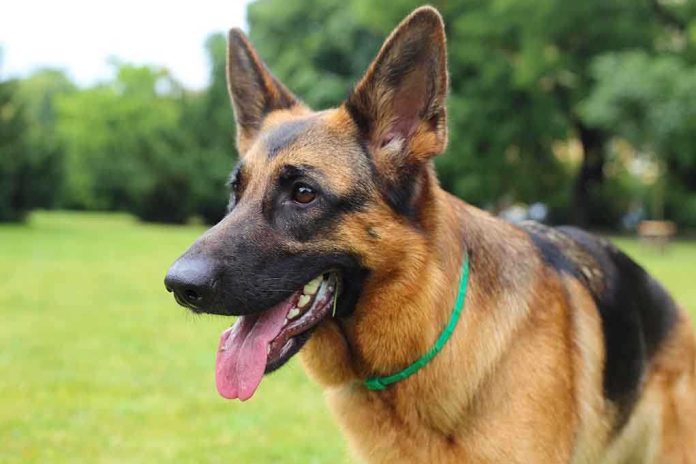
A dog’s nose detected what medical imaging missed, and one woman’s early cancer diagnosis proves that man’s best friend might be medicine’s next breakthrough.
Quick Take
- Dogs detect cancer through volatile organic compounds in breath and urine with accuracy rates between 78% and 97.6% in clinical trials
- Miss Witcher’s dog alerted her to undiagnosed breast cancer before conventional screening, prompting oncologists to credit the animal with saving her life
- Multiple cancer types including lung, breast, colorectal, melanoma, and ovarian cancers have been successfully identified by trained dogs
- Researchers are developing machine-based alternatives to replicate canine olfactory capabilities for point-of-care diagnostic testing
- The field remains in development stages, requiring standardization protocols and larger multi-center trials before clinical implementation
The Canine Advantage: A Million Times Better
Dogs possess an olfactory advantage humans cannot match. Their sense of smell reaches up to a million times better than ours, depending on breed. This extraordinary capability extends beyond detecting dropped food or identifying familiar people. Cancer patients’ bodies release specific volatile organic compounds that dogs recognize instantly but remain completely invisible to human noses. These compounds appear in breath and urine samples, serving as biological signatures of disease before conventional medical tests reveal anything amiss.
The science supporting canine cancer detection has moved beyond anecdotal evidence. A double-blind clinical trial demonstrated that dogs correctly identified 40 of 41 cancer samples when analyzing combined breath and urine samples, achieving a 97.6% detection rate. Breath samples alone yielded a 78% accuracy rate, while urine samples alone reached 87.8%. These numbers challenge the performance of some conventional screening methods and underscore why researchers across major institutions now take this capability seriously.
Miss Witcher’s Story: When a Pet Becomes a Physician
Miss Witcher’s experience illustrates the life-or-death implications of canine detection. Her dog’s behavioral changes alerted her to investigate her health despite no obvious symptoms. Medical examination revealed a large breast cancer that might have progressed undetected for months or years. Dr. Sheryl Gabram-Mendola, a breast surgical oncologist at Emory University’s Winship Cancer Institute, stated unequivocally: “I absolutely believe that the dog saved Miss Witcher’s life.” This wasn’t speculation from a grateful patient—it came from a credentialed physician who understood the cancer’s size and the window of early intervention her dog’s alert had provided.
Her case sparked broader investigation into what makes dogs so effective at detection. Researchers discovered that dogs could identify multiple cancer types: lung cancer through breath and urine samples, breast cancer from breath alone, and colorectal cancer with sensitivity matching or exceeding colonoscopy results. A terrier named Kiko had even preceded this systematic research by alerting his owner to undiagnosed type 2 diabetes through aggressive behavior, demonstrating that canine detection extends beyond cancer to other metabolic diseases.
From Laboratory Success to Clinical Reality
UC Davis researchers maintain cautious optimism about translating laboratory results into practice. Their studies show dogs represent “a safe, noninvasive method for detecting cancer before it is too late.” Yet significant work remains. Researchers acknowledge that “to translate this approach into practice further target compounds need to be identified.” Different studies employ varying methodologies and training protocols, making direct comparison challenging and highlighting the need for standardized approaches.
Dr. Gabram-Mendola’s team has already begun bridging the gap between canine capability and technological replication. They developed a breath analysis test examining more than 300 molecules, achieving over 75% accuracy in predicting breast cancer presence. The vision extends to point-of-care testing: patients could visit a physician’s office, exhale into a device, and receive results through a direct read system. This represents the practical endpoint where canine olfactory science becomes accessible healthcare.
The implications stretch across healthcare systems. Early-stage cancer detection typically offers significantly better prognosis and treatment outcomes than advanced-stage diagnosis. Non-invasive breath-based screening could reduce barriers to cancer detection in resource-limited settings where expensive imaging remains inaccessible. Commercial ventures and technological developers are already working to replicate canine olfactory capabilities through artificial intelligence and chemical analysis systems.
The Remaining Questions
Despite promising results, the field faces legitimate scientific questions. Breath sample detection at 78% accuracy trails combined breath and urine detection at 97.6%, suggesting different compounds signal cancer through different biological pathways. Saliva samples show lower sensitivity than breath samples for lung cancer detection. Published studies report sensitivity ranges from 78% to 99% depending on methodology and cancer type, indicating that standardization remains elusive. The scientific community recognizes both the genuine promise and the need for larger, multi-center trials establishing consistent performance benchmarks before widespread clinical adoption.
Sources:
Peer-reviewed clinical trial on canine detection of volatile organic compounds in cancer patients
ABC News report on Miss Witcher’s case and Dr. Sheryl Gabram-Mendola’s research at Emory University
Research comparing breath versus saliva samples for canine cancer detection
Owlstone Medical documentation of canine scent detection research findings
University of California research on training dogs for cancer detection protocols
Report on startups developing artificial intelligence alternatives to canine detection
University of Wisconsin veterinary research on canine cancer detection capabilities