

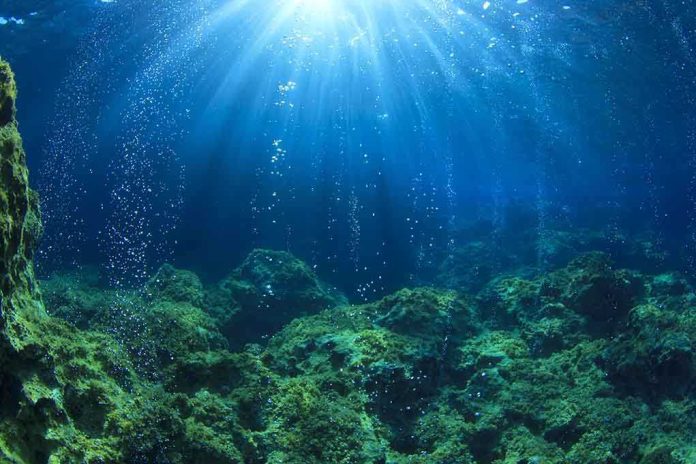
A Soviet nuclear submarine lying 5,500 feet beneath the Norwegian Sea continues leaking radioactive material at levels 800,000 times above normal, exposing decades of governmental neglect and raising questions about who pays the price for Cold War relics while ordinary citizens are left in the dark.
Story Snapshot
- K-278 Komsomolets sunk in 1989 releasing cesium-137 at 800,000 times normal levels and strontium-90 at 400,000 times normal near the wreck site
- Russian sealant applied in 1995-1996 with 20-30 year lifespan now failing, allowing reactor fuel corrosion to continue unchecked
- Norway bears monitoring costs in the millions while Russia selectively cooperates, highlighting unequal burden-sharing for Soviet-era disasters
- Nuclear torpedoes remain sealed for now, but experts warn of potential catastrophic release if containment degrades further
Cold War Legacy Haunts Arctic Waters
The Soviet submarine K-278 Komsomolets caught fire on April 7, 1989, during operations in the Norwegian Sea near Bear Island, Svalbard. The titanium-hulled prototype, commissioned in 1983 as a high-speed deep-diving vessel powered by a liquid metal-cooled reactor, surfaced briefly before sinking stern-first to 5,510 feet. The disaster claimed 42 of 69 crew members. The wreck now sits in permanent darkness where strong currents theoretically aid dilution, yet radiation persists at alarming concentrations decades later, raising concerns about environmental damage and government accountability.
Explosive Radiation Readings Detected at Wreck Site
Recent remotely operated vehicle surveys conducted between 2023 and 2026 confirmed sporadic leaks from the reactor’s ventilation pipe and hull fractures. A 2019 joint Norwegian-Russian expedition measured cesium-137 at 792 becquerels per liter directly in plumes emanating from the wreck—800,000 times the Norwegian Sea baseline. Strontium-90 registered at 400,000 times normal levels. The reactor fuel actively corrodes as seawater penetrates compromised compartments, releasing uranium and plutonium isotopes. While scientists emphasize rapid dilution within meters of the wreck, the sheer magnitude of contamination underscores the failure of 1990s mitigation efforts to permanently address the threat.
Government Patchwork Solutions Prove Inadequate
Russian expeditions in 1995 and 1996 sealed hull fractures and the torpedo compartment with a jelly-like sealant designed to last 20 to 30 years. That timeline expired between 2015 and 2026, yet no follow-up remediation has occurred. Norwegian authorities have shouldered annual monitoring costs since the 1990s, conducting surveys that reveal intermittent cesium leakage without Russian financial contribution. The imbalance reflects a broader pattern where Moscow manages Cold War liabilities selectively, leaving neighboring nations to bear environmental and economic burdens. Geopolitical tensions following the Ukraine conflict further limit cooperative access, leaving the wreck’s future status uncertain and taxpayers footing the bill.
Nuclear Torpedoes Remain Ticking Time Bombs
The submarine carried two nuclear-tipped torpedoes at the time of sinking. A 1994 expedition detected plutonium leakage from one torpedo, prompting the 1995-1996 sealing operations. Recent analysis by Justin Gwynn, senior scientist at Norway’s Radiation and Nuclear Safety Authority, confirmed the seals currently hold, preventing plutonium release. However, ongoing corrosion raises the specter of eventual seal failure. Unlike the reactor leaks, which dilute rapidly, a plutonium breach could introduce long-lived isotopes into Arctic fisheries, threatening Norwegian and Svalbard cod and haddock stocks. The torpedoes represent a catastrophic risk authorities acknowledge but seem powerless to eliminate, illustrating government inaction on critical safety hazards.
Broader Implications for Arctic Security and Trust
K-278 Komsomolets is one of approximately 12 Soviet submarines scuttled or sunk in Arctic waters, contributing to baseline radiation alongside 1960s-era nuclear tests at Novaya Zemlya and reprocessing plant discharges from facilities like Sellafield. The Komsomolets case underscores challenges in decommissioning nuclear submarines, with implications for International Atomic Energy Agency guidelines on deep-sea wrecks. Monitoring expenses drain Norwegian budgets while Russia retains salvage control, fueling Arctic militarization debates amid NATO-Russia standoffs. For citizens across the political spectrum frustrated by elites prioritizing geopolitical posturing over practical problem-solving, the wreck symbolizes governmental failure to address legacy threats transparently and equitably.
Marine biota near the wreck, including sponges and corals, show minor cesium-137 elevation but no deformities or bioaccumulation, according to peer-reviewed research published in the Proceedings of the National Academy of Sciences. Experts stress no immediate risk to human fish consumption, yet the lack of accumulation hinges on continued dilution—a dynamic climate change could disrupt. Long-term projections remain speculative, dependent on whether sealant failure accelerates leaks or new containment measures are implemented. The wreck’s fate rests in the hands of governments more focused on managing optics than ensuring lasting solutions for ordinary people worried about food safety and environmental stewardship.
Sources:
Sunken Soviet Submarine Is Leaking Radioactive Material in The Ocean
Soviet submarine K-278 Komsomolets – Wikipedia
The Fate of a Soviet Nuclear Sub Decades After It Sank
PNAS – Proceedings of the National Academy of Sciences