
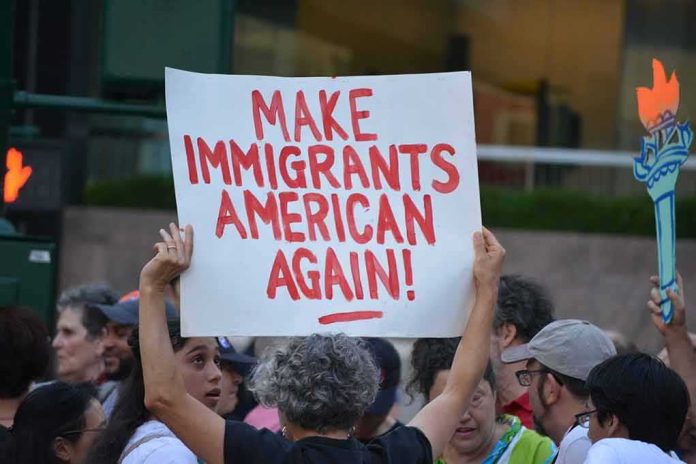
Holiday travelers in Salt Lake City picked up their bags to a chorus of “Abolish ICE,” and the clash over where protest ends and airport order begins snapped into focus.
Story Snapshot
- Advocates held an anti-ICE protest in Salt Lake City’s baggage claim free-speech zone.
- The action targeted regular detainee transfer flights run by Immigration and Customs Enforcement.
- Recent airport arrests in Seattle triggered outrage from local officials and airline staff.
- Debate centers on free speech rights versus passenger safety and smooth operations.
Protesters chose a legal lane inside the airport
Organizers in Salt Lake City staged their protest in a designated free-speech area at the airport’s baggage claim. They sang, held signs, and called to end Immigration and Customs Enforcement detainee flights. Reporters on the scene noted the group drew looks and occasional reactions from travelers. That placement matters. Airports are not traditional public forums, and rules can limit time, place, and manner of speech. Using the set zone kept the protest squarely within local policy.
The focus was narrow and tactical, not just symbolic. Advocates aimed at the regular pipeline that moves detainees through commercial hubs. By centering flights rather than broad immigration themes, the protest pressed a concrete demand at the precise site of government action. That is classic protest strategy in airports since 2017: go where policy meets the public eye, but stay inside the lines that avoid trespass or safety risks. The KSL account underscored that framing in its coverage.
Why Seattle’s arrests set the tone for holiday outrage
Only days earlier, masked immigration officers arrested two people on a crowded jet bridge in Seattle as passengers boarded. Alaska Airlines called the scene distressing and said the operation delayed the flight. A later report described officers pushing past a staffer who asked for credentials. Those claims set off alarms with airport officials and unions, who called the method disruptive and said it should stop at airports. The episode poured fuel on protests elsewhere.
Officials at the Port of Seattle said the action distracted workers from core safety duties and increased stress on crews. Labor leaders also said several crew members refused to continue the flight after seeing the arrests. That cascading impact—crew shaken, passengers delayed, operations scrambled—shows why airports treat unplanned confrontations as a serious risk. The facts from airline and port statements carry weight, even if Immigration and Customs Enforcement defends its authority to make arrests wherever it finds a subject.
Free speech, safety, and the narrow path in nonpublic forums
Court precedent treats airport terminals as nonpublic forums. That lets managers set reasonable limits to protect operations and safety while still allowing speech in defined zones. The line is bright for common sense: chant in the place set aside for speech, do not block corridors, and never intrude on secure areas. Salt Lake City’s protest fell on the legal side of that line. Seattle’s jet-bridge clash was an enforcement action, not a protest, but it shows how fast normal operations can unravel.
👀 WATCH:
Anti-ICE protesters STAGE singing demonstration inside Salt Lake City airportFootage shared by Turning Point USA's Frontlines shows demonstrators singing, "Don't stop fighting, till ICE is gone," inside Salt Lake City International Airport to protest deportation… https://t.co/NP5nv7dtQA
— Bobby (@bobbymorris280) November 24, 2026
Some activists argue that dramatic tactics force change. That may win attention, but it also risks backlash from travelers and workers who just want to get home. Conservative principles weigh order, safety, and respect for lawful process. By that lens, a protest in a marked area that does not hinder movement clears the bar. An arrest on a jet bridge during boarding that rattles crews and delays departures does not. Demanding secure, calm travel is not anti-speech; it is pro-public safety.
What this means for the next crowded travel week
Airports, airlines, and advocates now have a live blueprint. Airports should post clear, visible rules for speech zones and stick to them. Airlines should coordinate with law enforcement to avoid on-bridge arrests during boarding, which spike risk and confusion. Advocates should keep protests in permitted spaces tied to specific, verifiable policy targets. Travelers should expect visible expression but not blocked hallways or shaken crews. That balance protects both rights and reliability.
Sources:
thegatewaypundit.com, ksl.com, apnews.com, yahoo.com, us.headtopics.com, abc6onyourside.com