

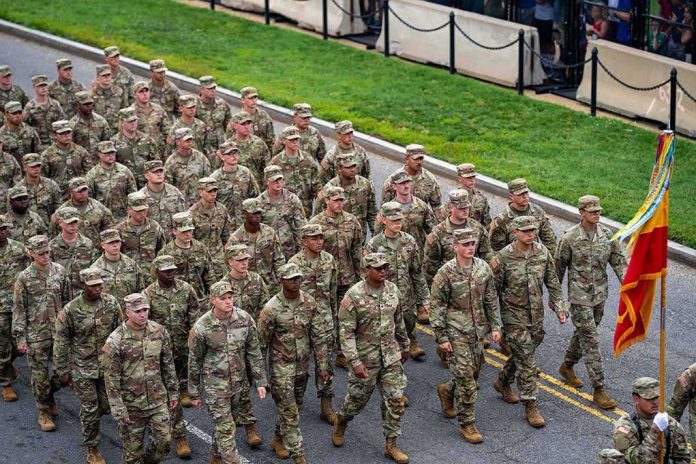
An active-duty U.S. Army sergeant admitted he sold national-defense information to buyers tied to China.
Story Snapshot
- Army Sgt. Jian Zhao pleaded guilty to a federal conspiracy involving defense information.
- Prosecutors say the plot ran from late 2021 to March 2025 with a named partner.
- Targets included training plans, operational orders, and radar blueprints in Okinawa.
- Agents seized about $30,000 in cash and Army hard drives during the arrest.
Guilty Plea Locks In The Core Facts
The U.S. Department of Justice said Sgt. Jian Zhao, stationed at Joint Base Lewis-McChord, pleaded guilty to conspiring to gather and transfer national-defense information to people connected to China. The charge stems from a federal case outlining his role in obtaining sensitive material for foreign buyers. A guilty plea is not a debate club moment; it is a courtroom admission with consequences. The government now moves to sentencing, where details about scope and harm often surface.
https://www.youtube.com/watch?v=f7dZcvcyv9w
Federal prosecutors backed the plea with an indictment that describes knowing, unlawful steps to collect and transmit defense-related documents, images, and equipment. The filing tracks a pattern that counterintelligence teams know well: a cleared insider with real access, a go-between to line up buyers, and a stream of items that map to specific capabilities. That mix does not look like idle curiosity. It looks like shopping lists built to exploit U.S. strengths.
What Prosecutors Say Was On The Menu
The Justice Department listed categories that matter in the real world: a large maritime training exercise in the Pacific, operational orders, and electrical diagrams and blueprints for a radar system in Okinawa. Those are not novelty souvenirs. Training schedules reveal who shows up, when, and with what. Operational orders expose timing and risk tolerance. Radar blueprints teach an adversary where we see best and where we might not. That knowledge shortens an enemy’s learning curve.
Prosecutors also named a co-conspirator, former Army soldier Ruoyu Duan of Oregon, as part of the effort that stretched from November 2021 through March 2025. That timeline spans multiple rotations, exercises, and procurement cycles. It suggests repeated tasking, payment, and delivery attempts, not a one-off grab. The government alleges Zhao used his supply sergeant access to reach gear and information most citizens never touch, a reminder that trust is a national asset, not a perk.
How The Case Broke Open
Agents arrested Zhao on March 6, 2025, at his home in Lacey, Washington, and recovered about $30,000 in cash, devices, and multiple Army hard drives, according to reporting based on the government account. Cash on hand and removable media fit the classic tools of an insider scheme. Physical drives evade network monitoring. Cash dodges simple bank flags. These are old tricks because they still work when someone inside the wire decides to sell out. The plea shows those tricks failed this time.
🚨📦 HE SOLD HIMARS SECRETS AND TOP SECRET HARD DRIVES. 📦🚨
Army sergeant Jian Zhao pleaded guilty Nov 23 in Portland. Prosecutors say he sold HIMARS manual excerpts and classified hard drives to buyers connected to China. He faces up to 10 years. Sentencing is March 1, 2027. pic.twitter.com/aQHShbD8K3
— ZeroBarkThirty (@zerobarkthirty) November 25, 2026
Some public summaries use different labels—“classified,” “sensitive,” or “military secrets.” The indictment and plea stick to the legal standard: information relating to national defense. That standard has teeth. It covers material that would help a foreign adversary, even if not stamped with the highest classification. Conservatives should want clear language and tough enforcement here. Words matter in court. Outcomes matter in the field. Precision in both protects troops and taxpayers.
Why This Case Fits A Larger Threat Pattern
This plot mirrors a broad campaign that blends cyber theft, front companies, and insider recruitment to nab U.S. defense and industrial know-how. The Department of Justice has reported that most economic-espionage cases allege a China link, and a large share of trade-secret cases do as well. That does not make every soldier a target, but it proves the demand signal is strong. When a willing insider appears, the pipeline lights up fast. Deterrence needs steady prosecutions and visible jail time.
The narrow caveat is simple: public filings do not list the classification stamp on every item or quantify damage in the open record. That is normal in national-security cases. Sentencing often reveals more, and redactions will likely remain. The larger point stands. A uniform, a clearance, and a post do not make someone loyal. Oversight and culture do. Commanders should keep audits tight, rotate duties smartly, and reward reporting of odd requests. Trust, but verify, then verify again.
What Comes Next And What To Watch
Sentencing will hinge on what was taken, what was shared, who paid, and how much risk it created. Expect the government to press hard on deterrence. Expect defense counsel to argue limited scope. Watch for references to radar vulnerabilities, exercise exposure, or changes to field practices. Those signals tell you if the harm was tactical, operational, or strategic. The plea already sends a clear message: sell our edge, and the system will find you, charge you, and take your freedom.
Here is the bottom line for citizens who want a strong America. Borders, budgets, and bravado mean little if we bleed secrets from the inside. Congress should back robust counterintelligence, modernize insider-threat tools, and fund fast, fair trials. The Pentagon should keep tightening access, logging, and culture. And every leader, from squad to staff, must teach that loyalty is not a slogan. It is a daily choice, backed by duty and enforced by law.
Sources:
zerohedge.com, justice.gov, militarytimes.com