
President Trump says he personally pushed Nvidia’s board to bring back Jensen Huang—and Wall Street roared.
Story Snapshot
- Trump said he lobbied Nvidia’s board to reinstate Huang as chief executive officer.
- The board brought Huang back, and Nvidia shares surged in fast trading.
- Trump framed the move as vital to national security and leadership in artificial intelligence.
- Nvidia had suffered a massive market value hit after Huang’s exit.
What Trump Said And What Happened Next
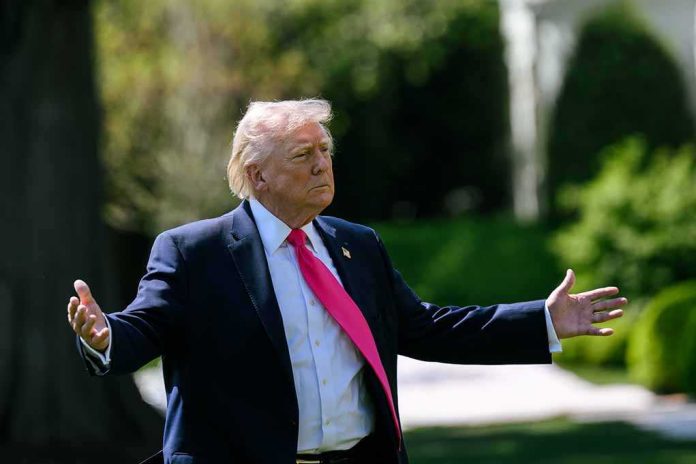
President Trump told CNBC he spoke with Nvidia’s board “directly and indirectly,” and that he “convinced them” to reinstate Jensen Huang as chief executive officer. NBC reported the same account, describing direct presidential involvement in the board’s decision. Soon after, the board brought Huang back. Financial coverage said the return sparked a sharp rally in Nvidia’s stock, reversing much of the slide tied to the leadership crisis. The sequence sent a simple message: leadership clarity can move markets fast.
CNN’s rolling coverage put numbers to the shock that came before the rebound. Nvidia’s market value had fallen by roughly $1.5 trillion after Huang stepped down and the board scrambled. That scale explains why a quick course correction hit like a starter’s pistol. Traders saw less chaos and more continuity, and they bet on it. Stocks do not wait for committee reports; they chase signals. A founder back in the chair is a bright, loud signal.
The National Security Frame And Why It Resonates
Trump cast Huang as a key asset in a global race for artificial intelligence. He argued that removing Huang risked weakening America’s edge against China and that keeping him, with assurances, served national security. That frame landed because Nvidia designs the chips that power large-scale artificial intelligence systems. Losing an experienced founder-operator during a sensitive period could slow product road maps and supply strategies that support both economic strength and defense readiness.
Coverage tied the leadership crisis to a swirl of alleged foreign-intelligence concerns and a personal scandal, which fueled urgency around the decision window. The reporting did not detail confirmed espionage findings, and it did not show that reinstating Huang cured any security risk. That said, linking leadership stability to strategic technology is common sense under American conservative values: protect critical talent, secure supply chains, and keep key capabilities onshore when possible.
Market Pop Versus Long Game
NBC and The Independent described Nvidia’s stock snapping back more than 30 percent, erasing most of the crisis losses. That move reflects relief and momentum more than proof of policy wisdom. A one-day jump cannot decide long-term health. Shareholders still need execution on chip designs, customer supply, and export compliance. The clear near-term lesson stands: remove the fog, and money returns. The broader lesson follows: concentrated leadership risk makes even great companies brittle.
The part of this Triad that lands is the rule-of-law test, not the communism analogy. Nvidia's Nov. 23 filing says the board reinstated Jensen Huang after input from senior levels of the U.S. government, and Trump told CNBC he had spoken with the board directly and indirectly and…
— Mike Young (@micyoung75) November 23, 2026
Boards everywhere should study this saga. Analysts and governance writers have flagged Nvidia’s thin succession planning and unusual dependence on its founder for years. Reports cited an absence of a named heir, more than 60 direct reports to Huang, and no board chair to counterbalance the chief executive officer’s power. That is a classic “key-person” risk. When the key leaves, the whole system shakes. When the key returns, the shake stops—but the structural risk stays.
The Boundary Between Policy And Corporate Control
Media coverage called Trump’s push “extraordinary,” because presidents rarely call a private board about a specific chief executive officer. The line between giving a government security assessment and advocating a specific personnel move can blur. On the merits, the case for intervention looks straightforward: Nvidia is central to artificial intelligence hardware, which is central to national strength. On precedent, the move invites copycats and raises questions about where elected power should end in boardrooms.
Practical guardrails can keep such moments rare and focused. First, government should state security facts fast and clean. Second, boards should maintain real succession plans to avoid panic. Third, companies in strategic sectors should rehearse crisis governance, with clear interim leadership and communication maps. Those steps fit conservative priorities: limited but strong government action, accountable private boards, and stability that supports free enterprise during shocks.
What To Watch Now
Three threads will show whether this rebound becomes a reset. Watch Nvidia’s next product milestones and delivery timelines. If execution stays on track, the market’s snapback will look earned, not lucky. Watch board disclosures for evidence of a real succession plan at last; that is the tell for grown-up governance. Watch policy signals on export controls and supply security, because artificial intelligence chips sit at the tightest choke points in the global economy.
Trump wanted a fast fix at a fragile moment, and he says he got it. The board gave investors certainty, and investors paid up for it. The deeper fix now belongs to Nvidia’s directors. Build a bench. Name a chair. Prove the company is bigger than one leader. America wins when its star firms reduce single-point failure and keep compounding—not only for one quarter, but for a decade.
Sources:
youtube.com, cnbc.com, futurism.com, nbcnews.com, arise.tv, csmonitor.com, fortune.com, wsj.com