

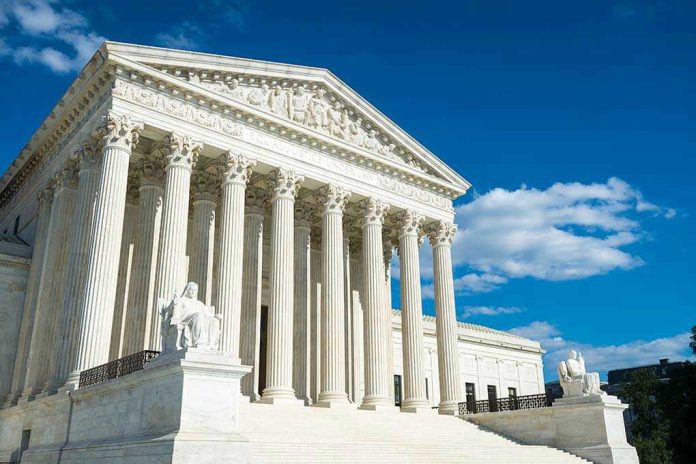
The Supreme Court just agreed to decide whether millions of mail-in ballots arriving after Election Day should count, and the ruling could reshape how Americans vote in the 2026 midterms and beyond.
Story Snapshot
- Supreme Court will hear Watson v. RNC, challenging Mississippi’s law allowing mail ballots postmarked by Election Day to arrive up to five days later
- The Fifth Circuit ruled ballots must be received by Election Day, potentially affecting 15 states plus Washington D.C. with similar late-arrival provisions
- Republican National Committee argues federal law mandates Election Day receipt, while Democrats and states defend voter access through flexible deadlines
- A ruling expected by summer 2026 will set binding precedent just months before the midterm elections, eliminating uncertainty about ballot counting rules
The Fight Over Five Days That Could Change Elections
Mississippi passed its mail ballot extension in 2020 during the COVID-19 pandemic, joining 15 other states and the District of Columbia in allowing ballots postmarked by Election Day to arrive days later. Illinois grants a generous 14-day window. These accommodations recognized postal delays and expanded voting access during unprecedented times. But the Republican National Committee sees something else entirely: an opening for fraud and a violation of federal law that explicitly designates the Tuesday after the first Monday in November as Election Day. Their lawyers insist that date means when ballots must be received, not merely mailed.
The Fifth Circuit Court of Appeals sided with the RNC, striking down Mississippi’s five-day grace period and forcing the Supreme Court’s hand. This decision reversed years of practice and threw election administrators into confusion about whether similar laws in more than a dozen jurisdictions would survive legal scrutiny. The timing couldn’t be more critical. The Court’s decision to hear the case in November 2025 positions it outside the Purcell principle, a judicial doctrine that discourages last-minute election rule changes. This gives states adequate time to adjust procedures before voters head to the polls in November 2026.
Why Postmarks and Prepaid Postage Matter More Than You Think
Jason Snead from the Honest Elections Project raises a technical issue that cuts to the heart of election integrity: prepaid postage eliminates reliable postmarks. Nineteen states and Washington D.C. provide prepaid envelopes for mail ballots, a convenience that ironically undermines verification. Traditional postmarks prove when voters mailed their ballots, establishing they met the Election Day deadline. Without clear postmarks on prepaid mail, election officials face difficulty confirming ballot legitimacy. Snead argues this creates opportunities for fraud, as ballots could theoretically be filled out and submitted after Election Day with no way to verify the deception.
The counterargument from state officials emphasizes constitutional authority and practical necessity. Mississippi and 18 other states filed a brief defending their right to craft election rules that accommodate local circumstances. Rural voters facing spotty postal service, military personnel stationed overseas, and Americans with disabilities all benefit from flexible arrival deadlines. These states contend that rigid receipt requirements would disenfranchise legitimate voters whose ballots arrive late through no fault of their own. The Constitution grants states broad powers to administer elections, they argue, and federal law doesn’t explicitly mandate same-day receipt.
The Political Stakes Behind the Legal Arguments
Ken Martin, Democratic National Committee chair, frames the case as blatant voter suppression, vowing to fight what he views as Republican efforts to restrict ballot access. The political dimension is undeniable. Mail voting expanded dramatically during 2020, with Democrats disproportionately using mail ballots compared to Republicans who voted in person at higher rates. Tightening mail ballot rules could affect electoral outcomes by reducing Democratic turnout advantages. Yet conservatives see the issue through an entirely different lens: preventing fraud requires clear, uniform standards that eliminate ambiguity about when voting ends.
The Supreme Court’s conservative majority gives Republicans reason for optimism, though the legal questions transcend simple partisan calculations. Federal law does designate a specific Election Day, lending credence to arguments for uniform deadlines. State sovereignty over election administration carries constitutional weight too. The Justices must balance these competing principles while considering practical effects on voter access and election security. Their decision will either validate state flexibility or impose nationwide standardization, fundamentally altering how America conducts federal elections.
What Happens Next and Who Gets Affected
Oral arguments will unfold in spring 2026, with a ruling expected by June or July. That timeline gives election officials roughly four months to implement any mandated changes before the midterm elections. If the Court sides with the RNC, election offices in 16 jurisdictions must immediately halt acceptance of late-arriving ballots, potentially invalidating thousands of votes from military members, overseas citizens, and rural residents. States would need to launch voter education campaigns explaining the new deadline and possibly expand early voting or ballot drop boxes to compensate.
The broader implications extend beyond 2026. A ruling establishing Election Day as a mandatory receipt deadline would create uniform federal standards, ending state-by-state variations that currently confuse voters and complicate election administration. The U.S. Postal Service would face intensified scrutiny over delivery speeds during election weeks. Election integrity advocates would celebrate closure of perceived fraud vulnerabilities, while voter access proponents would mourn reduced flexibility for Americans navigating work schedules, disabilities, and geographic challenges. The case represents a fundamental choice about what American democracy prioritizes: airtight security through rigid deadlines or maximum participation through accommodating rules.
Sources:
Supreme Court case could have major effect on 2026 midterms – TN Politico