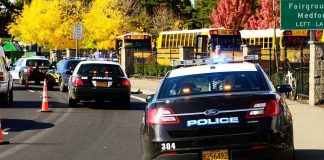

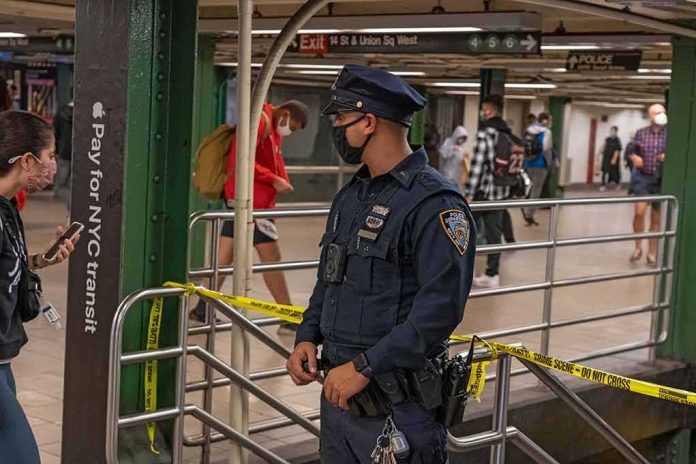
A single stray shot in a Brooklyn subway station sent two people to the hospital and a city into familiar questions about police gun safety.
Story Snapshot
- An NYPD officer’s gun discharged at Kingston–Throop Avenues around 4:40 p.m., police said.
- Bullet fragments injured another officer and a 34-year-old woman; all were treated and released.
- The New York City Police Department’s Force Investigation Division is handling the review.
- Two officers were placed on modified duty as the inquiry proceeds.
What Happened On The Platform
New York City Police Department officers were on the Kingston–Throop Avenues subway station in Bedford-Stuyvesant late afternoon when an officer’s service weapon fired. The discharge came around 4:40 p.m., according to published accounts citing the New York City Police Department. Bullet fragments struck a fellow officer and a bystander on the platform. The bystander, a 34-year-old woman, suffered minor injuries and was released after treatment. The injured officer and the officer whose gun fired were also hospitalized and later released.
Police said the shot was accidental and referred the case to the New York City Police Department’s Force Investigation Division. That unit reviews firearm discharges and related use-of-force events inside the department. News reports noted early confusion about whether the gun left the holster, but the central point from officials remained the same: the weapon fired and the fragments caused the injuries. No other riders were reported hurt, and conditions for the injured were listed as stable before discharge.
Who Is Reviewing And Why It Matters
The Force Investigation Division leads the internal review process after any firearm discharge. The unit’s role is to secure facts, collect evidence, and evaluate policy and training questions. This case will test handling standards in a confined, crowded space. The station layout, partner positioning, and weapon retention practices all matter when a single round can break apart on hard surfaces and cause fragment injuries. The department places involved officers on modified duty in these scenarios while the review proceeds.
The New York City Police Department’s public reporting shows that firearm discharges happen each year and are tracked in its Use of Force reports. The 2023 report counted 48 firearm discharges, which marked a decrease from the prior year. Years of assessments by outside researchers, including studies hosted by the RAND Corporation, have urged clear training on trigger discipline, weapon retention, and decision-making under stress. Those reviews also pressed for consistent, fast investigations when any gun fires, including accidental discharges.
What We Know About The Injuries
Doctors treated fragment wounds rather than direct gunshot wounds. The injured bystander was a woman in her thirties who left the hospital after care. The injured officer and the officer whose weapon fired were also evaluated and released. Police described all as stable before discharge. That outcome does not erase the risk. A fragment can blind, maim, or kill in a tight space. A tiled wall or steel beam can turn one mistake into a wider hazard on a busy platform.
An NYPD officer accidentally fired => her <= service weapon in a Brooklyn subway station Thursday afternoon — and bullet fragments struck another cop and a bystander.
The accidental discharge occured at about 4:40 p.m. inside the Kingston-Throop Avenue station in… pic.twitter.com/T9qelepY6J
— Crime In NYC (@Crime_In_NYC) September 12, 2026
Transit riders crowd close to hard surfaces that send rounds off at odd angles. Many stations also have narrow lines of sight and echoing acoustics. A firearm discharge in that setting is not just a technical error. It is a public safety failure with stakes measured in inches and milliseconds. Common sense says gun handling must assume worst-case ricochet paths. American conservative values emphasize personal responsibility and competence in the use of force. That standard must anchor every holstered step on a platform.
Why This Fits A Larger Pattern
Department reports and independent reviews have long shown that not every discharge comes from a shootout. Some are accidental or occur outside adversarial encounters. The New York City Police Department’s public data and past summaries track those events to spot risk patterns and training gaps. The 2023 Use of Force report reflects a multi-year decline in total discharges, yet any accidental shot in a crowded space is one too many. The review process exists to reinforce that baseline.
Clear facts support the basic frame here: an accidental discharge on a Brooklyn subway platform caused fragment injuries to an officer and a civilian, all later released from care, and the Force Investigation Division is leading the review. One brief caution is fair: officials have not yet provided a full public breakdown of the firing mechanics. That is routine at this stage and sits inside the formal review, not outside it. The core event is not in dispute.
What Accountability Should Look Like Next
Sound accountability starts with timely findings and direct language on cause. If the round fired from a holstered weapon, say so and fix what allowed it. If handling error triggered the shot, retrain and discipline as policy requires. If a mechanical fault existed, inspect that batch, document it, and warn the rank and file. The best way to protect riders and officers is to make this rare and to make lessons stick the first time.
Sources:
nypost.com, bbc.com, nytimes.com, policyarchive.org, catalogue.nla.gov.au, theiacp.org