

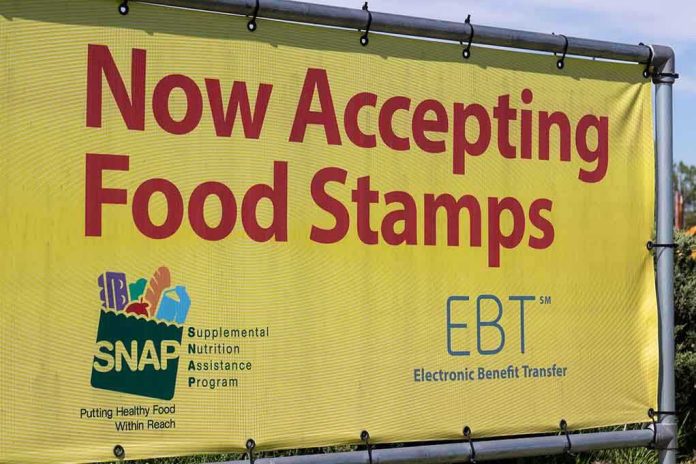
Millionaires legally collect food stamps through a federal loophole that bypasses asset limits, draining billions from taxpayers while the truly needy wait.
Story Snapshot
- 43 states use Broad-Based Categorical Eligibility (BBCE) to ignore federal SNAP asset caps of $3,000, letting households with millions qualify.
- Minnesota retiree Rob Undersander, a millionaire, received over $6,000 in benefits to expose the flaw in 2019.
- Michigan lottery winners kept SNAP after $1-2 million jackpots in 2011 due to no asset tests.
- Up to 5.4 million recipients exceed federal limits, including one in five with over $100,000 in assets.
- Reform bills like H.R. 416 aim to enforce federal standards amid $100B annual SNAP costs.
BBCE Policy Origins and Mechanics
Congress established SNAP with strict rules in 1977: gross income under 130% of the federal poverty line and assets below $3,000, rising to $4,500 for elderly or disabled households. Countable assets cover cash, savings, vehicles, and non-retirement investments. Broad-Based Categorical Eligibility emerged post-1996 welfare reform. States link SNAP to TANF programs, funding minor services like brochures to grant eligibility. This sidesteps federal asset tests entirely.
Clinton-era rules in 1999 expanded categorical eligibility to TANF non-cash benefits. Obama officials widened it further. Trump USDA proposed restrictions in 2019, but Biden withdrew them. States set TANF income up to 200% FPL with no asset limits, triggering SNAP access. By 2025, 43 states plus DC adopted BBCE; 28 maxed income at 200% FPL, and all but five dropped asset checks.
Real Cases Expose Absurd Outcomes
Rob Undersander, a Minnesota retiree with millions in assets and property, applied for SNAP in 2016 to test the system. Officials approved him based on low retirement income alone, ignoring his wealth. He received hundreds monthly, totaling over $6,000, which he donated to charity. Undersander testified in 2019, calling it fraud by design and urging closure. Minnesota lawmakers ignored his plea.
Michigan lottery winners provided another stark example. In 2011, a $2 million jackpot recipient and a $1 million winner retained SNAP benefits post-payout. States classified winnings as non-countable or relied on BBCE to bypass checks. Foundation for Government Accountability estimates reveal millions affected: over 5.4 million exceed federal limits in 2023, with one-third holding over $50,000 and one-fifth over $100,000 in assets.
Stakeholders Push for Fiscal Accountability
Foundation for Government Accountability and Cato Institute lead critiques, documenting cost-shifting to federal taxpayers. FGA reports states abuse TANF funds for pamphlets to enroll ineligible households. Cato highlights BBCE producing millionaire recipients, undermining SNAP’s goal for the poorest. Rep. Ben Cline (R-VA) sponsors H.R. 416, the No Welfare for the Wealthy Act, mandating federal income and asset tests nationwide.
USDA under Trump eyed administrative fixes; current leaders like Brooke Rollins consider similar steps. States favor BBCE for easier administration and maximized federal draws. Conservative analysts argue this aligns with common sense: aid belongs to the truly needy, not the wealthy. Facts support their view—$100 billion annual SNAP costs for 41.7 million amid diluted targeting erode trust.
Impacts and Path to Reform
Taxpayers fund undeserved benefits, shortchanging genuinely poor families. Long-term, BBCE invites abuse, as lottery cases prove, and fuels welfare skepticism. FGA urges states to cross-check data like winnings and wages for quick fixes. Congress debates in Farm Bill talks; H.R. 416 offers durable closure. States can opt out unilaterally, restoring integrity without waiting for Washington.
Sources:
The SNAP Loophole that Lets Millionaires Receive Food Stamps
Why Are Millionaires Receiving Food Stamps?
Can Millionaires Really Receive Food Stamps? – EPIC for America
SNAP Has an Eligibility Loophole. Congress Needs to Close It.