

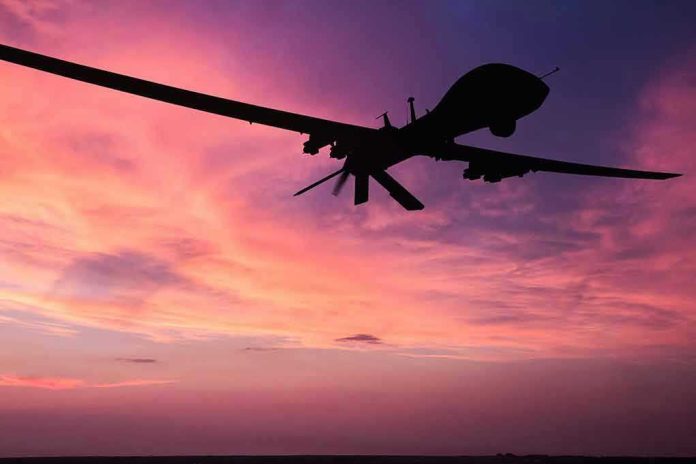
The U.S. military just shot down one of our own government drones with a laser weapon near the Texas border, marking the first confirmed friendly fire incident of its kind in an increasingly chaotic experiment with directed-energy weapons along America’s southern frontier.
Story Snapshot
- Military used a high-energy laser system to destroy a Customs and Border Protection drone near Fort Hancock, Texas, mistaking it for a threat
- The incident occurred in military airspace and prompted the FAA to close the area through June 24, 2026
- This marks the second laser-related mishap in two weeks, following CBP’s downing of a child’s birthday balloon
- Congressional Democrats blamed White House incompetence for bypassing bipartisan legislation requiring C-UAS operator training
- The LOCUST laser system has been deployed at the border since summer 2025 to counter Mexican cartel drone threats
When Friendly Fire Goes High-Tech
The incident unfolded near Fort Hancock, Texas, approximately 50 miles southeast of Fort Bliss Army base, when military operators identified what they deemed a “seemingly threatening” unmanned aerial system. Without coordinating with Customs and Border Protection, they engaged the target with a directed-energy laser weapon. The drone they vaporized belonged to CBP itself, a sister federal agency operating under the Department of Homeland Security. Pentagon spokespeople offered minimal explanation, telling reporters “This is the extent of information we have,” while a joint statement from the Department of Defense, FAA, and CBP assured the public the engagement occurred far from populated areas with no commercial aircraft affected.
The LOCUST System Comes Home to Roost
The weapon responsible for this embarrassment is the LOCUST laser system, a high-energy directed-energy platform designed for counter-unmanned aircraft systems operations. The Army airlifted this experimental technology to the southern border by July 2025 and loaned it to CBP as part of escalating efforts to combat Mexican cartel drone incursions. Thousands of federal troops have deployed to the border region under directives from President Trump, creating a militarized zone where multiple agencies operate overlapping surveillance and interdiction missions. The laser’s power to instantly neutralize aerial threats makes it attractive for border security, but this incident exposes the dangers of deploying cutting-edge military hardware without ironclad communication protocols between agencies sharing the same airspace.
A Pattern of Laser Mishaps
This friendly fire disaster follows an equally absurd incident just two weeks earlier when CBP operators used the same LOCUST laser system near El Paso to shoot down what they initially reported as a cartel drone. The target turned out to be a child’s birthday balloon. That mishap triggered an abrupt FAA airspace shutdown that was supposed to last 10 days but was rescinded within hours after the actual threat level became clear. The Trump administration initially denied the balloon incident, but sources confirmed the embarrassing mistake. These back-to-back failures reveal a disturbing pattern: operators wielding powerful directed-energy weapons are pulling the trigger on targets they cannot properly identify, and coordination between federal agencies remains dangerously inadequate despite operating in the same contested airspace.
Congressional Fury and Accountability Questions
Congressional Democrats unleashed scathing criticism following Thursday’s drone shootdown, with ranking members from key committees expressing outrage at what they characterized as predictable incompetence. Representative Rick Larsen of Washington, along with André Carson of Indiana and Bennie Thompson of Mississippi, told reporters “Our heads are exploding” over the incident, directly blaming the White House for sidestepping bipartisan legislation that would have mandated comprehensive training for C-UAS operators. The lawmakers pointed out that proper coordination protocols and operator certification requirements had been drafted with bipartisan support specifically to prevent this type of mishap. The administration’s decision to bypass that legislative framework and rush laser weapons to the border without adequate safeguards has now produced exactly the catastrophic coordination failure Congress warned against.
Airspace Restrictions and Broader Implications
The Federal Aviation Administration responded by issuing a Notice to Air Missions closing airspace around Fort Hancock for “special security reasons” from Friday through June 24, 2026. While officials emphasized no commercial aircraft were affected and no populated areas endangered, the extended closure signals serious concerns about continued laser operations in the region. The incident raises fundamental questions about the domestic deployment of directed-energy weapons that were designed for overseas combat zones. Military airspace authority gives the Pentagon operational control, but when multiple federal agencies operate drones in overlapping zones without real-time coordination, the potential for catastrophic errors multiplies. The economic impact remains minimal beyond drone replacement costs, but the political fallout could reshape how America deploys experimental weapons systems in domestic operations.
The joint agency statement promised “increased cooperation” at President Trump’s direction to counter legitimate drone threats from Mexican cartels and foreign terrorists. Yet promises of future collaboration ring hollow when basic notification systems apparently do not exist to prevent one federal agency from incinerating another agency’s surveillance asset. Common sense suggests that before firing lasers in shared airspace, operators should know which aircraft belong to allies. This incident demonstrates that border security operations have outpaced the coordination infrastructure necessary to execute them safely, turning the southern border into a proving ground where experimental weapons meet bureaucratic dysfunction with predictably disastrous results.
Sources:
Military shoots down Customs and Border Protection drone with a laser — Task & Purpose
Dept. of Defense shoots down Customs and Border Protection drone — ABC News