

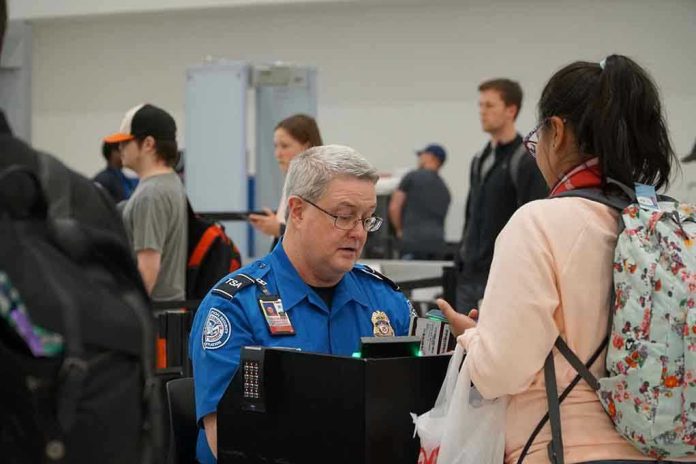
Mandatory Ebola screenings at Atlanta’s airport are less about catching fevers at the gate and more about testing how far Americans will let government reach into their travel, privacy, and common sense in the name of safety.
Story Snapshot
- Atlanta’s Hartsfield-Jackson is now a federally designated funnel point for mandatory Ebola screening of travelers from three African nations.
- Centers for Disease Control and Prevention (CDC) calls this one “layer” in a broader containment strategy, not a silver bullet.
- Critics question whether adding Atlanta materially improves safety or just adds visible hassle and cost.
- The deeper fight is over risk, freedom of movement, and how much theater Americans will tolerate for “reassurance.”
Mandatory screening comes to the world’s busiest airport
Hartsfield-Jackson Atlanta International Airport quietly shifted from busy travel hub to disease-control checkpoint when federal authorities added it to the list of airports with mandatory Ebola screening.[1][2][4] The move followed an earlier order sending all affected travelers only through Washington Dulles International Airport, effectively funneling United States citizens and permanent residents from the Democratic Republic of the Congo, Uganda, and South Sudan into a narrow corridor of federal health control.[1][2][4] Cargo flights and airline crews were carved out, but regular travelers were not.[4]
The Centers for Disease Control and Prevention announced that enhanced public health entry screening at Atlanta began at 11:59 p.m. on May 22, 2026, building on similar procedures already active at Washington Dulles.[2] The Centers for Disease Control and Prevention emphasized that Hartsfield-Jackson had previously run such screening and already had operational routines in place, making it an easy plug-and-play expansion.[2] Federal messaging framed the change as a “proactive measure” linked to an overseas outbreak, not a reaction to any known domestic case tied to Atlanta.[4]
What the screenings actually do to travelers
The new regime is not a vague “extra check” at the gate; it is a structured process that begins long before a traveler reaches Georgia.[2][4] Passengers who were present in the Democratic Republic of the Congo, Uganda, or South Sudan within 21 days of entering the United States are now routed so they must arrive through Washington Dulles, Atlanta, or soon Houston’s George Bush Intercontinental Airport.[1][4] Once they land, they face health questionnaires, temperature checks, and evaluation for symptoms consistent with Ebola before being released to their final destinations.[1][2]
Officials also attach the screening to a 21-day monitoring concept, since that is the typical upper range of Ebola’s incubation period.[2][3] The Centers for Disease Control and Prevention describes screening as just one link in a chain that includes overseas exit checks, mandatory airline illness reporting, entry screening at these select airports, and post-arrival public health monitoring.[2][3] In theory, this layered design means that even if a traveler passes through one layer undetected, another layer may catch a developing case before it spreads widely on American soil.[2][3]
Supporters see low-cost insurance; skeptics see public-health theater
Supporters of the Atlanta expansion argue that if the United States is already funneling higher-risk travelers into a small set of airports, adding the world’s busiest airport with an embedded Centers for Disease Control and Prevention presence is common sense.[1][2][3] Hartsfield-Jackson handles enormous domestic connections, so intercepting and educating a traveler there, before they scatter across multiple states, arguably reduces the risk of uncontrolled exposure.[1][2] From this view, the inconvenience is modest and the potential downside of missing a case is catastrophic.
Skeptics point out that neither the Centers for Disease Control and Prevention release nor the related federal notices present any hard numbers to justify Atlanta-specific screening as a measurably superior safeguard.[2][4] There is no published risk model showing how many cases such airport checks are expected to catch, or how many false negatives slip through.[2] CBS’s reporting underscores that, as of the policy expansion, officials had not announced a single Ebola case linked to Atlanta travelers.[4] For a conservative reader, that raises obvious questions about whether this looks more like visible “we’re doing something” theater than tightly targeted risk management.
Layered strategy or creeping normalization of control?
The Centers for Disease Control and Prevention pushes a “layered public health approach” as the intellectual backbone of these measures, pairing airport screening with overseas exit controls, illness reporting by airlines, and post-arrival monitoring.[2][3] That framework aligns with a long pattern: governments roll out visible checkpoints during frightening outbreaks because they reassure nervous citizens and demonstrate action, even when the statistical yield is low. The number of genuinely infected travelers is usually tiny compared with the total flow, so most of what these programs process is healthy people.[2][3]
The CDC has officially activated mandatory Ebola screenings at Hartsfield-Jackson in Atlanta, targeting travelers from the DRC, Uganda, and South Sudan as global deaths hit 220.
— POSHBerg Agubandieze (@POSHBAG1) May 26, 2026
From a common-sense, limited-government perspective, the critical question is not whether Ebola is dangerous; it clearly is. The question is whether expanding from one to two, then three, designated airports meaningfully changes risk or instead normalizes emergency routing orders and mandatory health interrogations as routine tools.[1][4] Without transparent data on effectiveness, Americans are asked to trust agencies that recently struggled with credibility during other public health crises. Prudence says protect the homeland; experience says scrutinize open-ended authority very carefully.
Sources:
[1] Web – Ebola-related travel restrictions now include Atlanta’s Hartsfield …
[2] Web – Enhanced Ebola Airport Screening Expands to Atlanta – CDC
[3] Web – US names second airport for Ebola screening as cases in Congo …
[4] Web – Public Health Arrival Restrictions and Enhanced Ebola Screening