

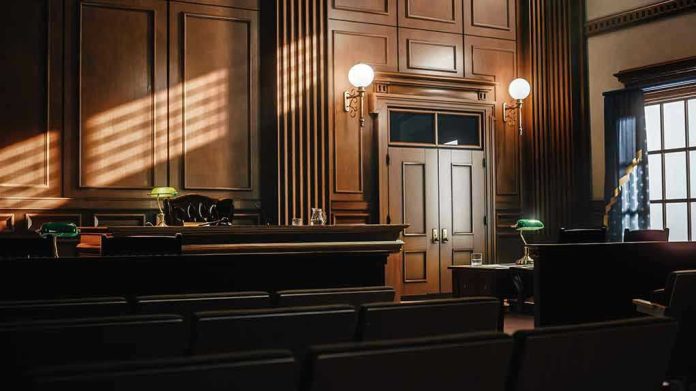
The real scandal in this courthouse-sex story is not the moaning behind closed doors, but how the system quietly gave a federal judge a gentler penalty than many Americans get for far less.
Story Snapshot
- A married federal judge carried on a secret courthouse affair with a high-ranking police officer for roughly two years, often during work hours.
- Law clerks reported “moaning,” “kissing sounds,” and other noises consistent with sex coming from chambers while they worked just feet away.
- The judge allegedly lied, blamed a clerk, then later admitted to the affair and sex in chambers after investigators reviewed logs and video.
- Despite conflicts of interest and risk of blackmail, the judge received only a private reprimand and some career limits, fueling anger over a two-tier justice system.
How a federal courthouse turned into the worst kind of office soap opera
A federal courthouse is supposed to be the place where everyone else’s scandals get sorted out, not where one plays out on the other side of a chamber door. According to a judicial misconduct complaint summarized in news reports, a married federal judge repeatedly met a law enforcement officer in chambers over about two years, often during work hours, while staff worked just outside.[1][2] This was not rumor mill gossip; it was a workplace reality the clerks literally heard.
Clerks reported hearing “kissing sounds,” “moaning,” and other noises consistent with sexual activity coming from the judge’s private office.[1] One clerk said the officer even used the word “affair” within earshot.[1] Another clerk was so disturbed by what they heard that they left work for the day rather than sit there, knowing the judge and a uniformed officer were apparently turning chambers into a motel room.[1] That is not a normal professional environment; that is a hostile and humiliating one.
🚨 **Federal Judge Caught Having Sex in Courthouse Chambers During Work Hours – And Got a SLAP ON THE WRIST**
A married federal judge in the 11th Circuit carried on a two-year affair with a high-ranking police commander… including repeated romps **inside the judge’s own…
— Erik Bryant (@Trumpwon) May 27, 2026
When the boss is a judge and the partner is a cop, trust collapses
The details on the officer matter. Reports describe the officer as a high-ranking law enforcement commander whose department appeared in that same federal court.[1] That means the affair did not just violate marital vows; it created an obvious conflict-of-interest problem. Every citizen whose case involved that department now has reason to wonder whether justice was blind or romantically entangled. American conservative values put a premium on equal justice and impartial referees; this conduct hits those values head-on.
The Code of Conduct for United States Judges requires judges to avoid both impropriety and the appearance of impropriety. It explicitly treats harassment and inappropriate workplace conduct as judicial misconduct. Turning a taxpayer-funded office into a private bedroom, with subordinates trapped outside listening, is exactly the kind of behavior that erodes respect for courts. It also creates a blackmail risk: the relationship was reportedly kept secret from the judge’s spouse and colleagues, giving anyone who knew leverage over a sitting federal judge.[1]
From outraged denials to reluctant admissions under investigation
When the first clerk complained, the judge did not immediately fall on the sword. The judge reportedly called the allegations “outrageous” and “base,” and suggested a law clerk fabricated the claims as payback for workplace discipline.[1] That offensive counterattack matters. It signals a willingness to smear a subordinate rather than take responsibility. It also shows why so many whistleblowers stay silent; taking on a life-tenured judge is risky even without being accused of lying out of spite.
Investigators did not stop at the judge’s word. They reviewed courthouse security footage and sign-in logs and interviewed former clerks.[1] That work, according to the complaint summary, led to a different story: the judge ultimately admitted both the affair and engaging in sexual acts in chambers.[1][2] From an ethics perspective, the cover-up and the false denials are nearly as serious as the original misconduct. A judge’s core job is to assess credibility and tell the truth. When that person lies about their own behavior, every past ruling looks a little less trustworthy.
Private reprimand, public outrage, and the double standard problem
After all this, the judicial council did not remove the judge. Instead, it issued a private reprimand, barred the judge from serving as chief judge, and blocked service on judicial conference committees.[2] The judge agreed to apologize to six former clerks and accept those limits.[2] That is it. No public censure with a name attached, no impeachment recommendation, no suspension without pay. For most citizens, this would feel like getting caught red-handed and then being told to write “I will not do it again” on the chalkboard.
Supporters of the current discipline system might argue that the Code of Conduct treats this as serious, and the internal process worked under the rules as written. They can also point out that many details remain confidential, so outsiders do not see the full record. But from a common-sense, Main Street perspective, the picture is simple: a powerful insider broke workplace rules, lied about it, compromised public trust, and kept the job anyway. That looks like a two-tier system where robes and rank buy mercy.
Why this scandal is bigger than sex and gossip
This case fits a pattern: judicial misconduct involving sex at work, misuse of government resources, and efforts to hide it tend to be shrouded in partial secrecy, with only summaries and headlines reaching the public.[1][2] That does not mean every judge is corrupt; most are not. But every time a story like this ends with a quiet reprimand, regular Americans lose another ounce of faith that powerful officials play by the same rules they enforce on everyone else.
Sources:
[1] Web – Married judge had sex with cop in courthouse — and horrified clerks …
[2] YouTube – Kenton Co. judge accused of having sex in courthouse …