
Gunfire and explosions ripped across Saravan as a new Baloch group said it fought Iran’s security forces and lost four men—while the regime called them terrorists and claimed a win.
Story Snapshot
- A group calling itself the People’s Fighters Front said four of its Baloch members died in Saravan clashes.
- Iran’s Islamic Revolutionary Guard Corps said it killed four “terrorists” and seized weapons and gear.
- Reports differ on security force losses, ranging from one to three dead in separate accounts.
- The fight fits years of borderland insurgency and counterinsurgency in Sistan and Baluchestan.
What happened in Saravan and why it matters
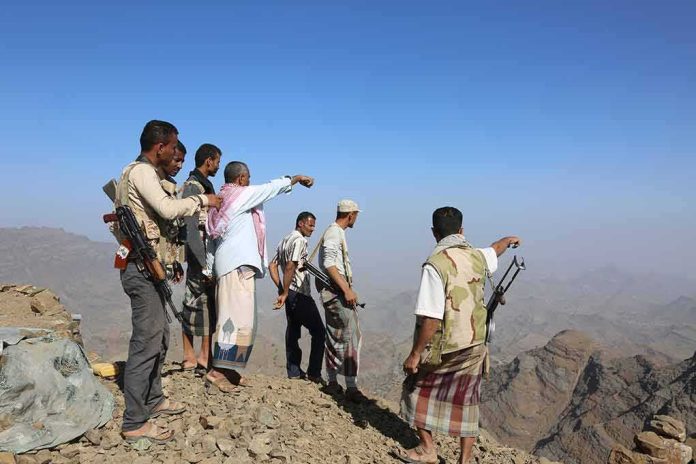
Iran’s Islamic Revolutionary Guard Corps said its ground forces stopped a four-man “terrorist team” near Saravan, close to the Pakistan border. The statement said four attackers died, a security member was killed, and authorities seized weapons and equipment. Soon after, the People’s Fighters Front, a Baloch group, said four of its members were killed in battles with Iranian military forces in Saravan. These claims point to the same clash but tell very different stories about who fought and why.
The casualty count on Iran’s side is not uniform across outlets. One report said one security force member died. Another said three Islamic Revolutionary Guard Corps members were killed in clashes with Baloch militants in the area, citing a Baloch rights source and a self-described People’s Fighters Front statement. Conflicting tallies are common in this border zone. The fog of war in Sistan and Baluchestan often lasts for days, sometimes longer, before numbers settle—if they do at all.
The competing frames: uprising versus terrorism
The People’s Fighters Front framed the event as armed resistance by Baloch fighters against state forces. The group’s claim of fallen members gives the anti-regime narrative a face and a name, at least for this incident. State media and aligned outlets countered with a classic counterterrorism script: professional terrorist team, cross-border infiltration, and seized caches of weapons and communications gear. This is the regime’s standard vocabulary for insurgent violence in the southeast.
Iran’s official line also emphasized a joint operation with intelligence and police, projecting control and coordination in the province. That message targets domestic audiences: the state is alert, organized, and winning. Opposition-linked narratives highlight strikes, street anger, and the cost of repression, seeking to cast the clash as part of a wider popular revolt against Tehran’s rule. Both frames serve their base. Both leave gaps you could drive a convoy through.
The pattern beneath the headlines
Saravan has seen this movie before. The area sits in a long-running cycle of insurgency and counterinsurgency. Groups like Jaish al-Adl, a Sunni Baloch militant group, have carried out deadly attacks against Iranian forces in or near Saravan for more than a decade, including a 2013 ambush that killed 14 border guards. The terrain, the smuggling routes, the porous border, and deep local grievances make this a hard fight for any state to tidy up fast.
⚔️🚫 Clashes End with the Breaking of the Siege and the Withdrawal of Armed Individuals, Resulting in Heavy Casualties for Military Forces
🔻 According to reports from Hal Vash/ on Saturday, September 12, 2023, following previous reports about an eight-hour clash in the Bakhshan…
— Alex kennedy (@Alexkennedy213) September 12, 2026
Clashes in this region rarely produce clean facts in real time. Numbers shift. Labels harden. Each side picks the terms that serve its strategy. For American readers who value clarity and accountability, the test is simple: weigh claims tied to concrete facts. Here, the People’s Fighters Front publicly owned its losses in Saravan. The Islamic Revolutionary Guard Corps publicly owned the operation and its alleged seizures. Those admissions anchor the story better than slogans do.
What to watch next
Look for names, funerals, and photos from both sides. If Iran releases pictures of seized weapons and communications gear, that will back its account of a planned operation. If the People’s Fighters Front issues more detail on its unit, members, and goals, that will harden its profile as an organized insurgent actor rather than a one-off cell. Keep an eye on strike calls and local shutdowns; sustained civilian action can signal a wider movement, not just a gunfight.
Policy-wise, this matters beyond Iran’s southeast. Cross-border tensions with Pakistan can flare when militants move in both directions. Tehran’s security choices ripple into trade, energy routes, and regional stability. A disciplined border policy, swift truth on casualties, and hard proof on foreign ties would serve the public interest. Americans expect that standard at home. They should expect it abroad, too.
Sources:
thegatewaypundit.com, hengaw.net, ncr-iran.org, iranintl.com, presstv.co.uk, sundayguardianlive.com