

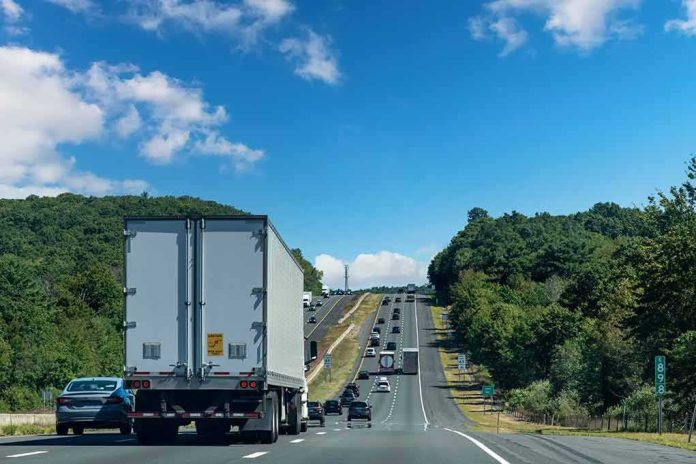
A 28-year-old Mexican migrant died under a semi-truck’s wheels after sprinting from immigration agents on a Florida highway.
Story Snapshot
- Police say the man ran into traffic while trying to evade immigration agents.
- An agent performed CPR, but the man died at the scene.
- Recent years show more deaths tied to enforcement encounters, raising scrutiny.
- Names, precise location, and primary reports for this Florida case remain limited.
A chase, a highway, and a split-second fatal choice
Local reporting says agents tried to detain a Mexican national in St. Augustine, Florida. The man ran onto a busy roadway and into the path of a tractor-trailer. A collision followed. An agent tried CPR but could not save him. This account mirrors a known pattern. In Virginia, a Honduran man, Josué Castro Rivera, died in 2025 after running into traffic during an encounter with immigration agents, a case widely cited as part of a string of flight-related deaths.
Evidence gaps still surround the Florida case. The public record lacks a released police report with a full timeline. Authorities have not posted body camera or dash camera video. No named eyewitness accounts have been placed on the record. These gaps matter for trust, but they do not erase the core claim: police say the man fled into traffic and was struck. Until primary documents surface, the confirmed details remain narrow.
How this death fits a broader and deadlier period
Deaths linked to immigration enforcement encounters surged in 2025 and 2026. A United States congressional briefing counted at least eight people who died in dealings with Immigration and Customs Enforcement (ICE) early in 2026 alone, beyond the many who died in custody in 2025. The nationwide picture includes shootings, medical failures in detention, and traffic deaths during flight from agents. Each category raises distinct policy and training questions for federal and local authorities.
Government and independent reviews show a second theme: transparency fights follow tragedy. In Houston, advocates challenged an ICE account of a fatal shooting and called for video evidence. The Department of Justice has also cataloged incident trends with migrants, showing how rapidly routine stops can turn lethal when confusion spikes and bystander risk rises. These documented clashes over evidence shape how communities view every new case that lacks clear video or thorough public reports.
Accountability without theatrics: what facts demand next
Common sense and American conservative values point to a simple path. First, publish the incident report from the local sheriff’s office, with times, locations, and vehicle data. Second, release any body camera footage and nearby traffic camera video, with redactions for privacy where required by law. Third, disclose the medical examiner’s findings on the exact cause and time of death. These are standard steps that do not vilify agents or sanctify suspects. They just tell the truth.
A 28-year-old Mexican migrant was struck and killed by a semi-truck in St. Augustine, Florida, while fleeing ICE and HSI agents.
He and three others bailed from a vehicle at a gas station, ran across State Road 16, and straight into traffic.
Instead of complying with federal… pic.twitter.com/GLjM2e6X6h
— Gina Beana Fofina (@Ginasassyass) July 15, 2026
Law enforcement claims should carry weight when backed by records. The Florida account is plausible and lines up with past flight-into-traffic deaths. But lasting trust comes from daylight. If the man ran into traffic, the logs and videos will show it. If the truck’s event data recorder captured speed and braking, release it. If the agent gave CPR, the report will confirm it. Clear files calm rumor mills. They also protect good officers who did their jobs by the book.
Sources:
foxnews.com, theguardian.com, congress.gov