

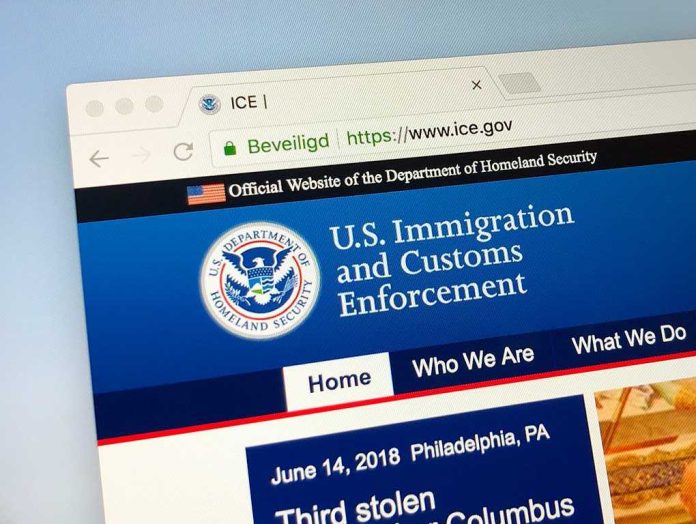
When a government memo quietly tells armed, masked agents they can walk into your home without a judge’s warrant, the real shock is not one mother’s lawsuit—it is how normal this has become.
Story Snapshot
- ICE now relies on an internal memo, not a judge, to justify going into American homes.
- Civil-rights groups say warrantless raids and “ruse” tactics are breaking the Fourth Amendment.
- Victims are filing billion‑dollar claims, but the government has paid out almost nothing.
- The fight is really about whether the rule of law still protects the people government dislikes most.
How We Got From Routine Immigration Enforcement To Masked Raids
Federal immigration enforcement once lived in a tight legal box: knock on the door, show a judge-signed warrant, follow the Constitution like everyone else. That box has been pried open. An internal Department of Homeland Security memo, reported by the Associated Press, tells Immigration and Customs Enforcement officers they may use administrative deportation forms to enter homes without a judge’s warrant, reversing years of agency policy that treated the home as off-limits without judicial approval.[10][15] That change did not pass Congress. It arrived as a quiet interpretation, and it gave field agents far more power than most Americans realize.
On the ground, those new powers combine with old habits. For years, immigration agents have used “ruses” to get inside homes: posing as local police, probation officers, or even regular neighbors looking for a contractor, all to coax someone to open the door.[19][21] Advocacy groups argue these tactics dodge the simple constitutional rule that officers need either a judge’s warrant or true consent to enter a home.[21] When you answer the door believing you are talking to local police about a fake case, that “consent” looks far less like a free choice and more like a trick played on people with limited power to push back.
Why Lawsuits Are Exploding Against ICE’s Warrantless Arrest Policy
Civil-rights lawyers are not guessing about patterns; they are suing over them. The American Civil Liberties Union filed class actions in Minnesota and Colorado alleging Immigration and Customs Enforcement and Customs and Border Protection engaged in suspicionless stops, warrantless arrests, and racial profiling of Somali and Latino residents.[1][2] Another major suit in Washington, D.C. challenges the so-called “home entry” policy itself, arguing that executive-branch forms signed by agency officials cannot replace a judge’s warrant under the Fourth Amendment.[17] A federal consent decree in the Midwest already found immigration officers violated limits on warrantless arrests and ordered nationwide retraining after at least twenty-two people were detained without proper legal grounds.[23]
Money claims are rising too. Immigration and Customs Enforcement’s own reports show more than three hundred fifty tort claims seeking about fifty-five and a half billion dollars in damages over alleged violent arrests, wrongful detention, and related harms, with less than one million dollars paid out so far.[6] For conservatives who care about limited government and property rights, that ratio should raise eyebrows. When an agency faces tens of billions in alleged harm and pays pennies, the signal is not “nothing to see here”; it is that the government writes the rules, controls the process, and almost never admits fault, even when courts say its officers broke the law.
What The Government Says To Defend Its Power
Inside the system, lawyers for the Department of Homeland Security and Immigration and Customs Enforcement claim they are not breaking the Constitution at all. The home-entry memo leans on a form called the I-205 Warrant of Removal, signed by an agency official, not a judge.[10][15] Their position is simple: if a person has a final order of removal, the combination of that order and the administrative warrant gives officers enough legal cover to enter the home, as long as they follow “knock and announce” and time-of-day rules.[10] Former leaders tout operations like “Metro Surge” in Minnesota as proof the system targets criminals, not families, pointing to thousands of arrests of people with serious records.[3]
Legal scholars and many judges are not convinced. The Brennan Center for Justice notes the memo flips long-standing Department of Homeland Security training and clashes with core Fourth Amendment doctrine that the home sits at the top of constitutional protection and that only a neutral judge can authorize entry.[15] A federal judge has already ruled that Immigration and Customs Enforcement administrative warrants do not authorize home entry in at least one California case, directly rejecting the agency’s theory.[15] Courts in Illinois have extended a consent decree limiting warrantless arrests after finding the government violated it within months, which undercuts claims that internal “safeguards” are enough to keep power in check.[20][23]
The Human Stakes Behind A Mother’s Anxiety And Hair Loss Claim
The specific lawsuit by an unnamed immigrant mother, framed online as an “illegal alien” suing over anxiety and hair loss, does not yet appear in official court databases or major press archives, so the factual details of her case remain unconfirmed.[7] That gap matters. Conservative respect for due process cuts both ways: the government deserves a fair hearing, and so do people bringing claims, even when the media dislikes them. What we can say is that her story sits squarely inside a documented pattern of immigration raids gone wrong, including U.S. citizens allegedly slammed to the ground or chased by masked agents who targeted the wrong person.
From a common-sense conservative lens, two truths can coexist. The United States needs strong, serious border enforcement. A nation that cannot decide who enters and stays slowly ceases to be a nation. But that same nation rests on the idea that government power has limits, especially at your front door. If an agency can swap a judge’s warrant for its own paperwork, hide its officers’ faces behind masks, and then face almost no real financial or legal consequence when it oversteps, the people who pay the price are not government lawyers; they are families left with trauma, medical bills, and yes, sometimes hair falling out from stress.
Sources:
[1] Web – Illegal Alien Mother Sues Government Over Anxiety, Hair Loss After …
[2] Web – ACLU Sues Federal Government to End ICE, CBP’s Practice of …
[3] Web – Immigrant Rights Advocates Sue Trump Administration over ICE’s …
[6] Web – When ICE Agents Break the Law, Can Victims Sue? The Supreme …
[7] Web – ICE Facing Billions in Claims After Violent Arrests – Jeelani Law Firm
[10] YouTube – The legal battle over ICE agents wearing masks
[15] YouTube – Internal memo says ICE agents can enter homes without a warrant
[17] Web – ICE’s Secret Policy to Forcibly Enter Homes Without a Judicial …
[19] YouTube – Internal government memo says ICE officers don’t need a warrant to …
[20] Web – This Deceptive ICE Tactic Violates the Fourth Amendment – ACLU
[21] Web – Court scrutiny of ICE mounts as judge rules warrantless arrests …
[23] YouTube – ICE memo gives agents broad authority to arrest those they believe …